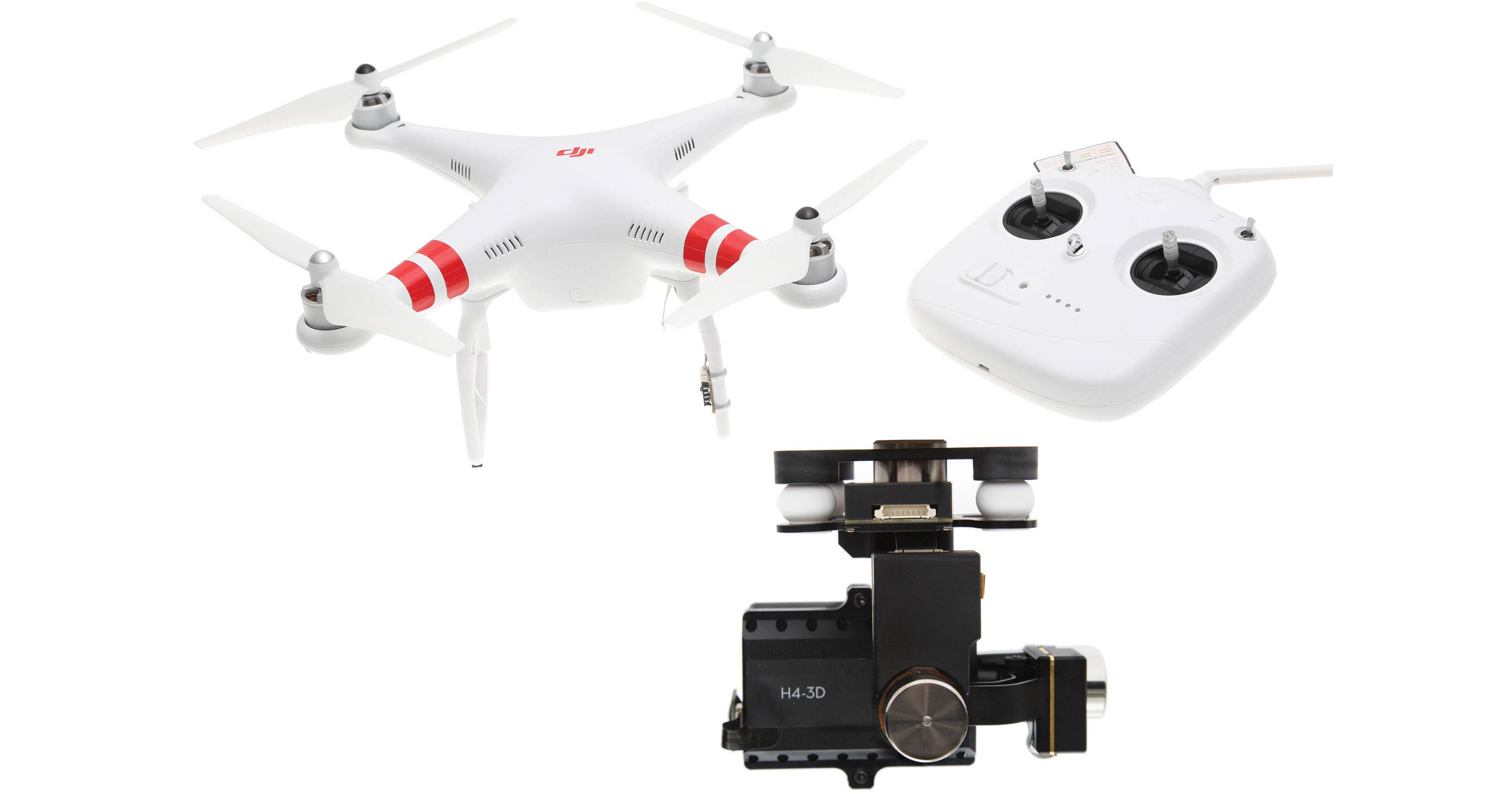


The Phantom 2 Quadcopter v2.0 with Zenmuse H4-3D Gimbal Kit is a bundle from DJI allowing you to capture stabilized aerial video and photos with a GoPro HERO4 action camera (GoPro available separately). This version of the Phantom 2 - v2.0 - features more efficient motors, ESCs, and props than the predecessor for extended flying time. Additionally, a redesigned transmitter (handheld radio controller) now features an integrated gimbal control dial and a rechargeable battery.
This bundle is considered ready-to-fly, which means the transmitter, flight battery, charger, and other basics are included and that the aircraft is mostly assembled. It will still require proper pre-flight calibration to setup the navigation system before each flight.
For more information on the items in this bundle, please follow the links below.
The Phantom 2 Quadcopter v2.0 features a number of notable hardware updates over the previous Phantom 2 model from DJI, including more efficient motors, redesigned self-tightening props, a new transmitter (radio controller) with built-in battery and gimbal control dial, and other improvements. The Phantom 2 - for those who aren't familiar - is a quad-rotor UAV aircraft that can be great fun to fly standalone, but more than anything serves as a platform for capturing aerial shots using a GoPro HERO action camera (gimbal and camera available separately). It features a "Smart Battery" with integrated regulation circuitry that provides up to 25 minutes flying time; which is a substantive improvement over the original Phantom's still respectable 14 minutes.
This version of the Phantom 2 is classified - in RC jargon - as "ready-to-fly" (RTF). This means that a pre-bound transmitter (radio controller) is included, and the most of the major assembly - anything involving soldering and special tools - was done at the factory. However, autonomous - that is, computer-assisted - flying still requires a number of pre-flight calibration steps before the aircraft can safely take to the skies. The most important being GPS calibration. GPS provides the most important data the navigation system uses to determine where the quadcopter is in relation to the pilot. Without GPS the aircraft can still provide some correction to maintain stability; but all other assisted flying features - especially those required by beginners - will be unavailable.
Because of the complexity associated with multi-rotor aircraft, the flight control system in the Phantom 2 relies on a GPS-based navigation as well as a sensor gimbal, compass, and other data to maintain flight stability and provide assisted-flying features. While fully manual operation is possible, and can be unlocked using the Assistant Software, most users, especially videographers hoping to get the smoothest possible shoots, will opt for GPS or GPS Attitude flight mode. In GPS Mode the flight control system keeps the quadcopter stable and right-side-up when moving, and holds it in a fixed horizontal and vertical position whenever you release the sticks.
The Phantom 2 features a 5200 mAh "smart" battery system that has been simplified compared to most RC LiPo batteries. The battery slots in without having to connect any DC leads, and features four LED indicators visible on the outside, tail-end of the aircraft helping you keep track of battery levels in flight. Charging is also simplified, with all of the charging circuitry built into the battery itself; there is no more separate balance lead to worry about plugging in. Because of this design, the Phantom 2 battery cannot be charged with all-purpose balance chargers, only chargers made specifically for it.
Note: An optional camera mount or Zenmuse gimbal is required to use a GoPro camera with the Phantom 2 Quadcopter.
Warning: When using an Wi-Fi enabled GoPro, ensure the GoPro's Wi-Fi is turned off as it operates on the same 2.4 GHz frequency as the Phantom 2's transmitter and receiver. If the GoPro's Wi-Fi is left on the transmitter's (radio controller) connection may be broken causing the aircraft to become inoperable. This may result in loss of property or damage to your equipment.
- Left Dial: Use this to operate the tilt function of a Zenmuse gimbal
- Trainer Port: Connect the remote control to the computer to run a simulation application
- Throttle Lock: Pull down the throttle stick to descend; the stick will lock into place and the aircraft will descend steadily. Push the throttle stick upward to release throttle lock
- LED Battery Indicator: Foregoing AAs, the transmitter now runs on a built-in LiPo battery. Four LEDs on the front tell you how much charge is left
- Micro-USB Port: Use the micro-USB port to recharge the built-in battery. The LED indicators will display charging status as the battery tops up
- Up to 200g per axis more thrust than the previous design
- The single wire stator design improves motor efficiency and its ability to withstand a larger current
- New bearings, with a higher durability and ability to withstand greater impacts, are used to avoid damage in the event of an accident
- New insulation coating powder is used to improve the stator voltage capacity, helping extend the working life and stability of the motor
- A new ESC (electronic speed controller) - ESC v2.0 - is used to ensure the efficiency improvements of the motors are maximized
The more transmitter also adds a Left Dial for operating the tilt function of a Zenmuse gimbal, a trainer port for flight simulations, and an LED display indicating the charge status of the internal LiPo battery
GPS Attitude Mode, or Attitude Mode, is a more manual flying mode in which the Phantom 2 does not try and maintain a fixed spatial position. When you release the controls it will continue to drift unless friction slows it down or you stop it. And in this mode it will be more likely to be blown around if there is any wind. This not a true manual mode, however, in that the GPS navigation system is still used to maintain flight stability and by the "return to home" feature in the event of signal loss
One of the biggest obstacles to capturing polished video from a multi-rotor RC aircraft is camera shake. Wind turbulence buffets the aircraft, and even on a still day there is always rotor-incurred vibration to contend with. If you are recording with the GoPro HERO4 Black and using a multi-rotor with a DJI flight controller installed, the Zenmuse H4-3D Gimbal is the solution. This 3-axis, brushless motor gimbal corrects for pitch and roll, and allows for tilting of -130° to +45°. It can power from the flight battery, and for Phantom 2 installations uses the aircraft's integrated GCU. An optional GCU is available separately for other models. The H4-3D is compatible with the A2, WooKong-M, Naza‐M, Naza‐M V2, and Phantom 2 flight control systems.
Note: The H4-3D is specifically balanced for the GoPro HERO4 Black -- it will not work with the HERO3, HERO3+, or HERO4 Silver
- A2
- WooKong-M
- NAZA-M
- NAZA-M V2
Note: The NAZA‐M LITE is not supported. Additionally, the NAZA‐M V2 PMU must be used if using a NAZA‐M V1 flight controller