Video Chat with a Pro Video Expert - Live

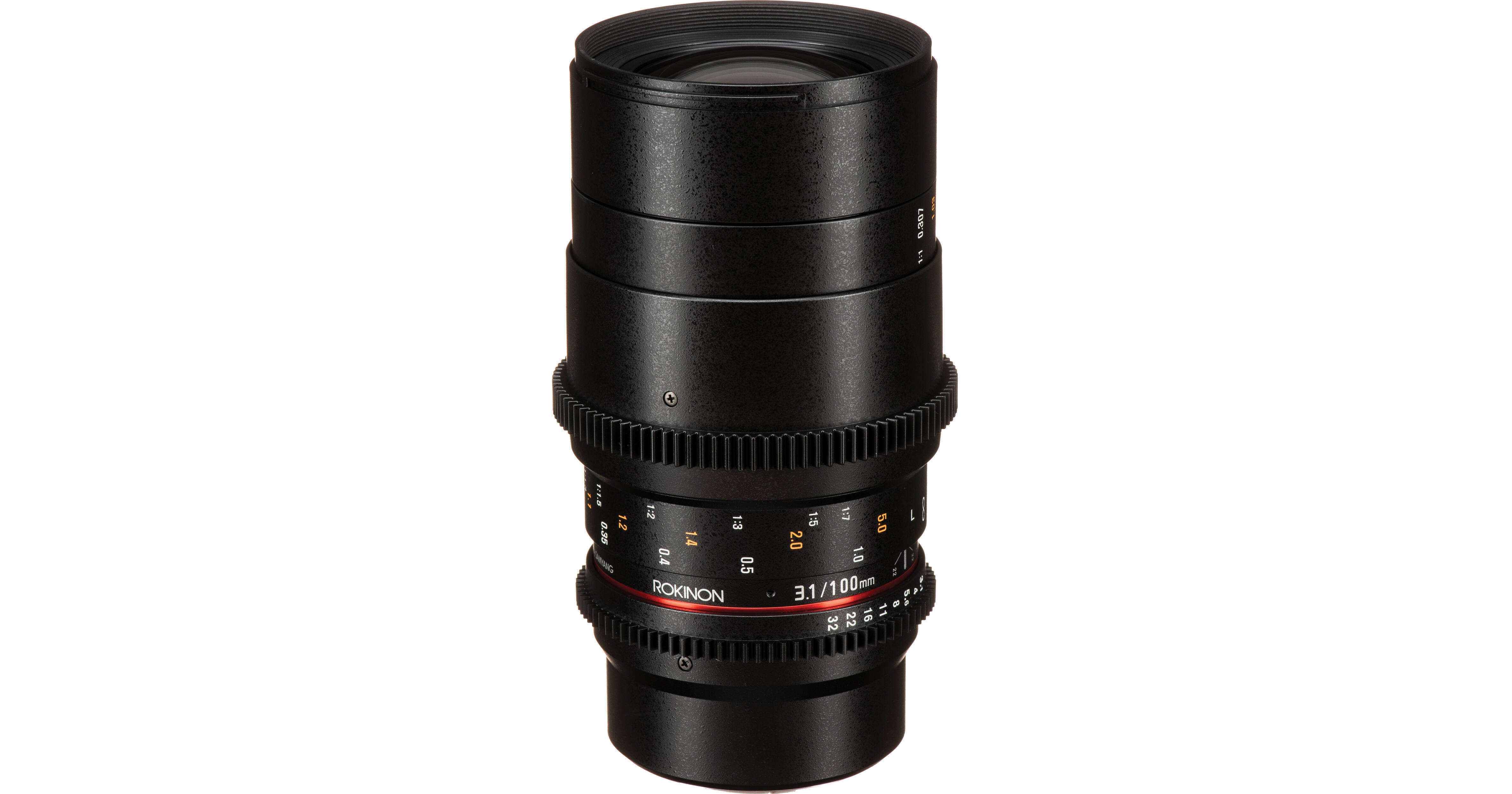
Rokinon 100mm T3.1 Macro Cine DS Lens for Micro Four Thirds Mount

BH #RO10031MFT • MFR #DS100M-MFT
Print
Rokinon 100mm T3.1 Macro Cine DS Lens for Micro Four Thirds Mount
Key Features
  • 100mm Lens
  • Covers Four-Thirds Format
  • Multi-Layer Coating to Reduce Flare
  • Standard Gearing for Focus and Iris
Utilizing a multi-layer coating process for consistent color rendition from lens to lens, the Rokinon 100mm T3.1 Macro Cine DS Lens answers the challenge of assembling a set of lenses over time. The lens comes in Micro Four Thirds Mount, and it features industry standard geared focus and iris rings that share common position with other Rokinon Cine DS lenses. To aid focus pullers who have to work both sides of the lens, the aperture and focus scales are marked on both sides of the lens.
More Details
In Stock
No Store Display
Free Expedited Shipping
Protect Your Gear
Add a protection plan from $58.99
Ask an Expert
800-606-6969

Rokinon 100mm T3.1 Macro Cine DS Overview

Learn from B&H Experts

From Manufacturer

Utilizing a multi-layer coating process for consistent color rendition from lens to lens, the Rokinon 100mm T3.1 Macro Cine DS Lens answers the challenge of assembling a set of lenses over time. The lens comes in Micro Four Thirds Mount, and it features industry standard geared focus and iris rings that share common position with other Rokinon Cine DS lenses. To aid focus pullers who have to work both sides of the lens, the aperture and focus scales are marked on both sides of the lens.

This 100mm lens produces a 12.6° angle-of-view when used with Micro Four Thirds sensor cameras. It can be used for macro videography, which means you can record an image that is the same size or bigger on the sensor as it is in real life. The 15 glass elements in 12 groups render sharply defined images with a minimum of distortion and chromatic aberrations, with a minimum focus distance of 1' from the lens. A removable lens hood provides flare protection when shooting without a matte box, and the lens's threaded front accepts 67mm filter rings.

Ultra Multi Coated lenses minimize flare and ghosting, and the lenses are color matched to a standard eliminating the need to acquire an entire set of lenses at the same time.
Industry-standard gearing for focus and aperture rings. Each lens in the Rokinon DS series shares common focus and iris gear ring positions, which speeds up lens changes as accessories such as follow focus units or iris motors don't have to be re-positioned.
Declicked aperture ring for smooth iris pulls.
A removable lens hood provides flare protection without a matte box.
The lens opens up to T3.1, creating extremely shallow depth of field.
UPC: 084438764451

Rokinon 100mm T3.1 Macro Cine DS Specs

Key Specs
Focal Length
100mm
Maximum Aperture
T3.1
Lens Mount
Micro Four Thirds
Lens Format Coverage
Full-Frame
Filter Thread
67 mm
Image Stabilization
No
Electronic Communication
No
Focal Length
100mm
Maximum Aperture
T3.1
Minimum Aperture
T32
Lens Mount
Micro Four Thirds
Lens Format Coverage
Full-Frame
Angle of View
MFT
Diagonal: 12.6°
Optical Design
15 Elements in 12 Groups
Filter Thread
67 mm
Minimum Focus Distance
12" / 31 cm
Aperture/Iris Blades
9
Image Stabilization
No
Lens Mounting
No
Gear Standard
0.8 MOD
Electronic Communication
No
Diameter
Maximum: 3.2" / 81.3 mm
Length
5.82" / 147.9 mm
Weight
25.8 oz / 730 g
Packaging Info
Package Weight
2.14 lb
Box Dimensions (LxWxH)
7.7 x 5.2 x 5.15"

Rokinon 100mm T3.1 Macro Cine DS Reviews

Fantastic quality

By Tony
Rated 5 out of 5
Date: 2022-05-31

I had one and sent it back due to something rattling inside, but this one is fine, and the quality of glass and overall construction is excellent.

Nice

By James
Rated 5 out of 5
Date: 2021-10-28

Sharp video

See any errors on this page?

can this shoot a 1:1 ratio?

can this shoot a 1:1 ratio?
Asked by: Abigail
No, when using the Rokinon 100mm T3.1 Macro Cine DS Lens for Sony E-Mount, it is not a 1:1 macro. It is a close-up lens that achieves 1:5. You will need extension tubes, a bellows, or a true macro lens to achieve 1:1 with this lens.
Answered by: Elliot
Date published: 2025-06-23

question

Internal focusing for this cine version as well?
Asked by: Anonymous
The lens has an internal focusing design, which means that the length of the barrel wont change as you focus, which is particularly important when shooting with a matte box.
Answered by: Muriel A.
Date published: 2019-09-27

question

Is this lense going to get cheaper in blackfriday?
Asked by: Pedro
We in sales do not know what sales are coming. We can suggest being ready on Black Friday for bargains.
Answered by: Dennis A L.
Date published: 2018-08-26

question

That lens shouldnt be a MACRO lens?
Asked by: Michael M.
To be called a macro lens, the image has to be recreated in a 1:1 ratio life size on the sensor. With this 100mm lens, focused at it's minimum distance of 12 does come close but not 1:1. I would say it is about 1:2 which may be close enough for you. If needed to get closer, I would use close-up lenses like these.
Answered by: Dennis A L.
Date published: 2024-09-10

Does this lens work with Sony A7iii without any ...

Does this lens work with Sony A7iii without any other adapter?
Asked by: Content
Yes it does. This is a Sony E-Mount Lens which covers a full frame sensor. It will work with the A7III without the need for adapters.
Answered by: Joe P
Date published: 2019-10-02

question

Can it be used for macro photography with Sony 6000 ?
Asked by: Jimmy L.
would a cine macro b better than the normal macro lens?
Answered by: Douglas S.
Date published: 2019-05-01

Does this lens work with Cannon D3200?

Does this lens work with Cannon D3200?
Asked by: Rodrigo
Do you mean the Nikon D3200? If you have the Nikon D3200 then yes, the Rokinon 100mm T3.1 Macro Cine DS Lens for Nikon F Mount can be natively mounted on your camera.
Answered by: Paige K
Date published: 2022-10-19

question

How does this lens work on lowlight?
Asked by: Pedro
@B&H Staff: Could you please provide a bit more clarity? Doesn't F-stop measure the amount of light that enters the front of the lens (based on the width of the opening of the diaphragm), while T-stop measures the amount of light making it to the back of the lens? Thus, T3.1 is faster than F3.1.
Answered by: Ivan
Date published: 2021-05-04
  • y_2026, m_7, d_12, h_12CST
  • bvseo_bulk, prod_bvqa, vn_bulk_3.0.47
  • cp_1, bvpage1
  • co_hasquestionsanswers, tq_11
  • loc_en_US, sid_1132694, prod, sort_[SortEntry(order=HAS_STAFF_ANSWERS, direction=DESCENDING)]
  • clientName_bhphotovideo
Whatever You Need, We've Got It