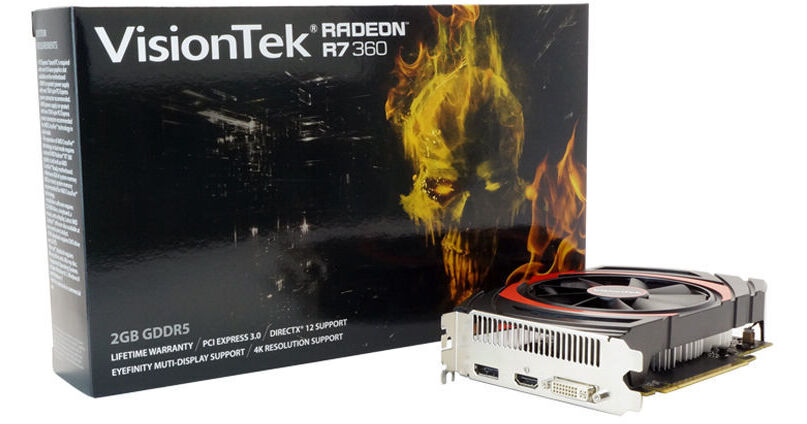
VisionTek Radeon R7 360 Graphics Card

BH #VIR73602GDR5 • MFR #900806
Print
VisionTek Radeon R7 360 Graphics Card
Key Features
  • 1050 MHz Core
  • 768 Stream Processors
  • GCN Architecture
  • 2GB GDDR5 vRAM
Upgrade your PC with the ASUS Radeon R7 360 Graphics Card for a discrete graphics boost. With a discrete graphics card your computer will be able to drive higher resolution monitors at their native resolution and drive multiple displays for increased desktop space over single-output integrated graphics. Having a discrete graphics card not only improves graphics performance over integrated chips, but also increases CPU performance by assisting the processor with parallel computing tasks. With a GPU core clocked at 1050 MHz and 2GB of GDDR5 vRAM, the R7 360 can also play games at resolutions greater than HD.
More Details
No Longer Available
No Store Display
Ask an Expert
800-606-6969

Vi ionTek R7 360 Overview

Upgrade your PC with the ASUS Radeon R7 360 Graphics Card for a discrete graphics boost. With a discrete graphics card your computer will be able to drive higher resolution monitors at their native resolution and drive multiple displays for increased desktop space over single-output integrated graphics. Having a discrete graphics card not only improves graphics performance over integrated chips, but also increases CPU performance by assisting the processor with parallel computing tasks. With a GPU core clocked at 1050 MHz and 2GB of GDDR5 vRAM, the R7 360 can also play games at resolutions greater than HD.

The output panel on the R7 370 features dual-link DVI-D and DVI-I outputs, as well as HDMI and DisplayPort outputs. All four outputs can support up to 2560 x 1600 resolution and up to three outputs can be used simultaneously. The DVI-I output supports legacy analog VGA displays and projectors with an optional DVI to VGA adapter.

To keep this card cool, VisionTek implemented an active fansink cooler with two large axial fans. The fans force air through the heatsink, dissipating heat created by the graphics card, lowering the card's internal temperature. Because this kind of cooler recirculates air back into the case, this card works best in cases that have unrestricted airflow.

VSR
AMD's Virtual Super Resolution is a scaling utility. It uses the GPU architecture to take advantage of beyond-HD resolution capabilities with lower screen resolutions by having the graphics card render at higher resolutions and then intelligently down-sample the output to fit the smaller screen. Aliasing and jagged artifacts are reduced on down-scaled rendering compared to a native resolution rendering.
FreeSync Technology
AMD's FreeSync Technology allows for communication between the graphics card and a monitor with FreeSync support. Having this communication enables the monitor to dynamically adjust its refresh rate to the frame rate being output by the graphics card, thereby greatly reducing tearing, stuttering, and other artifacts.
Eyefinity
AMD Eyefinity is a multi-display utility which allows you to arrange multiple displays on your desktop. Having multiple displays can increase productivity and also provide a more immersive gaming experience.
FRTC
AMD's Frame Rate Target Control lets you select a target frame rate for the graphics card to maintain. Since the graphics card only has to work as hard as necessary to generate a set frame rate, rather than try to attain unnecessarily high frame rates, game-play will be smoother.
CrossFire
AMD's CrossFire works with compatible motherboards and allows you to install and combine two of the same GPUs to split the processing load and render graphics with improved frame rates and image quality in supported applications. The R7 360 cards do not require a Crossfire bridge in order to enable this capability.
PowerTune Technology
AMD's PowerTune Technology allows the GPU to run at higher clock speeds with sufficient thermal headroom. PowerTune will intelligently adjust the clock speed when the GPU's temperature and power consumption to give the best performance possible at a given temperature.
ZeroCore Power Technology
Shuts down the GPU when not in use to greatly reduce power usage while the card is idle.
TrueAudio Technology
AMD TrueAudio Technology allocates GPU processing to audio, allowing for greater overall audio processing for advanced audio sequences, especially in games.

Vi ionTek R7 360 Specs

GPU
GPU Model
AMD Radeon R7 360
Stream Processors
768 
Base Clock Speed
1050 MHz
Interface
PCI Express 3.0 x16
Supported APIs
DirectX: 12
OpenGL: 4.5
OpenCL: 2
Vulkan
Memory
Memory Speed
6500 MHz (Effective)
Memory Configuration
2 GB
Memory Interface
GDDR5
Memory Interface Width
128-Bit
Memory Bandwidth
112 GB/s
Display Support
Video Output
1x DVI-D DL
1x DVI-I DL
1x DisplayPort
1x HDMI
Maximum Digital Resolution
2560 x 1600
Power Requirements
Max Power Consumption
100 W
Power Connection
1x 6-Pin PCI Connector
Recommended System Power Requirement
500 W
Dimensions
Length
6.5" / 16.5 cm
Width
Dual-Slot

Vi ionTek R7 360 Reviews

See any errors on this page?
Whatever You Need, We've Got It