Video Chat with a Pro Audio Expert - Live

Fredenstein HD Reference 2-Channel Microphone Preamplifier

BH #FRHDREFERENC • MFR #HD REFERENCE
Print
Fredenstein HD Reference 2-Channel Microphone Preamplifier
Key Features
  • Great for Acoustic Instruments
  • Great for Drums and Vocals
  • ±24V Power Rails
  • 0 to 64 dB Gain in 1 dB Steps
Audio engineers and producers searching for a reference-quality microphone preamp with an ultrawide bandwidth, extremely low noise floor, impressive distortion specs, and a remarkable impulse response will be impressed with the Fredenstein HD Reference, a fantastic two-channel microphone preamplifer. Its unique topology features a true Class-A design, zero negative feedback, and a 100% balanced circuit with 72 premium transistors for gain, as well as a ±24V power supply.
More Details
No Longer Available
No Store Display
Ask an Expert
800-606-6969

Fredenstein HD Reference Overview

Audio engineers and producers searching for a reference-quality microphone preamp with an ultrawide bandwidth, extremely low noise floor, impressive distortion specs, and a remarkable impulse response will be impressed with the Fredenstein HD Reference, a fantastic two-channel microphone preamplifer. Its unique topology features a true Class-A design, zero negative feedback, and a 100% balanced circuit with 72 premium transistors for gain, as well as a ±24V power supply.

The preamplifier provides extremely low noise and low distortion with an ultrawide frequency response (1 Hz to 920 kHz, -3 dB) at all gain settings. The preamp sports a combination of high-end specifications to provide a smooth transition into saturation. This is due to the absence of negative feedback and the fast recovery inherent in the topology, which allows the sound to go from pristine and three-dimensional through rich and powerful depending on how hard one drives it.

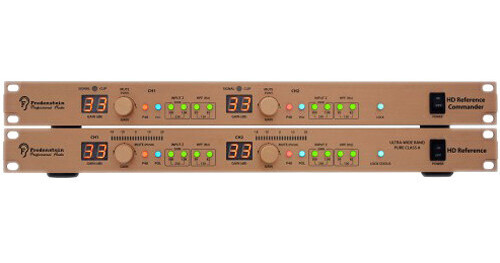
Each channel features a combination rotary encoder that doubles as a push-button mute and gain control with 1 dB stepped operation from 0 to +64 dB (using highly reliable relays). A large 7-segment LED display indicates signal levels and clipping. There are three impedance settings, three high-pass filter frequencies, 48V phantom power, and a polarity switch.

Other notable features include automatic muting when changing phantom power settings to prevent damage to your monitors, and a pair of high-quality Direct Inputs (DI) for use with instruments.

The HD Reference is compatible with the separately sold Commander remote, which allows you to keep the preamp close to the microphone, while being able to make adjustments in the control room. By keeping the mic cables short, the preamp is able to preserve the fragile mic-level signals without degradation or noise and send a robust line-level signal to any reasonably distanced converter, console, or compressor. There is a Lock button, which prevents the HD Reference settings from changing when using the Commander remote.

Controls
Gain Control
Rotary Encoder sets the Gain in 1 dB steps which are displayed next to the knob. Pushing the Knob activates an immediate MUTE. This control as with all others can be remote controlled.
POL Polarity Control
Pushing the POL switch selects the polarity. When lit (blue), the output polarity is reversed. Otherwise the true nonreversed, polarity is selected (normal operation).
Low-Z: 1-Kilohm Low-Impedance Input
When lit (green), the input impedance changes from 200 kilohms to 1000 ohms. Some dynamic and ribbon microphones are most linear when driving a low-input impedance.
Low-Z: 300-Ohm Low-Impedance Input
When lit (green), the input impedance changes from 200 kilohms to 300 ohms.
P48 Phantom Power
Most FET condenser microphones as well as some other microphones with built-in amplifiers require +48V Phantom Power. Setting the P48 switch (red light) enables +48V through the balanced microphone line. Please check your microphone documentation if you are not 100% sure. Enabling P48 on microphones not designed for P48 might cause severe damage to the microphone. The DI input is not supplied with Phantom Power.
Low Cut Filters
Low-Cut 39 Hz: A 39 Hz low-cut filter is activated when lit, avoiding unwanted low frequencies while tracking.

Low-Cut 82 Hz: A 82 Hz low-cut filter is activated when lit, avoiding unwanted low frequencies while tracking.

DI, Direct Input
The most common use for the DI input is to connect instruments like guitars directly to the HD Reference. The input impedance is greater than 2 megohms to insure compatibility with most instrument pickups. After inserting a balanced (TRS, tip-ring-sleeve) or an unbalanced (TS, tip-sleeve) plug, the balanced microphone input through the box or rack is automatically disabled.

The gain range for the DI is from 0 to +40. Turning the Gain knob past +40 will have no effect. When a 1/4" plug is inserted into the DI jack, the HD Reference automatically switches on the DI preamplifier and lights up a LED at the bottom right of the Gain display. If a separately available Commander is used, it will also use that LED to display that the DI is plugged in.

Lock Status
There is also an indicator called Lock Status, which lights up if the Lock button is pushed on the separately available Commander. If this is lit, all controls on the HD Reference are frozen and can only be controlled from the Commander. This is to prevent tampering.

Fredenstein HD Reference Specs

Frequency Response
2 Hz to 700 kHz, (-1 dB)
1 Hz to 920 kHz, (-3 dB)
Distortion
<0.0082 at +4 dBu Output Level (31 dB Gain)
Noise (EIN)
< -128.5 dB (150-Ohm Source Impedance 64 dB Gain)
< -130 dB A-Weighted
Input Impedance
>200 Kilohms or 1000 or 300 Ohms Selectable
CMRR
>60 dB at 54 dB Gain
DI Input
DI Impedance: >2 Megohms
Maximum Input Level
+20 dBu
Output Impedance
600 Ohms
Maximum Output Level
+30 dBu
Maximum Input Level
+20 dBu (DI or Microphone Input) +0 dBu
Rack Units
1 RU
Dimensions
19 x 1.8" / 48.2 x 4.4 cm
Weight
Not Specified by Manufacturer

Fredenstein HD Reference Reviews

See any errors on this page?
Whatever You Need, We've Got It