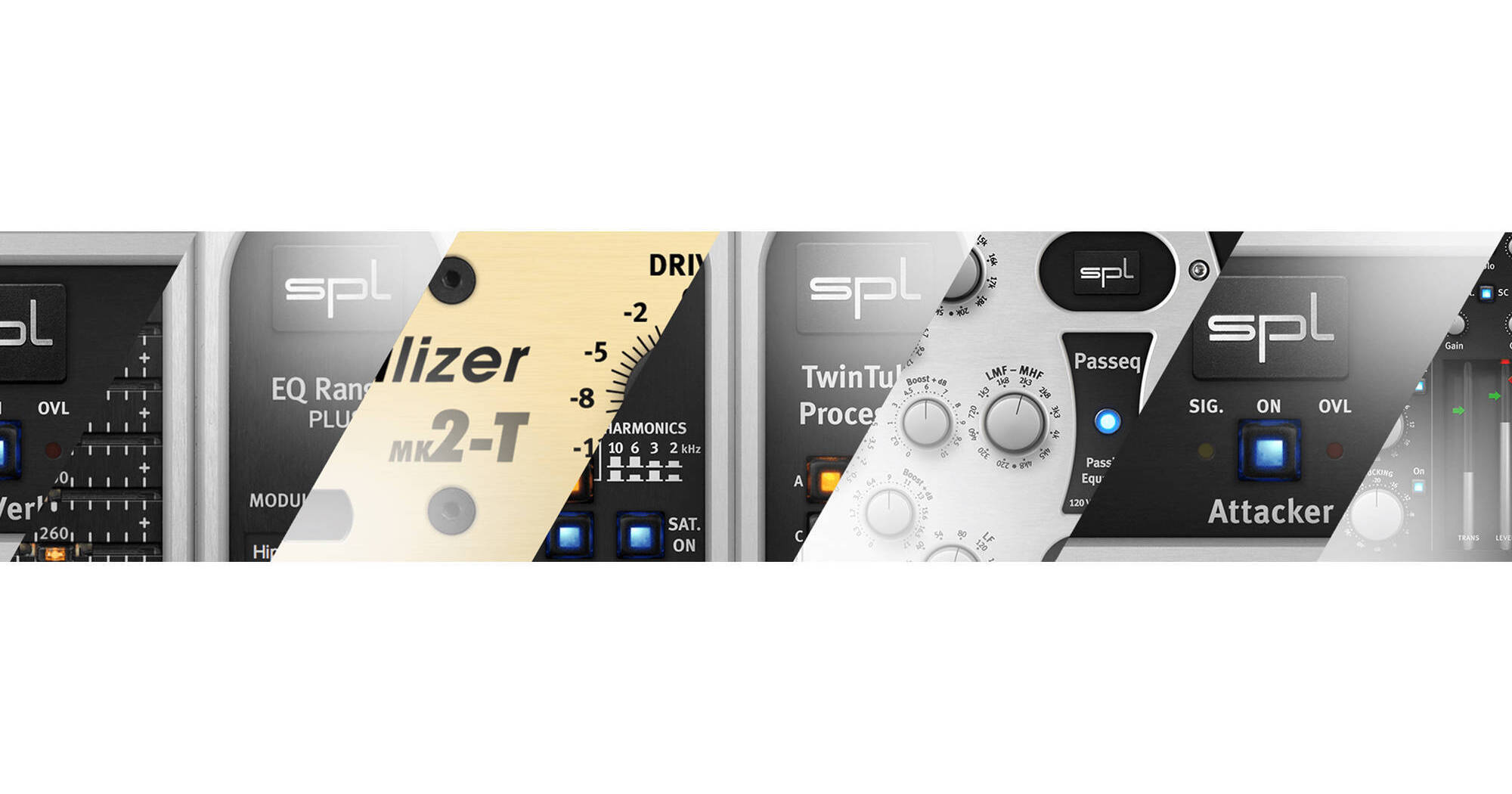


The 100% SPL Bundle - V2.1 from SPL rounds up the company's entire line of plug-ins for the ultimate collection of audio mixing tools. Transient Designer Plus, Vitalizer, De-Essers, EQs and Saturation are just a few of the plug-ins included. The recently released EQ Ranger Plus utilizes 181 custom EQ modules, designed by Grammy-winner Craig Bauer and Brainworx founder Dirk Ulrich, to instantly provide the perfect center frequencies and bandwidths for the genre of music and source you're working with. Also included in the bundle is the Transient Designer Plus plug-in, which builds upon the original with the same ease of use, but with powerful additions including output gain control, a soft-clip limiter, parallel processing, and powerful side-chain facilities.
The Attacker from SPL is a plug-in featuring part of the company's Transient Designer processor and basically amplifies the attack portion of an audio event. When using EQs to manipulate sound, the entire tonal aspect of the signal is affected without consideration for its temporal aspect. By amplifying the attack curves of a sound event, the mix can be made to sound more transparent.
The processing of drum and percussion sounds is the most typical application, but it is in no way limited to that category. Instruments can be mixed at lower levels while still maintaining their positions in the mix and occupying less space. An output gain control compensates for level changes after processing the signal, providing a simple and safe adjustment of levels while helping avoid any clipping.
De-Essers from SPL includes two slightly different de-essers, a classic and a dual band version. There are some small but audible sonic differences between the two. What is not different is the processing, which does differ from other de-esser processors. The latter compress the audio around a specified center frequency which is often set quite wide to clamp down on the sibilance. While this simple to implement, it does cause nasty artifacts to creep in quite early with increased processing.
The SPL De-Esser works on the principle of phase cancellation with automatic sibilance detection, which allows processing to be limited only to the range where sibilant sounds are present. The bandwidth is set narrowly around the range of the sibilance so that neighboring frequencies remain unaffected. This frequency band is then mixed back into the main signal phase-inverted to cancel out the sibilance, leaving the original signal virtually untouched.
For mastering purposes an M/S mode has been added for processing a full mix, allowing for the high frequencies of cymbals, guitars or keyboards to remain nearly untouched. Additionally, internal code supports mouse wheel control for the rotary controls. Place the mouse cursor over a control and move the scroll wheel to adjust the setting.
The De-Verb from SPL is a plug-in based on the company's Transient Designer processor and basically allows for reducing any reverb events. The possibilities for studio and live applications are seemingly endless when reverb curves of any sound event can be very simply reduced to decrease ambience and reverb-tails.
This different approach allows for foregoing the setting of a threshold level, with other parameters set automatically and in a musical manner as they follow the characteristics of the input signal. An output gain control compensates for level changes after processing the signal, providing a simple and safe adjustment of levels while helping avoid any clipping.
DrumXchanger from SPL is a drum replacement plug-in that uses the company's Transient Designer technology for sound recognition, allowing the processor to faithfully recognize even the faintest ghost notes, regardless of their dynamic level. The plug-in actually includes two Transient Designer processors, one for the original and one for the sampled sound.
Two different thresholds can be set for a more accurate recognition of drum hits - a level threshold and a transient threshold. The sample plays back as soon as both of these values are reached, resulting in simple operation of the software.
Additionally, the software is a powerful tool for optimizing drums tracks in its own right. The processing possibilities without the need to replace any sounds are almost limitless, while sound replacement can be done gradually in order to mix both the original and the sampled sound to taste.
The EQ Ranger Plus Plug-In from SPL builds upon the original EQ Ranger by collaborating with Brainworx to create the next evolution of their go-to source of quick and intuitive frequency treatment for fast-moving studio professionals. With the help of Grammy Award-winning mixer/producer Craig Bauer and Brainworx founder Dirk Ulrich, the EQ Ranger Plus offers a vast array of new, optimized combinations of center frequencies and bandwidths. There are 181 modules that span across six genres that allow you to pick the source with precision results.
Also included in the EQ Ranger Plus is the original SPL EQ Ranger Volume 1, which consists of three graphic EQ plug-in emulations, based upon the company's respective SPL RackPack series analog hardware modules. The package includes Bass Ranger, Vox Ranger and Full Ranger. While Bass Ranger and Vox Ranger process specific frequency ranges, the Full Ranger module complements them with a set of filter bands that covers the whole frequency range.
- 181 EQ settings created by Grammy Award-winning mixer Craig Bauer and Brainworx Founder Dirk Ulrich
- 181 factory presets that include cut and boost settings optimized for each specific Genre/Source module, plus 23 presets for the original three EQ Rangers Vol. 1 modules
- Convenient +/- buttons allow stepping through of each module directly from the plug-in interface
- Reset function quickly zeros all frequency bands in the selected module
- Graphical EQ interface offers quick and easy access to relevant frequencies without getting bogged down with too many parameters
- Cut time in half by not having to hunt for frequencies commonly manipulated in a given source
- Efficient operation of passive filters, producing musical and transparent curves
- Very effective at subduing or emphasizing key frequencies while keeping the sound solid and focused
The Mo-Verb from SPL is a plug-in based on the company's Transient Designer processor and basically allows for amplifying any reverb events. The possibilities for studio and live applications are seemingly endless when reverb curves of any sound event can be very simply enhanced to emphasize a dry ambience or reverb.
This different approach allows for foregoing the setting of a threshold level, with other parameters set automatically and in a musical manner as they follow the characteristics of the input signal. An output control gain control compensates for level changes after processing the signal, providing a simple and safe adjustment of levels while helping avoid any clipping.
The Passeq from SPL is an emulation of the company's analog hardware unit, and unlike other passive EQs, delivers three-bands for both boost and cut stages. A similarity shared with these types of EQs is the use of fixed (switchable) frequency points within each band. The Passeq provides twelve switchable frequencies per band, and since boost and cut frequencies are not identical, the result is a total of seventy-two frequencies per channel, more than enough for the most elaborate EQ curves.
The software programming faithfully reproduces the unique sound of the original hardware, with the complex interactions between each single filter reproduced in detail. Intrinsic to passive filter designs is that the signal always runs through the whole network. Whenever the settings change, interactions take place between the filters which adds to the characteristic sound of these types of EQs.
Additionally, internal code supports mouse wheel control for the rotary controls. Place the mouse cursor over a control and move the scroll wheel to adjust the setting.
Transient Designer Plus from SPL is a level-independent, dynamic processing plug-in that can transparently shape the attack and sustain characteristics of sounds no matter their level, jet engine-loud or whisper-quiet, constant or fluctuating. Using only two primary controls, it's possible to increase or decrease in mere seconds the attack portion of a sound up to 15 dB, and simultaneously amplify or attenuate its sustain up to 24 dB.
The process can make trap drums slam harder, tame a ringing snare drum, or reduce excessive cymbal bleed into tom microphones. Increase sustain on soaring guitar solos, enhance crunchy pick strikes on electric guitar vamps. Make legato rhythm tracks pulse, or reshape reverb envelopes for a non-linear response. To automatically smooth-out operations, the output gain control is followed in the audio path by a soft-clip limiter, with the limiter preventing digital clipping with all but the most extreme settings.
Other features include a one-knob parallel mix control. Sidechain functions provide surgical, pinpoint processing, internal filtering, and a sidechain solo function allows for monitoring only the filtered sidechain signal, while sweeping the center frequency. And the external sidechain input can be used to create ultra-tight grooves. Undo and redo functions with up to 32-steps each make it easy to recover control setups accidentally altered.
The TwinTube from SPL is a tube effects plug-in modeled after the company's analog hardware, and combines two essential tube effects in a single processor, saturation along with harmonics processing. Both stages work independently and are based on individual processing stages, allowing the effects to be utilized separately or together.
Harmonics processing can be applied to four different fundamental frequency bands to improve presence and clarity without significantly raising signal levels. The saturation control can be compared to the effects of tape saturation, adding warmth and providing density to virtually any kind of sound source.
Additionally, internal code supports mouse wheel control for the rotary controls. Place the mouse cursor over a control and move the scroll wheel to adjust the setting.
The Vitalizer MK2-T from SPL is an audio enhancement processor suitable for all sound production stages, including recording, mixdown, mastering, or playback. The software applies psycho acoustic and audio metric principles to achieve a noticeable improvement while enhancing sounds, processing only the original signal without generating artifacts.
The plug-in can enhance individual signals, subgroups or sum signals, and provide clarity and presence to a mix. It can also separate several low signals effortlessly and improve spatial impression, bring static loops to life, and act as an excellent solution for restoring old recordings.
Additionally, internal code supports mouse wheel control for the rotary controls and faders. Place the mouse cursor over a control and move the scroll wheel to adjust the setting.