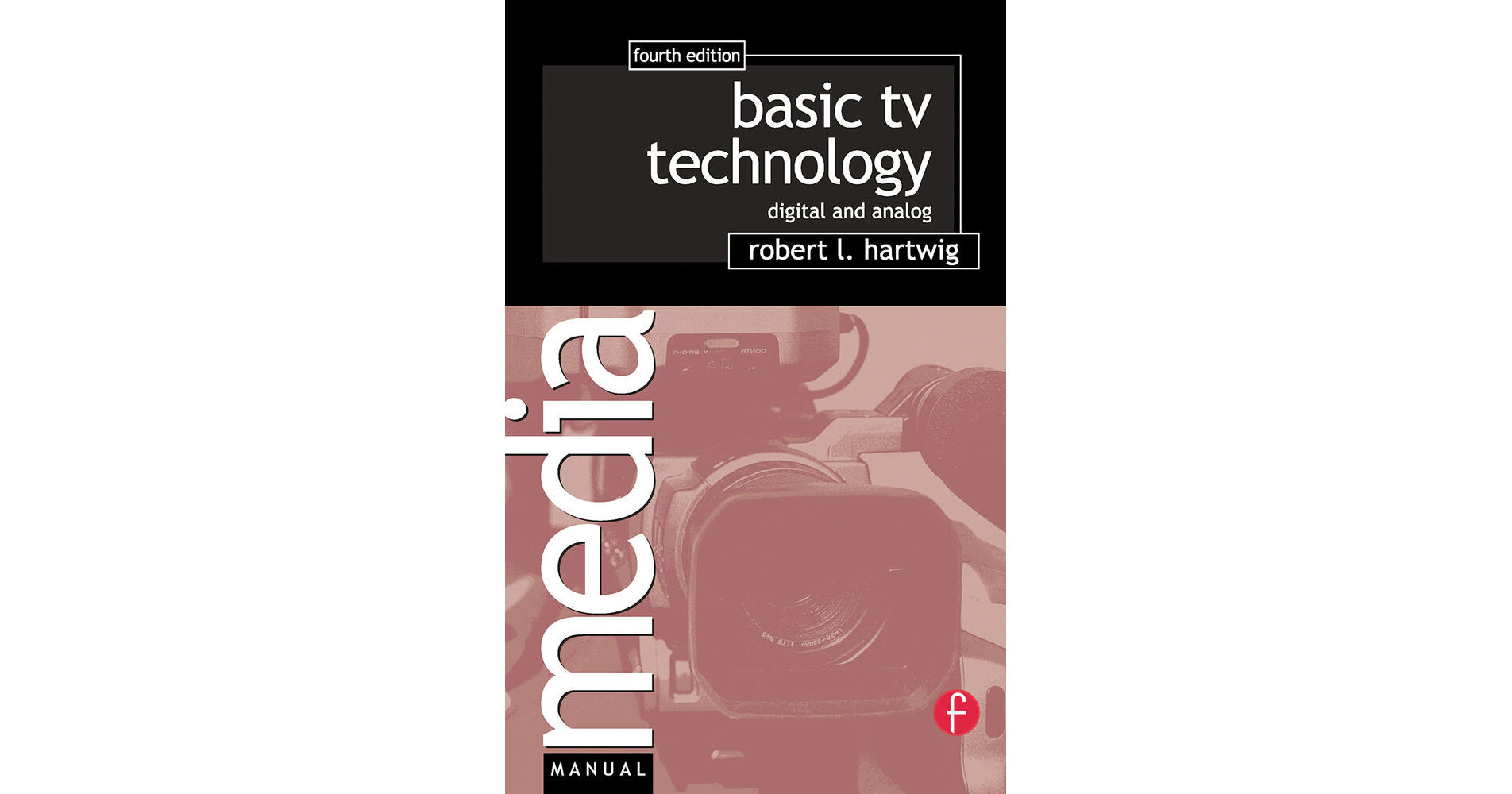
Authored by Robert L Hartwig, Basic TV Technology: Digital and Analog from Focal Press is an essential basic guide to the fundamentals underlying all television and video systems, written for students and nontechnical professionals. You don't need to have a math or science background in order to understand this explanation of how the principal pieces of equipment work, what their functions are, and how they are integrated to form a complex video system. An understanding of this material will be necessary for you to succeed in the real world, where one person often has to perform many different roles and functions within a production. Armed with some basic technical background information, you'll be more effective at figuring out new applications and problem solving.
The fourth edition of Basic TV Technology has been updated to reflect the industry shift to digital video and includes new information on compression, television standards, LCD displays, HD, and equipment. This book features the accessible Media Manual format, in which every topic is covered in two pages: one of explanatory text and one of figures.
The parts of the atom
The flow of electrons through metals
Direct current (DC)
Alternating current (AC)
Voltage
Current
Power
Resistance and impedance
Mathematical symbols and formulas
Frequency
AC frequency
Capacitance
Induction
Noise
Signal-to-noise ratio
Kilo
Mega
Giga
milli
micro
nano
Conversions
Interlace Scanning
Progressive Scanning
Horizontal blanking
Vertical blanking
CCD layout and operation
Broadcast-quality requirements
What is digital?
What Computers do
Bits & Bytes (binary numbering system)
A to D conversion
Sampling and quantizing
D to A conversion
Color verses black and white
Additive and subtractive colors
Complementary colors
Color temperature
Filters
Black Balance
White balance
From black and white to color
Digital responses to this situation
Home video cameras
Convergence
How it works
Drive pulses
Blanking pulses
Sync pulses
Color burst
Combining sync with video
Reading the vectorscope
Color bar display
Distribution amplifiers
Out-of-phase cameras
Timing the system
Vertical interval switchers
Component switchers
Digital switchers
Special effects
Production and editing switchers
On-air switchers
Routing switchers
Switcher buses
Switcher outputs
Wipes
Linear or transparent keys
Problems of composite video
Component video
Y/C
Compressions
Pushes
Flips
Rotations
Other special effects
Manipulation
Interpolation
Recorders
Videotape
Recording heads
Audio versus video recording
Helical video recording
Sound and control tracks
VTR Lockup
Capstan lock
Vertical lock
Frame lock
Horizontal lock
Gyroscopic time base error
What a time base corrector does
How a TBC works
Horizontal sync as a clock
D-to-A conversion
Video proc amp
Window of correction
Nonsynchronous sources
Frame synchronizer
Dynamic tracking heads
Freeze frames
TBCs, VTRs, and production
DV video
Problems of videotape
Video servers
Physical cutting and splicing
Electronic editing
Assemble edits
Insert edits
Off-line editing
On-line editing
Drop frame/non-drop frame editing
Entrophy reduction
Entrophy encoding
Originating computer graphics
Interface between people and machines
Computer-generated imagery (CGI)
Digital Video effects
Production HDTV standards versus broadcast HDTV standards
The early years
Mono and stereo
5.1 Stereo
Impedance
Balanced and unbalanced audio
Line and mic levels
Analog and digital
Professional and consumer equipment
Microphones
Mixers
Loudspeakers
DAT
Solid State Recorders