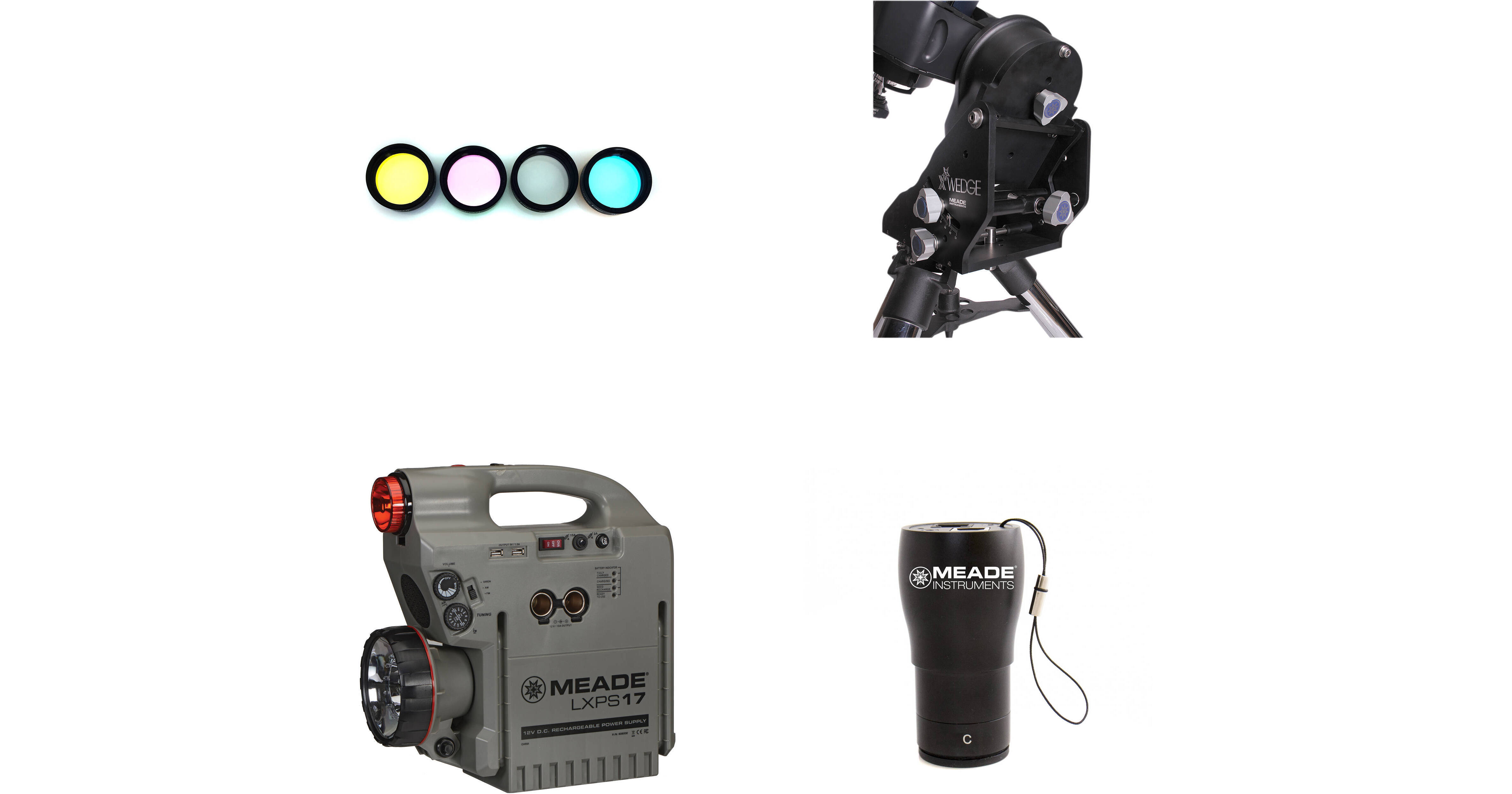


Designed as an ideal imaging companion for your 10, 12, or 14" LX-series telescope, this Meade Instruments Accessory Bundle gives you the tools for successful imaging of the Moon and planets, helping make your observation sessions easier. The kit comes with the monochrome version of their LPI-G eyepiece camera; a four-piece imaging filter set that includes red, green, blue, and infrared filters; the equatorial X-Wedge for easier and smoother tracking with reduced vibrations; and 12V power supply to keep your scope and camera running.
Meade Instruments designed the LPI-GM Autoguiding and Imaging Eyepiece Camera for beginner and veteran astrophotographers alike. As an imaging camera, it simply replaces a 1.25" eyepiece on a telescope to capture photos of the Sun (using appropriate solar filters or dedicated solar scopes), the Moon, planets, planetary moons, and wide-field nightscapes to be processed, edited, matted, and stacked using the included Sky Capture software installed on a computer. This version of the LPI-G is offered here with a monochrome CMOS sensor to make adding filters to in post faster and easier.
More experienced astrophotographers tend to have elaborate higher-resolution and faster imaging rigs, so the LPI-GM is designed with an ASCOM-compliant ST-4 port to connect it to autoguider-capable mounts. In this capacity, the LPI-G is installed on a secondary guider-scope, with the primary imaging system installed on the larger OTA. With the LPI-G connected to a mount and PC, it will use the camera and user-supplied autoguider software to monitor the mount's tracking and make precise corrections to reduce or eliminate errors which can result in fuzzy images and star trails.
- 1.2MP monochrome CMOS AR130 imaging sensor
- Resolution: 1280x960 at 28 fps; 640x480 at 30 fps
- Image formats: JPEG, BITMAP, PNG, TIFF, FITS
- Compatible with imaging and guiding software such as Maxim DL, PHD, and FireCapture
- USB port: Connect LPI-GM to computer to interface with Sky Capture software for processing and editing images
- ST-4 guider port: ASCOM-compliant; Use for high-precision autoguiding tracking during long-exposure astrophotography
- Included ST-4 cable plugs into mounts with autoguider ports
- Operating System: Windows (32 & 64 bit) Vista/XP/7/8/10
- Processor: Intel Core2 2.8 GHz equivalent or higher
- Memory: 2GB or higher
Meade Instrument's PSLXPS17 12 VDC 17 Ah Power Supply is a valuable accessory to power any Meade 12V telescope. In addition to powering your telescope, it features an AM/FM radio with a siren mode, two 5V USB ports to charge small electronic devices such as phones and GPS hand units, and two 12 VDC car/vehicle ports for larger devices. All outputs are fuse-protected and the fuse is changeable if it blows. The power supply also has a powerful LED spotlight equipped with a hinged head for precise beam placement when you're navigating to the observation sight or setting up. A secondary flashlight is set about the spotlight for performing tasks, and an included red filter snaps over the lens to illuminate without affecting night-adjusted vision. The flashlight also has a strobe mode to signal observation partners or in emergencies. Its rechargeable lead acid battery can be charged using the included wall or car/vehicle plugs, and colored LEDs allow you to monitor the charge and battery status at a glance. A carrying handle is molded into the top of the unit, and a storage compartment is integrated into the housing to hold small items.
The X-Wedge Equatorial Wedge from Meade delivers smooth and accurate altitude and azimuth adjustments of a tripod and pier mounted optical tubes. The X-Wedge is mounted between the optical tube and the tripod to match the observer's latitude, achieving precise polar alignment of your telescope. Machined from a solid block of lightweight ultra-rigid aircraft aluminum, this wedge outperformed competing equatorial wedges, proving to be 30 percent more stable. The enhanced stability provided by the X-Wedge is essential for achieving tack-sharp images of deep sky objects such as galaxies and nebulae.