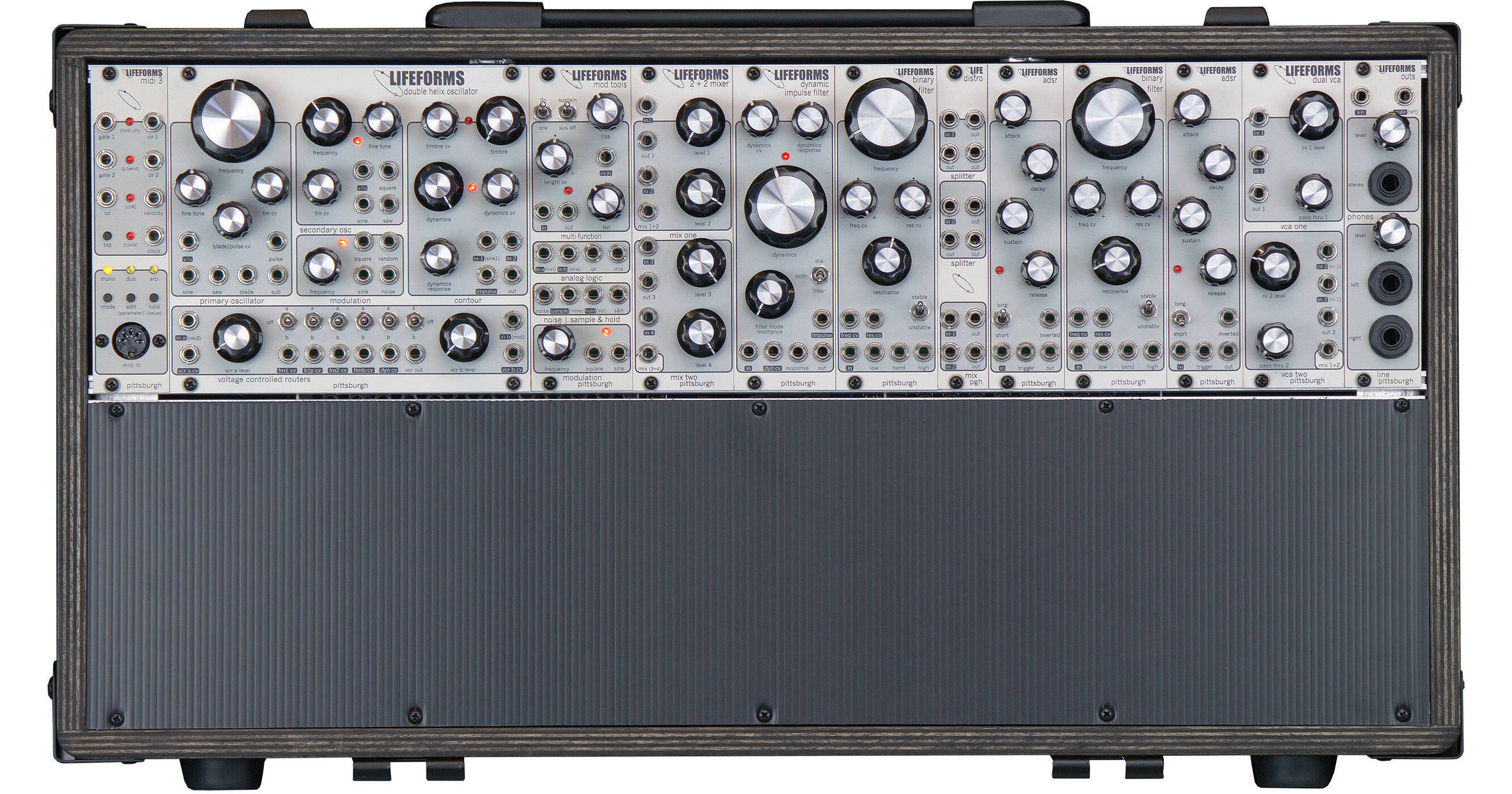


The Lifeforms Foundation 4 from Pittsburgh Modular is a standalone, fully modular synthesizer modeled after the vintage modulars of the '70s and features no hardwired signal path or fixed-voice architecture to restrict creativity. The modules in this system are designed simultaneously as a single, monolithic synthesizer to ensure that it sounds and feels like a complete instrument. The system offers both east and west coast synthesis schools to produce a rewarding sonic palate, regardless of the musical destination. The Foundation 4 is housed in the EP-208 road case and includes a black plastic panel that can be easily trimmed as new modules are added, to keep the case looking clean.
The instrument is comprised of 12 modules including a MIDI-to-CV converter, dual oscillator, modulation tools, a 2+2 mixer, a dynamic impulse filter, two binary multi-mode filters, a Distro module, two ADSR envelope generators, a dual VCA, and an output module with headphone and line-level outputs. The case offers an integrated power supply and Eurorack bus system capable of powering additional modules. The Lifeforms Foundation 4 is compatible with all Eurorack-format modules and ships with 24x 1/8" / 3.5mm patch cables.
The Lifeforms MIDI 3 from Pittsburgh Modular is a 3rd generation MIDI-to-CV converter compatible with the Eurorack format and is designed to convert MIDI note messages into the analog control voltages used by modular and other analog synthesizers, allowing synthesizers to be controlled by a MIDI keyboard, sequencer or DAW. The MIDI 3 has a robust feature set including monophonic and duophonic MIDI response modes, assignable CC, and dedicated velocity outputs. Additionally, the module offers a feature-rich clock source with tap tempo, MIDI and external gate-clock dividers, and multiple arpeggiator responses.
The two CV outputs can be used to control the pitch of an oscillator, the cutoff frequency of a filter, or any other voltage-controlled function. The two gate outputs can be used to trigger envelope generators or any module expecting a gate or clock source. The MIDI 3 is 6hp wide, 1.4" (35mm) deep, and uses 60mA of power. The module includes a ribbon cable.
- Monophonic: Monophonic mode works great when using a modular as a single-voice synthesizer patch. Channel 2 Gate and CV outputs mirror the outputs of Channel 1. Monophonic mode has several keyboard responses to choose from: last-note priority, low-note priority, and high-note priority. Each response is available with and without gate retriggering.
- Duophonic: The MIDI 3 module uses the two sets of Gate and CV outputs to allow two notes to be played simultaneously. The first MIDI note is sent to Channel 1 Gate and CV outputs and the second is sent to Channel 2 Gate and CV outputs. Duophonic mode has three keyboard response modes to choose from. Unused channel and new-note priority, unused channel and low-note priority, and split-keyboard priority. Duophonic mode is designed for working with a two-voice modular-synthesizer patch.
- Arpeggiator: The MIDI 3 module includes a robust arpeggiator mode with multiple mono and duophonic responses to choose from. Available responses are monophonic response as played, double-triggered monophonic response as played, random monophonic response, random monophonic with a random Channel-2 gate, and random duophonic response with dual random gates. The arpeggiator can be clocked using tap tempo, MIDI clock, or external gate.
- Internal Clock: The internal MIDI 3 clock utilizes the tap tempo button to modify the rate of the internal clock. The internal clock is used to clock the arpeggiator and is also output to the CLOCK jack.
- External MIDI Clock: The external MIDI clock responds to MIDI start/stop messages and MIDI tempo from an external MIDI clock source. The external MIDI clock is used to clock the arpeggiator and is also output to the CLOCK jack. In external MIDI-clock mode, the tap tempo button cycles through five available clock divisions.
- External Gate Clock: The external gate clock responds to gate signals patched into the CLOCK jack. The external gate clock is used to clock the arpeggiator. In external-gate clock mode, the tap tempo button cycles through six available clock divisions.
- Assignable MIDI Channel: The MIDI 3 can be assigned to respond to all channels or any individual MIDI channel.
- Assignable Pitch-Bend Range: The range of pitch bend can be set to +/- 2 notes, +/- 5th, +/- 1 octave, +/- 2 octaves.
- Control Change Output: Provides a CC response of 0 - 5V.
- Assignable Control-Change Channel Assign: Allows you to assign the MIDI CC channel the MIDI 3 responds to.
- Velocity Output: Provides a velocity response of 0 - 5V based on active note.
The Lifeforms Double Helix Oscillator from Pittsburgh Modular is a complex matrix oscillator designed to be the nucleus of a Eurorack analog synthesizer. At the core of the Double Helix are two wide-range precision oscillators with the primary offering a full complement of waveforms and multiple modulation options, while the secondary oscillator features a more focused set of waves and frequency modulation. Both oscillators will run a sub-audio frequency and will work as LFOs for a voltage-controlled modulation source.
The contour section features a highly-tuned wavefolder paired with a dynamic impulse low-pass gate. The first half of the section is a voltage-controlled, 6-stage wavefolder that adds odd harmonics to the incoming waveform. The timbre controls set the density and amplitude of the folds. When processing a sine wave, the wavefolder creates a spectral change from zero harmonics to square, with an infinite harmonic series.
The second half of the contour section is a dynamic impulse low-pass gate that performs similarly to pairing a low-pass filter and VCA together and as the dynamics control is opened, the filter adds harmonics and the VCA increases the amplitude of the waveform. As the dynamics control is closed, the filter removes harmonics and the VCA decreases the amplitude of the waveform, which mimics how sound behaves in the real world, creating a more naturally tonal response.
The modulation section includes an LFO offering simultaneous square, sine, and random waveforms, as well as a noise source for audio or modulation use. Two voltage-controlled routers manage all the CV inputs and create a dual voltage-controlled modulation matrix, well suited for complex signal paths, experimentation, and live performances. The Lifeforms Double Helix is 28hp wide, 1.5" (37mm) deep, and requires 205mA of power. The module includes a ribbon cable.
- Primary Oscillator Controls
- Frequency Knob: Frequency control sweeps from LFO through the full audio range
- Fine Tune Knob: Limited-range frequency control
- Blade/Pulse CV Knob: Blade wave shape and pulse width control CV input attenuator
- FM CV Knob: Frequency modulation CV input attenuator
- V/O Input Jack: 1 volt per octave pitch tracking input
- Sine Wave Output Jack
- Saw Wave Output Jack
- Blade Wave Output Jack
- Sub Wave Output Jack
- Pulse Wave Output Jack
- Secondary Oscillator Controls
- Frequency Knob: Frequency control sweeps from LFO through the full audio range
- Fine Tune Knob: Limited range frequency control
- FM CV Knob: Frequency modulation CV input attenuator
- V/O Input Jack: 1 volt per octave pitch tracking input
- Sine Wave Output Jack
- Saw Wave Output Jack
- Square Wave Output Jack
- Contour Controls
- Timbre CV Knob: Timbre control CV input attenuator
- Timbre Knob: Wave folder gain control
- Dynamics Knob: Low pass gate dynamics control. Full left, no gain and no harmonics. Full right, full gain and full harmonics
- Dynamics CV Knob: Dynamics control CV input attenuator
- Dynamics Response Knob: Sets the decay time related to the impulse gate input and dynamics CV input
- In 1 Input Jack: Contour section audio signal input mixed with In 2. This jack is normaled to the primary oscillator sine wave
- In 2 Input Jack: Contour section audio signal input mixed with In 1
- Impulse Input Jack: Gate or trigger input used to strike the dynamic impulse circuit and quickly modulate the dynamics of the audio signal
- Output Jack: Contour section audio signal output jack
- Modulation Controls
- Frequency Knob: Frequency control sweeps through LFO range
- Square Output Jack: Square wave output jack
- Random Output Jack: Stepped random CV output jack
- Sine Output Jack: Sine wave output jack
- Noise Output Jack: Analog noise output jack
- In A Input Jack: Modulation source A. This signal is sent through the voltage controlled router to any CV input switched to the A position. This jack is normaled to the modulation section sine wave
- VCR A CV Input Jack: CV input used to modulate channel A modulation signal level passed through to the routing switches
- VCR A Level Knob: Sets the channel A modulation signal level passed through to the routing switches
- FM 1 CV Input Source Switch: Sets primary oscillator FM CV input source. Select between A (up), B (down), A and B off (center). The selected signal is mixed with the signal from the FM 1 CV Input Jack
- FM 1 CV Input Jack: Primary Oscillator FM signal input jack. The input jack is mixed with the FM 1 CV Input Source Switch
- Blade/Pulse CV Input Source Switch: Sets Primary Oscillator blade wave shape and pulse width CV input source. Select between A (up), B (down), A and B off (center). The selected signal is mixed with the signal from the Blade/Pulse CV Input Jack
- Blade/Pulse CV Input Jack: Primary Oscillator blade wave shape and pulse width signal input jack. The input jack is mixed with the Blade/Pulse CV Input Source Switch
- FM 2 CV Input Source Switch: Sets Secondary Oscillator FM CV input source. Select between A (up), B (down), A and B off (center). The selected signal is mixed with the signal from the FM 2 CV Input Jack
- FM 2 CV Input Jack: Secondary Oscillator FM signal input jack. The input jack is mixed with the FM 2 CV Input Source Switch
- Timbre CV Input Source Switch: Sets the contour section timbre CV input source. Select between A (up), B (down), A and B off (center). The selected signal is mixed with the signal from the Timbre CV Input Jack
- Timbre CV Input Jack: Contour section timbre CV input jack. The input jack is mixed with the Timbre CV Input Source Switch
- Dynamics CV Input Source Switch: Sets the contour section dynamics CV input source. Select between A (up), B (down), A and B off (center). The selected signal is mixed with the signal from the Dynamics CV Input Jack
- Dynamics CV Input Jack: Contour section dynamics CV input jack. The input jack is mixed with the Dynamics CV Input Source Switch
- VCR Output Jack Source Switch: Sets the VCR output jack source. Select between A (up), B (down), A and B off (center)
- VCR Output Jack: Channel A or Channel B signal output jack. Output of modulation signal passed through to the routing switches
- VCR B Level Knob: Sets the channel B modulation signal level passed through to the routing switches
- In B Input Jack: Modulation source B. This signal is sent through the voltage controlled router to any CV input switched to the B position. This jack is normaled to the modulation section sine wave
- VCR B CV Input Jack: CV input used to modulate channel B modulation signal level passed through to the routing switches
The Lifeforms Mod Tools from Pittsburgh Modular provides a diverse analog ecosystem of modulation capable of a variety of functions including an envelope generator, LFO, noise source, sample & hold, mixer, analog logic, slew, and oscillator.
The module is broken up into four sections: Multi-Function, Analog Logic, Noise / Sample & Hold, and Modulation. The Multi-Function section is a voltage-controlled slope generator that can be used as a voltage-controlled envelope, LFO, oscillator, slew, envelope follower, and more. The Analog Logic section is a two-channel mixer with standard unity gain mix out as well as an analog "or" logic output. The "or" logic outputs the current highest positive-only voltage from either of the inputs, creating interesting modulation or wave shaping options. Patching audio signals through the "or" output creates a half-rectified waveform.
The Noise / Sample & Hold section pairs an analog noise source with a sample & hold circuit to create random stepped CV signals. The Modulation section provides a free-running LFO with both square and wine wave outputs. The Lifeforms Mod Tools module is 8hp wide, 1.5" (37mm) deep and requires 53mA of power. The module includes a ribbon cable.
- LFO/Envelope Switch: Switch between envelope and LFO cycling mode
- Sustain / Sustain Off Switch: Input level following sustain on or off
- Rise Control Knob: Adjusts the rise/attack time of the envelope or rising side of the LFO
- Length CV Attenuverter Knob: Rise and fall modulation level attenuverter
- Length CV Input Jack: Rise and fall modulation input jack
- Signal Indicator LED: Signal indicator LED represents the current voltage level within circuit
- Input Jack: Main signal input jack
- Output Jack: Main signal output jack
- Fall Control Knob: Adjusts the fall/decay time of the envelope or falling side of the LFO
- Input A Jack: Mixer channel A input jack normaled to the Multi-Function Output Jack
- Input B Jack: Mixer channel B input jack normaled to the Modulation Sine Output Jack
- Or Output Jack: Unity gain, positive only logical 'or' output of Input A and Input B
- Mix Output Jack: Unity gain mix output of Input A and Input B
- Noise Output Jack: Analog noise output jack
- Sample Input Jack: CV sampling input jack normaled to Noise Output Jack
- Hold Input Jack: Stepped CV output jack normaled to Modulation Square Output Jack
- Sample & Hold Output Jack: Stepped CV output jack
- Frequency Knob: Frequency control sweeps through LFO range
- Square Output Jack: Square wave output jack
- Sine Output Jack: Sine wave output jack
The Lifeforms 2+2 Mixer from Pittsburgh Modular is a flexible, low-noise ambidextrous four-channel mixer and/or attenuator for audio and CV that can be used in several ways. Three of the four channels have an output that can be patched to remove the channel from the mixer circuit and allow it to become a stand-alone attenuator. Each pot is wired with a logarithmic volume curve that is tuned for use with audio but will function with CV as well.
Patching the mix output of 1+2 removes channels 1 and 2 from the mix (3+4) output and creates two, 2-channel mixers. Patching the output of channel 1, 2, or 3 will remove it from the mixer circuit. Channel 4 cannot be removed from the mixer, but if channels 1 through 3 are being used as attenuators, then channel 4 is the only input remaining and can be used as a buffered attenuator. The 2+2 Mixer module is 8hp wide, 0.9" (24mm) deep, and requires 7mA of power. The module includes a ribbon cable.
- In 1 Jack: Channel 1 input jack
- Out 1 Jack: Channel 1 output jack. Plugging in a cable removes channel 1 from the mixer and allows it to be used as a passive attenuator
- Level 1 Knob: Channel 1 level attenuator
- In 2 Jack: Channel 2 input jack
- Mix 1+2 Out Jack: Channel 1 and 2 output jack. Plugging in a cable removes channel 1 and 2 from the Mix (3+4) output and allows channel 1 and 2 to act as separate a 2-channel mixer
- Level 2 Knob: Channel 2 level attenuator
- In 3 Jack: Channel 3 input jack
- Out 3 Jack: Channel 3 output jack. Plugging in a cable removes channel 3 from the mixer and allows it to be used as a passive attenuator
- Level 3 Knob: Channel 3 level attenuator
- In 4 Jack: Channel 4 input jack
- Mix (3+4) Out Jack: Main mixer output
- Level 4 Knob: Channel 4 level attenuator
The Lifeforms Dynamic Impulse Filter from Pittsburgh Modular is a variable-response low-pass gate that combines three functions into a single module, including a resonant lowpass filter, a high-quality VCA, and a combined lowpass gate mode that manages both timbre and loudness at the same time. The core of the filter uses a Sallen-Key topology to produce a smooth two-pole filter that will self-oscillate at high resonance settings.
Most lowpass gates utilize a vactrol, a light-dependent resistor that lends itself to organic percussive sounds with a natural decay. The dynamic impulse filter employs a newly developed dynamic response control circuit that emulates a vactrol's sonic characteristics, but with a variable response time that is tunable and adapts to any musical context. The impulse trigger input and the dynamics response control allow the module to add an organic, percussive quality to any sound, or become a versatile analog drum generator. The dynamic impulse filter will uniquely emulate everything from snappy deep kicks to woody toms and expressive hand drums, opening up a new world of electronic percussive sounds. The Lifeforms Dynamic Impulse Filter module is 8hp wide, 0.8" (20 mm) deep, and requires 35mA of power. The module includes a ribbon cable.
- Dynamics Response Knob: Sets the decay time related to the impulse gate input and dynamic CV input
- Dynamics Knob: In filter mode, the dynamics knob controls the center frequency of the filter. In VCA mode, the dynamics knob controls the pass-through signal level. In low-pass gate mode, the dynamics knob controls both the center frequency of the filter and the pass-through signal level
- Dynamics CV Knob: Attenuates the incoming dynamics CV signal
- Filter Mode Resonance Knob: Only active in filter mode, the filter-mode resonance knob controls the amount of resonance
- Mode Switch: Switches between the 3 module modes. VCA position (up) enables VCA mode, both position (center) enables lowpass gate mode, and filter position (down) enables lowpass filter mode
- Input Jack: Audio signal input
- Dynamics CV In Jack: CV input used to modulate the dynamics amount
- Response Out Jack: Dynamics response CV output. This output is optimized to control the vactrol response of modules utilizing vactrols. It is designed to be patched into a CV input. The Response Out jack will respond like a gate when used with non-vactrol modules
- Impulse Gate In Jack: Gate or trigger input used to strike the vactrol and quickly modulate the dynamics of the audio signal
- Out Jack: Audio signal output
Borrowed from the Lifeforms SV-1 Eurorack module, the Lifeforms Binary Filter from Pittsburgh Modular is a classic voltage-controlled, analog, state-variable filter, which offers a wide variety of sounds from very smooth and natural to unpredictable and distorted. The filter offers multiple responses simultaneously including low-pass, high-pass, and band-pass.
With the stable mode selected, the filter provides a warm, organic sweep through the full frequency range. The low-pass is gummy and relaxed, while the high-pass is clean and defined. Switching to unstable mode and without an incoming audio signal, the filter produces a high-quality voltage-controlled sine wave. Adjusting the Q while in unstable mode modifies the shape of the waveform. Add an incoming audio signal to the unstable mode and the output changes dramatically, resulting in anything from ringing fuzz to heavy distortion. The Binary Filter module is 8hp wide, 0.9" (24mm) deep, and requires 22mA of power. The module includes a ribbon cable.
- Frequency Knob: Adjusts the center frequency of the filter
- Resonance Knob: Adjusts the resonance (Q) of the filter
- Frequency CV Knob: Frequency control voltage attenuverter
- Resonance CV Knob: Resonance (Q) control voltage attenuverter
- Stable | Unstable Mode Switch: Switch between stable and unstable modes
- Frequency CV In Jack: CV input used to modulate the filter frequency
- Resonance CV In Jack: CV input used to modulate the filter resonance
- Input Jack: Audio signal input
- Low-pass Output Jack: Low-pass filter response output
- Band-pass Output Jack: Band-pass filter response output
- High-pass Output Jack: High-pass filter response output
The Lifeforms ADSR from Pittsburgh Modular is a four-stage envelope generator with independent controls over attack, decay, sustain, and release parameters. The module is designed to shape gate or trigger signals over time to produce a more expressive instrument. Typically, the module is used to control the amplitude of an oscillator or the cutoff frequency of a filter, but may be used to create a modulation envelope on any function on a module that accepts CV inputs.
The incoming gate signal passes through each stage of the envelope. The initial gate/trigger signal passes to the attack portion, which determines the amount to time needed for the envelope generator to reach the peak output voltage before moving onto the decay stage. Decay sets the amount of time needed to transition to the level set by the sustain knob. The sustain level is maintained if the gate / trigger remains on or high. Once the gate/trigger is released, the release stage takes over and is controlled by the release knob, which causes an abrupt cut of the signal when set low, or will slowly fade out with higher setting. The Lifeforms ADSR module is 6hp wide, 0.9" / 24mm deep and requires 23mA of power. The module includes a ribbon cable.
- Attack Knob: Attack stage control
- Decay Knob: Decay stage control
- Sustain Knob: Sustain stage control
- Release Knob: Release stage control
- Input Jack: Gate or trigger input
- Range Switch: Sets the range of the four stage controls
- Trigger Out Jack: A trigger is generated at the end of the release stage
- Inverted Out Jack: A positive only, inverted envelope
- Output Jack: Envelope output
The Lifeforms Distro from Pittsburgh Modular is an active audio and CV interchange Eurorack module with three independent sections for splitting and mixing. All outputs are individually buffered for robust signal separation and unity gain pass-through.
The top two splitter sections create three copies of the incoming audio or CV signal and are well suited for mission-critical pitch-sensitive CV signals, while the mixer section offers both mixing and splitting with a two-channel unity gain mixer and a set of individually-buffered outputs. This section can be used as a two-channel mixer, buffered signal splitter, or both. The Lifeforms Distro module is 4hp wide, 0.8" (20mm) deep, and requires 20mA of power. The module includes a ribbon cable.
- 2 x 1-in/3-out splitters featuring buffered copies for audio and CV signals
- 1 x 2-channel mixer, buffered signal splitter, or both
The Lifeforms Dual-VCA from Pittsburgh Modular works as a voltage-controlled amplifier for audio and CV applications and also functions as a two-channel voltage-controlled mixer. Each VCA offers a high-quality, linear voltage-controlled amplifier with offset gain, CV attenuation, and a dedicated mix output. The Lifeforms Dual-VCA module is 8hp wide, 0.9" (24mm) deep, and requires 34mA of power. The module includes a ribbon cable.
- VCA 1
- CV In 1 Jack: CV input used to control the VCA
- CV In 1 Attenuator Knob: CV input attenuator
- In 1: Signal input
- Pass-Thru 1 Knob: Adjusts the pass-thru level of the input signal
- Out 1: Signal output
- VCA 2
- CV In 2 Jack: CV input used to control the VCA
- CV In 2 Knob: CV input attenuator
- In 2: Signal input
- Pass-Thru 2 Knob: Adjusts the pass-thru level of the input signal
- Out 2: Signal output
- Mix Out: Fully-buffered mix of the VCA 1 and VCA 2 outputs
The Lifeforms Outs from Pittsburgh Modular is a stereo headphone amplifier and line-output module offering dual independent level controls. The module offers stereo 1/8" (3.5mm) inputs for left and right. The left input works with a mono input and will send the same signal to both left and right headphone- and line-level outputs. The stereo TRS 1/4" headphone output features a level control, while the dual mono 1/4" outputs have their own independent level control. The Lifeforms Outs module is 6hp wide, 1.5" (39mm) deep, and requires 20mA of power. The module includes a ribbon cable.
The Structure EP-208 from Pittsburgh Modular is a professional Eurorack modular synthesizer case designed to transport and protect up to 40 Eurorack modules. The case is constructed from hand-stained premium hardwood and features four rails, each with 20 sliding square nuts, and 80x black (4-40-sized 1/4") screws for mounting modules. The detachable lid allows for enough clearance to leave the modular fully patched during transport. The overbuilt power supply delivers three times the amount of power than most other cases and is designed for sensitive analog circuitry, power-hungry digital processors, and ground-sensitive user-interface modules. The Structure EP-208 ships with a standard IEC power cord.
- Hardwood and steel construction
- Two 104hp rows
- 208hp total space available
- Removable lid
- Lid fits over fully patched system (No need to remove patch cables)
- Edge-to-edge rails reduce gaps between modules and the case side
- 20 smooth-sliding square nuts per rail (Holds up to 40 modules)
- Includes 80 black (Size 4-40 1/4") module-mounting screws
- Beautifully hand-stained hardwood
- Matching black-steel hardware set
- 4 amps of clean +12V power
- 3 amps of clean -12V power
- 2 amps of clean +5V power
- 30 keyed Eurorack power headers
- External power switch with LED
- Universal IEC power connector
This 24-pack of Nazca Noodle Patch Cables from Pittsburgh Modular are hand-made Eurorack modular synthesizer patch cords that are designed to be strong and flexible. Each cable is made with a 3mm width jacket, 5.5mm over-molding, and finished with a 3.5mm mono plug. With the soft and flexible skinny plug over-molding, the cables will fit into the tightest patch points.
- Cerise Red: 2 x 13" + 2 x 25"
- Citron Yellow: 2 x 13" + 2 x 25"
- Lime Green: 2 x 13" + 2 x 25"
- Cobalt Blue: 2 x 13" + 2 x 25"
- Rasberry Sorbet: 2 x 13" + 2 x 25"
- Black Licorice: 2 x 13" + 2 x 25"