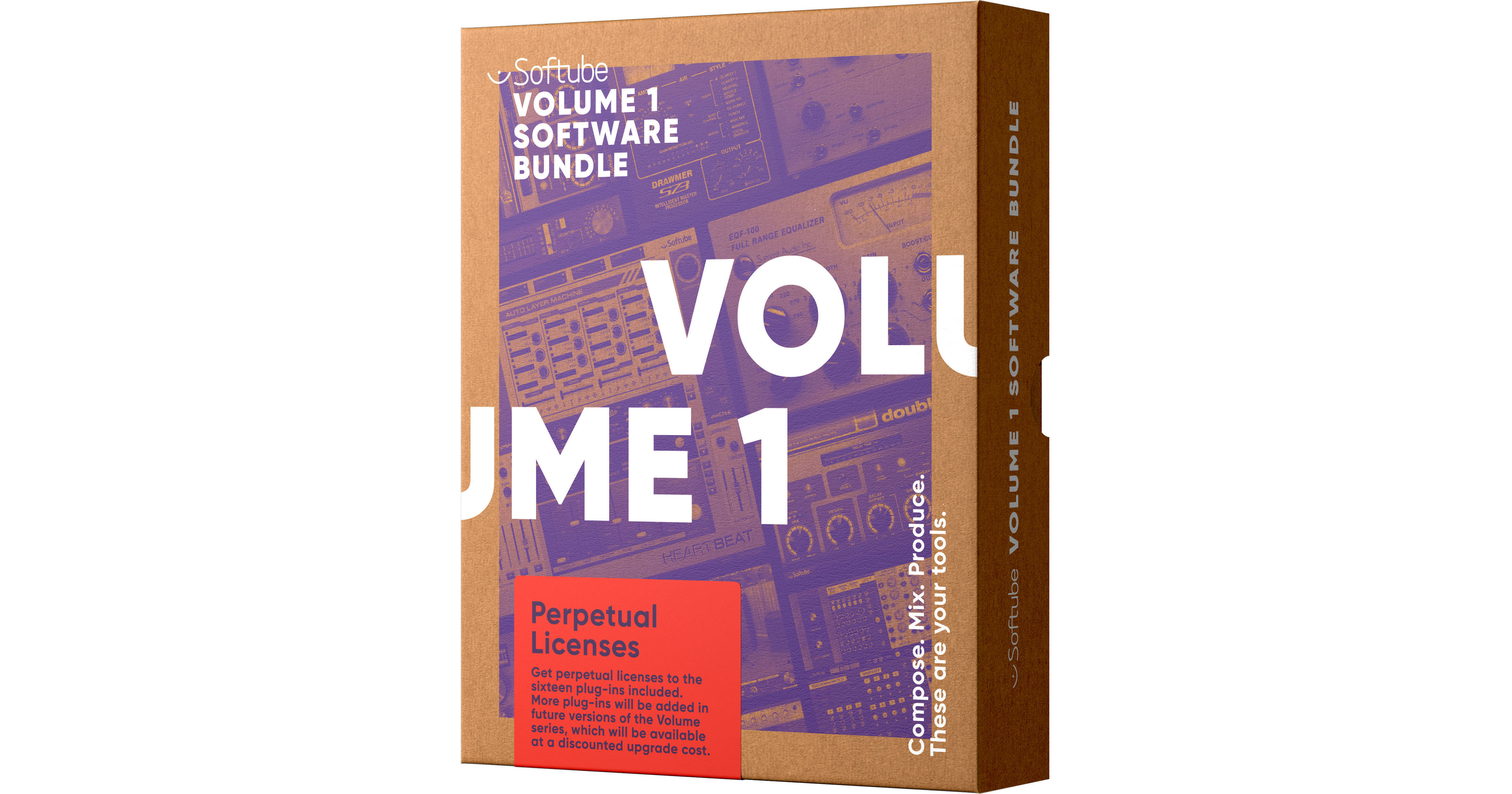


Conceived by identifying the eleven most common tasks in modern-day music production, Volume 1 from Softube is a bundle which includes sixteen plug-ins designed to give you the tools to create drum machine and synth tracks, record electric guitars and basses, mix vocals and acoustic guitars, and finalize your mixes.
This version lets you upgrade to Volume 1 from your version of the TSAR-1 Reverb plug-in. It comes with a 90-minute mix tutorial video featuring Grammy-nominated engineer Ryan West.
Plug-Ins At-a-Glance:
- Summit Audio Grand Channel
- Summit Audio EQF-100 Full Range Equalizer
- Summit Audio TLA-100A Leveling Amp Compressor
- TSAR-1 Reverb, Stereo Reverb
- TSAR-1R Reverb
- FET Compressor, "Solid State" Compressor
- Modular, Virtual Modular Synthesizer
- Trident A-Range EQ, Equalizer
- Vintage Amp Room, Virtual Guitar Amplifiers
- Drawmer S73 Intelligent Master Processor, Dynamics
- Fix Flanger and Doubler, Modulation and Vocal Doubling
- Heartbeat, Drum Synthesizer
- Tube Delay, Valve Preamp Delay Effect
- Bass Amp Room, Bass Amplifier and Speaker Emulation
- Saturation Knob, Output Distortion
Available for download, the Summit Audio Grand Channel Plug-In from Softube combines the EQF-100 Full Range Equalizer and TLA-100A Compressor plug-ins, giving you a channel strip for your mixes. Having the two combined in a single native-based plug-in makes adjustments easier, as you will often find that the compressor affects the equalizer and vice versa.
The user interface of the Grand Channel plug-in features the Bypass and Routing panel, TLA-100A Compressor, and EQF-100 Full Range Equalizer stacked one on top of the other, in that order. The user interfaces of the individual units are the same as the individual plug-ins.
The EQF-100 equalizer features four fully parametric bands of equalization, a high-pass filter, a low-pass filter, and I/O VU meters. The TLA-100A Compressor offers adjustable attack and release times and a smooth, soft knee character. Its additional panel offers low cut, parallel compression, and adjustable harmonic excitement via the Saturation knob.
The Bypass and Routing panel is used for engaging or bypassing the separate units and for selecting the processing order. By default, the sound reaches the equalizer before the compressor, but you can easily reverse the order with a single switch. Additionally, there are two main volume controls on the unit—the Output Volume on the EQF-100 and the gain knob on the TLA-100A.
The characteristics of distortion yielded by the EQF-100 and TLA-100A are different. The TLA-100A has a separate saturation control which lets you adjust the headroom of the unit, so you can go from a clean sound with almost no audible distortion to a fully saturated sound, leaving no transients intact. Try more saturation when taming transients in drums, and back off the knob when you need to warm up a vocal track. On the other hand, the distortion of the EQF-100 has a totally different character. Boosting the EQ or cranking the output volume yields a warm and fat type of harmonic excitement that is suited for vocals, bass, or brass.
This software is compatible with Mac and Windows computers and can operate in VST, AU, and AAX formats.
The Summit Audio EQF-100 Full Range Equalizer Plug-In from Softube is modeled from the EQF-100 tube-driven passive equalizer. This native based plug-in can be used in your DAW (Digital Audio Workstation) software to boost frequencies and not limit yourself to cutting.
The user interface consists of 4 separate bands of equalization (low, low mid, high mid, and high), two cut filters (high and low), the VU meter section, and the Output Volume. Each of the 4 frequency bands consists of 7 fixed frequencies with fully adjustable bandwidth (Q) and gain. All bands can be bypassed separately. The lowest and highest bands can also be set to shelving mode. Each cut filter consists of 3 set frequencies and bypass.
The 4 fully parametric bands of equalization plus the low and high cut gives you plenty of flexibility for virtually any track or style. Driving the output VU meter into the red area yields a warm and fat distortion coming from the output stage–similar to the effect of tube stage amplification added to the output from the passive EQ design in the original hardware.
The EQF-100 plug-in can operate in both stereo and mono modes. In stereo, both channels are linked but processed individually. How the different modes (stereo, mono and mono-to- stereo) are selected depends on your host software.
The TLA-100A Leveling Amp Compressor Plug-In from Softube is modeled from the classic Summit Audio outboard processor. The TLA-100A creates gentle and natural sounding gain reduction, keeping dynamics controlled without "squashing" the sound.
The compression works in a program dependent manner; you set it and forget it. It can provide anything from transparent leveling to soft, warm distortion if driven really hard. For ease of use, Softube's TLA-100A plug-in incorporates a Saturation knob not found on the original unit. Additionally, the plug-in provides a parallel compression wet/dry balance and a low cut filter that can either be applied to the program or just the detection circuit.
- Attack: fast, slow
- Release: fast, slow
- Meter: output, reduction
- Gain: 0 to 10
- Gain Reduction: 0 to 10
- Sidechain: internal, external
- Low Cut: Off to 600 Hz
- Low Cut Select: input or detector
- Saturation: clean, normal, high
- Parallel Inject: wet, 50/50, dry
TSAR-1 from Softube is a true stereo reverb plug-in that features a powerful and modern algorithm. A comprehensive and easy-to-use interface makes operation effortless with five parameters making up the reverb section, with additional controls for fine tuning the reverb effect.
Pre Delay is often used to achieve a subtle rhythmic effect or to carefully match the tail with the early reflections. Time provides for longer or shorter reverb tails while density adjusts the character - modern and dense, or sparse, lush and vintage. Tone and High Cut together adjust the overall sound of the reverb.
Secondary controls include Early Reflections Type, Early Reflections Mix, Diffusion, Modulation, and Reverb Mix and Output Volume. Forty-one well designed presets categorized into a "modern" and a "vintage" set make full use of the parameters. The modern set focuses on the classy reverb sounds of today, while the vintage set mimics the characters of old school reverbs.
In situations where full control over reverb is not required, the included TSAR-1R plug-in delivers the same sound using just three reverb parameters, Pre Delay, Time and Color, along with the required Mix and Volume knobs.
The FET Compressor from Softube is a native based compressor plug-in modeled after what is arguably considered the most famous solid state hardware compressor. The company realized that simply approximating the most apparent features is not enough to capture the uniqueness of the original hardware, so instead of modeling individual features and putting them together digitally, they modeled the unit in its entirety - input and output stages, gain reduction feedback loops, bias differences of different transistors, etc.
Unlike the original, the plug-in features a fully variable ratio although it can still function the standard way with fixed ratios. And of course the "All Buttons In" mode has been included. The signature attack that the original is famous for is faster than a single sample, and a look-ahead detector can make it function even faster. Parallel compression functions within the plug-in and since the "Dry" signal also spends some time inside the algorithms, it can take on the subtle distortion derived from pushing the input and output stages.
Added features not found on the original hardware include external side chain support, detector look-ahead with low- and high-cut filters for the detector, two modeled VU meters, and a stereo peak meter that allows for controlling the output signal. In case there is no use for the extra features, they can be simply switched off.
Modular from Softube is a virtual modular synthesizer, created in close collaboration with Doepfer, that provides the sound, flexibility, and expandability of a true analog modular synthesizer, but as a software plug-in. The basic system includes six modeled Doepfer modules and over twenty utility modules.
Modular's workflow is very close to the use of physical Eurorack modular synths—add modules, connect them using virtual patch cords, adjust knobs and switches. Get MIDI connectivity with the MIDI to CV/Gate Converter, and add any of the included step sequencers. Additional modules from quality Eurorack vendors are available for separate purchase.
The plug-in offers a wide range of presets for those unfamiliar with modular synthesizers, but both experts and beginners can benefit from using the Performance modules. These give the user a limited set of knobs and buttons that can be freely assigned to control any parameter on any module in the current patch.
The Trident A-Range EQ from Softube is a native based EQ plug-in based on the EQ section of the Trident A-Range console, and created in collaboration with Malcolm Toft, its original designer. Although many seminal records were recorded through the A-Range consoles, only thirteen of them were ever made. The plug-in is a model of channel 15 from one of these console currently located at Sweet Silence Studio 'B' in Denmark.
The channel features four-bands of EQ along with switchable high- and low-pass filters. Top and bottom bands are shelving, while the mid filters are bell shaped with the choice of bands often referred to as sounding "musical". When running a hot enough signal through the original unit and boosting the bands, it is possible to get it to distort. That functionality is reflected in the plug-in, but instead of using an input volume to drive the signal, a Saturation knob is used, alleviating the need to constantly adjust output volume.
Vintage Amp Room from Softube is a native based plug-in that emulates three vintage guitar amplifiers and speaker cabinets in a studio set-up, along with fully flexible microphone positioning. Straightforward and simple, the plug-in is perfect for live performances and recordings, as well as for re-amping and last-minute tweaking.
White is based on an all-round amplifier that set the industry standard for classic, distorted rock n' roll sounds. The model features the bare essentials only - all tubes, one channel, and no reverb or any other built-in effects. Sound-wise, it goes from screaming preamp "shred", to warm, speakers-about-to-break power amp distortion.
Brown is based on one of the most versatile amplifiers in music history. Suitable for all kinds of genres and instruments, the sound it produces is clean, crisp and clear, but also warm, thick and punchy. From the clearest country-style sound for steel guitars, to a dirty bluesy guitar noise, it works for both funky rhythms and mellow chords.
Green produces a pleasant guitar sound with warm yet intense power amp distortion. Its character makes it shine through in mixes, without drowning out other instruments. The modeling is based on an adaptable three-channel amplifier model that has been widely used during the last forty years, from classic pop recordings in the 60's, through to today's independent and alternative rock.
The Drawmer S73 Intelligent Master Processor from Softube is a dynamics plug-in based on the renowned hardware Drawmer 1973 three-band FET stereo compressor. The software features an enhanced multi-band compressor, and by making the choices a mastering engineer would make, the plug-in is able to fine tune and improve mixes with a minimum of tweaking. Simply use the Style parameter to switch between ready-made mastering processing techniques to quickly find the sound that best suits the mix.
The Fix Flanger and Doubler from Softube is a plug-in package that handles hands-on flanging with unique stereo-widening methods, as well as vocal doubling with lush chorus and rich textures. The plug-in is based on the Real Time Auto Doubler AD-2 originally created by Paul Wolff.
The Fix Flanger is capable of both classic guitar pedal-style flanging with an automatically swept flange, as well as direct control in the manual mode. The VSO mode features hands-on control with emulated servo motor bounce and true cross zero flanging, just like a tape machine.
The Fix Doubler provides texture and richness to vocals and polyphonic instruments. The algorithms of the Fix Flanger combined with a streamlined interface, and Paul Wolff's Auto Double algorithm, makes it easy to get lush chorus and rich layers on vocal tracks. Auto Double delivers smooth doubling without flanging at delays as low as 3 ms.
Heartbeat from Softube is a software drum synthesizer, mostly based on modeled analog synthesis. At its center, the plug-in contains eight instrument channels with two different bass drum channels, delivering a variety of textures. Two snare drum channels have six parameters each, which allows for producing anything from edgy rim shots, soft snare rolls, to machine-like claps. The hi-hat and cymbal channels include flexible synthesis engines, while the identical percussion channels can be used to model anything from 80's-style synthetic toms, to cowbells and noise drops.
The effects section includes slightly adapted versions of the company's Valley People Dyna-mite dynamic shaping model and the TSAR-1 Reverb. Filter Echo is a filtered delay effect with adjustable cut off and resonance parameters. Adjustable output saturation is also available. Each of the eight channels has a dedicated mixer channel with controls for volume, pan, ping-pong (auto panning), EQ (adapted specifically for each instrument), and send levels to the reverb and delay effects.
For additional interaction, the software features an Auto Layer Machine with four channels that can each be used to layer sounds or trigger a chain of events. A Chaos slider insures things don't stay too predictable. Flexible global velocity parameter knobs for volume, pitch, attack and decay allow for responsive velocity changes, and a Time Gate shortens the overall decay to create a stuttery and stiff machine sound.
Spring Reverb from Softube is a native based plug-in that recreates the authentic sound of a spring reverb, brining instant vintage character and grit to any audio track. A feature of the original hardware units was that if the reverb was accidently hit, it emitted a thunderous sound. The software emulates this with the Shake control, while a Tension control tightens or loosens the springs to cover a wide range of spring reverb sounds.
An additional control allows the user to engage from one to three springs. Set the control to ONE for a more pronounced springy sound and to THREE for a smoother sound. Authentic tube emulation and a treble and bass EQ add further depth to the sound of the plug-in which can also used both as a send and an insert effect.
- Shake control that shakes the springs around for that "springs-being-shaken" sound
- Tension control to shape the spring character and reverb length
- Number of spring pairs continuously adjustable from one to three
- Tube driver simulation in the reverb section, with bass and treble EQ
Bass Amp Room from Softube is a native based plug-in that delivers authentic amplifier and cabinet modeling and is designed to handle all bass amplifier needs, from dirty rock to a modern clean sound. The plug-in consists of a model of a classic bass amplifier, three speaker cabinets with click-and-drag microphone positions, and a DI section with tone controls and a limiter. The DI section can be blended with the amplifier sound for even more versatility.
Although designed as a guitar amplifier, the 70's amplifier that is model here is an excellent choice for bass players, delivering a thick and solid preamp distortion, which when pushed does not give up the low end. The power amp has a more traditional distortion that will at extreme settings start to sound more "broken". A high/low switch (not part of the original amplifier) adds a cleaner and fatter sound when necessary.
The cabinets include an industry standard 8 x 10" for fat rock solid bass tones with lots of low end and definition. For rock sounds, the 4 x 12" delivers a focused and hard sound. The third cabinet is an open back 1 x 12" that isn't traditionally the usual choice for a bass player, but nonetheless represents an option that could be used in a studio setting.