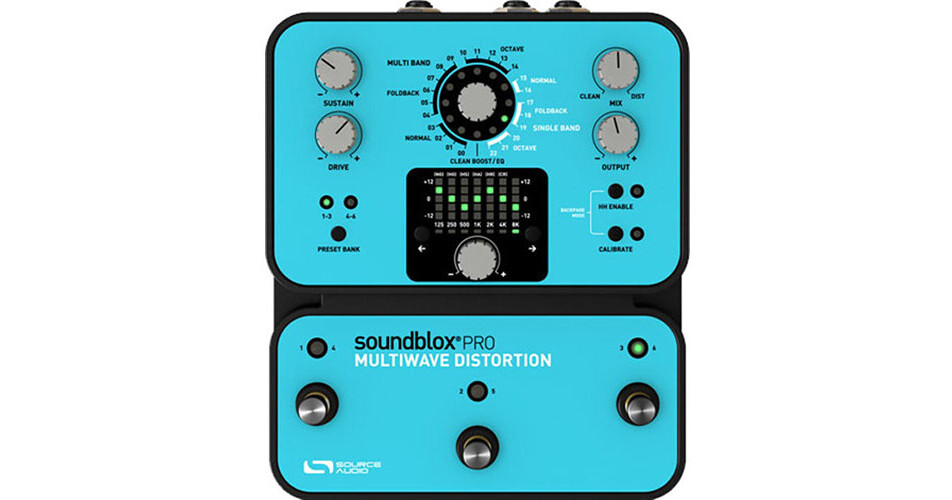
Designed for electric guitarists, the Source Audio Soundblox Pro Multiwave Distortion Pedal provides 23 distortion effects, as well as a clean boost for utilizing the pedal’s extensive tonal parameters without seeking extra gain (a particularly suitable feature for clean lead breaks and solos). Sounds can be saved in six user presets, three of which can be engaged at any time with the onboard footswitches. These switches also allow you to bypass the effects completely, or to save edited presets and store them in the pedal’s memory.
The pedal sports both multi-band and single-band distortions, using 56-bit DSP architecture and 24-bit conversion on the AD/DA to achieve these effects. Yet despite these digital processes, the pedal provides active analog bypass, which ensures your signal is fully routed around the DSP with no signal degradation when disengaged.
A word on the tones provided: In multi-band, the input signal is split into 10 discrete frequency bands, with each one distorted independently and recombined at the output signal; single-band processing, on the other hand, mimics more traditional analog distortion effects. These two processes are further segmented into three genres: "Normal" for more traditional distortion within each category, "Foldback" for synth-like, aggressive fuzz distortions, and "Octave," which elicits unconventional harmonic saturation an octave above the notes you’re playing. Thus, the pedal can provide a plethora of possibilities for your pedal rig. A DC power supply is included with the pedal.
Signal can be split into multiple bands and distorted individually for sound clarity.
The unit features Source Audio’s 56-bit Digital Signal Processor—the SA601—and crystal clear 24-bit converters.
7-band Equalizer for in-depth tone control.
Expression input allows you to morph timbres between preset sound banks.
A MIDI input provides external access to presets and parameters.
Hot Hand enabled; for use and can be used with any Hot Hand motion sensor to extend the capabilities of the unit.
Active analog bypass is fully routed around the DSP and active input ensures no signal degradation.
9 VDC power supply included.
DRIVE: Controls the amount of distortion gain applied to the signal.
EFFECT KNOB: Selects the type of distortion.
EQ KNOB: The equalizer knob changes the value of the selected band up or down in 1 dB steps.
MIX: Adjusts the mix of distorted signal to clean signal.
OUTPUT: Adjusts the output level of the effect.
BAND SELECT LEFT and RIGHT: These two buttons on either side of the EQ knob select which frequency band you’ll process with the EQ.
PRESET BANK: This pedal presents six user presets in two banks; you can select the preset bank with this button, at which point all three presets will be available via the three footswitches.
HH ENABLE: The Hot Hand enable button enables or disables Hot Hand control for the selected preset; This way, Hot Hand control can be set up for an individual preset and can be left off for the others
CALIBRATE: Pressing this button will turn on calibration mode, which allows you to set a zero point for an attached Hot Hand sensor; please note that calibration can only be enabled when HH Enable is on.
FOOTSWITCHES: These switches allow you to select among three presets with your feet, though you can also bypass the pedal by pressing any of these footswitches twice; please note, however, that all changes to presets will be lost if you switch presets—or go into bypass—without saving first (saving is as easy as pressing and holding a footswitch down).
MULTI-BAND FOLDBACK 4–9: The use of foldback in these settings creates more extreme distortion sounds. The higher-numbered effects have more foldback creating even more distortion. Power chords will work well with these modes.
MULTI-BAND OCTAVE 10–14: Settings 10 and 11 give the purest octave effect. Settings 12 through 14 also have foldback and can elicit unconventional tones. The responsivity of these modes all you to dial down the guitar volume knob for a different range of sounds.
SINGLE-BAND NORMAL 15–16: These two settings are conventional, single-band distortion sounds.
SINGLE-BAND FOLDBACK 17–19: With the entire guitar signal processed through a single foldback distortion curve, there will be much more intermodulation-type distortion produced. Long sustained notes and unison bends work well in these modes.
SINGLE-BAND OCTAVE 20–22: 20 is the purest single-band octave effect, while 21 and 22 include some foldback.
CLEAN BOOST: This setting bypasses the Drive knob and will not provide any distortion. The Tone and Output knobs still apply although there is no compression. The most common use for this setting is to have a preset that gives you clean signal boost with some tonal adjustment. This is also useful for when you want to morph from a clean sound to a distorted sound using an expression pedal.