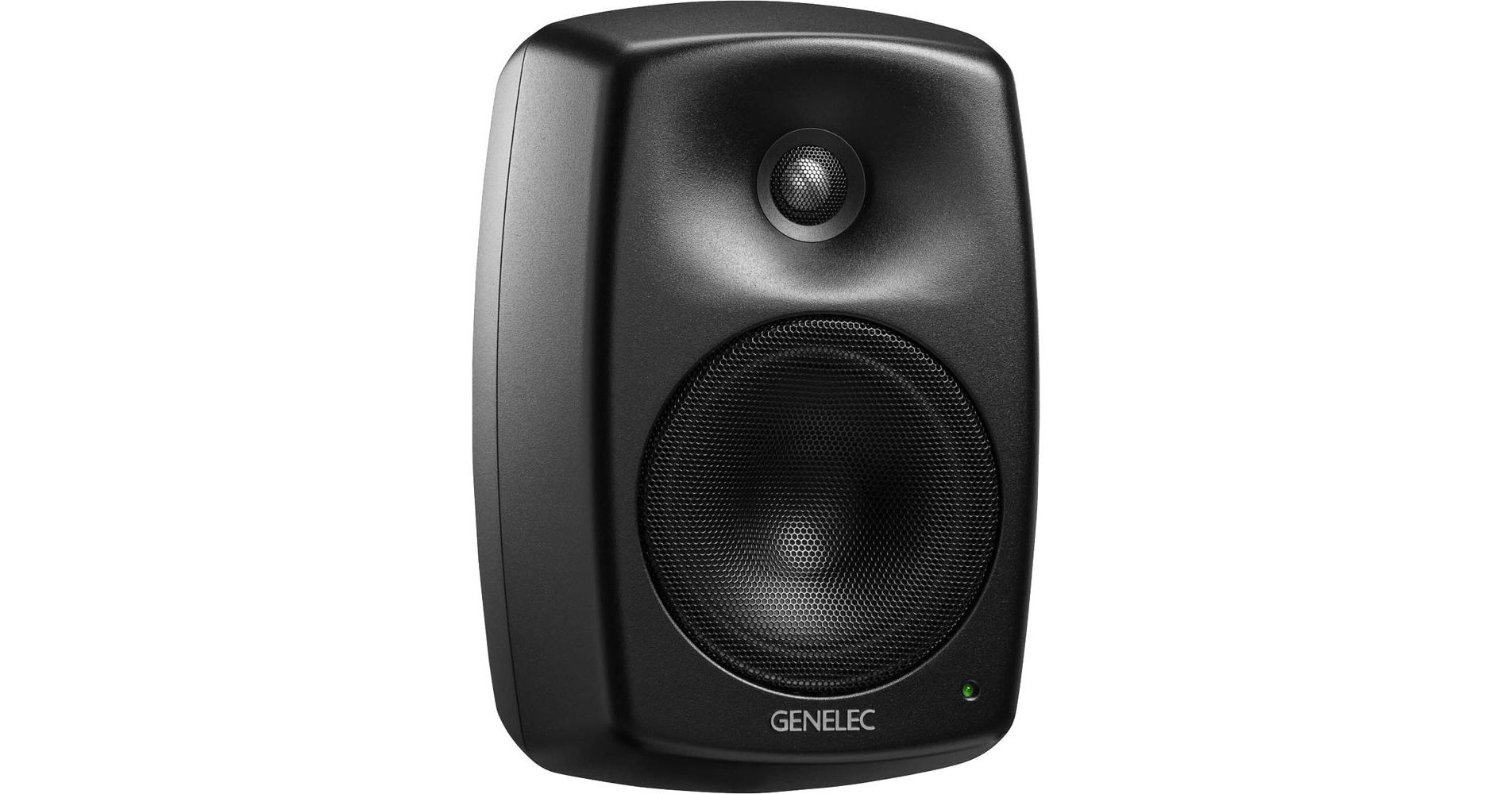
Styled in a mystic black finish, the Genelec 4030C is a single, bi-amplified installation speaker designed to produce precise, intelligible sound quality in even the most challenging acoustic spaces. This compact speaker delivers clarity, reliability, and adaptability.
The speaker features 100W of Class-D amplification driving a 5.25” woofer and 3/4” metal-dome tweeter, producing a frequency response of 54 Hz to 20 kHz with a max SPL of 110 dB. The rear panel features a balanced, analog Euroblock input and several dip switches for adjusting the speakers tonal balance for the best possible sound in your environment. The 4030C includes a power cord, simple bracket, mounting hardware, and a block connector.
At a Glance
- Highly efficient dedicated Class D power amplifiers, one for each driver
- Switched-mode power supply technology offering high SPL output
- Active crossover filter
- Electronic system protection
- Balanced analog line input
- Flexible room acoustic compensation tool set built-in
Directivity Control Waveguide (DCW)
- Flat on and off-axis response for wider usable listening area.
- Increased direct-to-reflected sound ratio for reduced control room coloration.
- Improved stereo and soundstage imaging.
- Increased drive unit sensitivity up to 6 dB.
- Increased system maximum sound pressure level capacity.
- Decreased drive unit distortion.
- Reduced cabinet edge diffraction.
- Reduced complete system distortion.
Minimum Diffraction Enclosure (MDE)
- The DCW waveguide has been integrated in the MDE aluminum enclosure to provide improved control of the loudspeaker’s directivity. Basically, the low-frequency limit for constant directivity is determined by the size of the waveguide, so the larger the surface, the better the control. With a very controlled off-axis radiation, the listening window becomes consistent, which is of utmost importance with multi-channel audio monitoring.
- Controlled directivity also reduces possible first order reflections on surfaces near the loudspeaker, helping to provide consistent audio reproduction in different acoustical environments. In fact, the entire front baffle is gently curved and the acoustically transparent grilles are part of the outer cabinet aesthetics, blending perfectly with the various other curved surfaces.
Advanced Reflex Port Design for Extended Low-Frequency Response
- Both driver and vent contribute to the total radiation of a reflex enclosure. Most radiation comes from the driver, but at the vent-enclosure resonant frequency, the driver displacement amplitude is small and most of the radiation comes out of the vent.
- To minimize the air speed in the tube, the cross-sectional area of the vent should be large. This in turn means that the vent tube has to be long, which presents quite a design challenge.
- The long, curved tube maximizes airflow, so deep bass can be reproduced without compression. The reflex tube terminates with a wide flare located on the rear of the enclosure, minimizing port noises and providing excellent bass articulation.
- The curvature of the tube has also been carefully designed to minimize any audible noise, compression, or distortion. The inner end of the tube has proper resistive termination to minimize once again audible chuffing noise and air turbulence.
- Proper reflex port design also allows to significantly reduce the woofer’s displacement, improving the linear low-frequency output capacity.
Room Response Compensation for Precise Performance
The interaction between room acoustic and loudspeaker radiation is complex. Each room changes the monitor's response in a unique way, e.g. reflective vs. damped rooms, or placement against a wall vs. on a stand away from the walls.
- Bass Roll-Off
- Bass Tilt
- Treble Tilt
Optimized Amplifier for Each Driver
- The power amplifiers are directly connected to the speaker drivers, maximizing the control exerted by the power amplifier’s damping on the driver’s voice coil, reducing the consequences of dynamic changes in the driver's electrical characteristics. This may improve the transient response of the system.
- There is a reduction in the power amplifier output requirement. With no energy lost in the passive crossover filter components, the amplifier power output requirements are reduced considerably (by up to 1/2 in some cases) without any reduction in the acoustic power output of the loudspeaker system. This can reduce costs and increase audio quality and system reliability.
- No loss between amplifier and driver units results in maximum acoustic efficiency.
- Active technology can achieve superior sound output vs. size vs. low-frequency cut-off performance.
- All loudspeakers are delivered as a factory aligned system (amplifiers, crossover electronics, and enclosure-driver systems).
Active Crossover
- The frequency response becomes independent of any dynamic changes in the driver's electrical characteristics or the drive level.
- There is increased flexibility and precision for adjusting and fine-tuning each output frequency response for the specific drivers used.
- Each driver has its own signal processing and power amplifier. This isolates each driver from the drive signals handled by the other drivers, reducing intermodulation distortion and overdriving problems.
- The ability to compensate for sensitivity variations between drivers.
- The possibility to compensate for frequency and phase response anomalies associated with a driver’s characteristics within the intended passband.
- The flat frequency response of a high-quality active loudspeaker is a result of the combined effect of the crossover filter response, power amplifier responses, and driver responses in a loudspeaker enclosure.
Sophisticated Drive Unit Protection
- Reduces the output level when required, (e.g. when driver voice coil temperature reaches the safe limit), which highly improves system reliability.
- Appropriate protection circuitry design in every loudspeaker and subwoofer enables the maximization of system output sound level.
Intelligent Signal Sensing (ISS)
The Intelligent Signal Sensing, ISS circuitry tracks the signal input of the loudspeaker and detects if it is in use. If the ISS circuit does not find any audio on the input for a period of time, it sets the loudspeaker to a low-power sleep state and the loudspeaker will consume less than 0.5 watts. When an input signal is detected, the loudspeaker immediately turns itself on.
Versatile Mounting Options
On the base of the loudspeaker is a 3/8" UNC threaded hole compatible with a standard microphone stand. On the rear, there are two M6x10mm threaded holes for Omnimount size 20.5 brackets or the keyhole wall mount adapter provided with the loudspeaker.