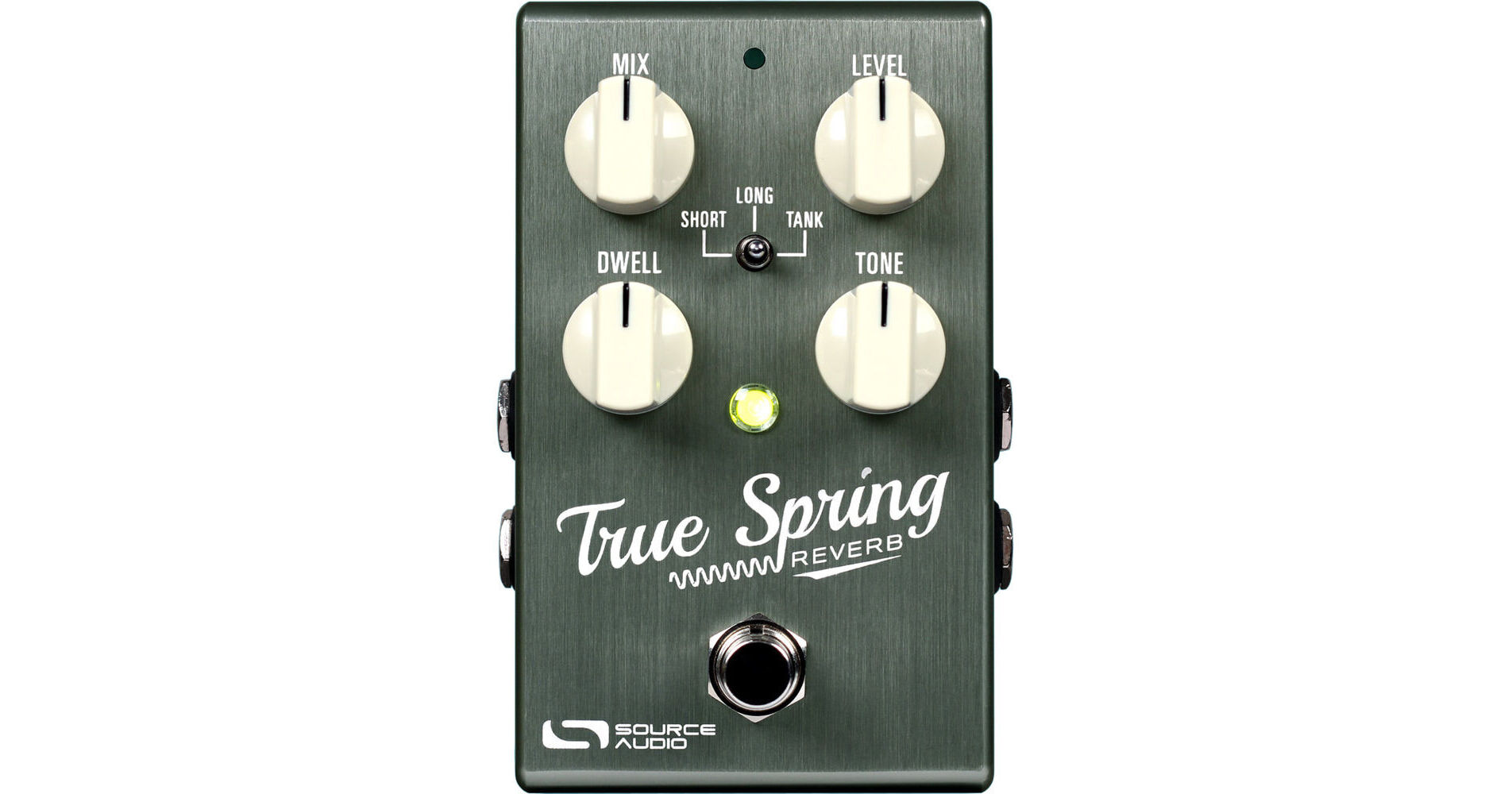
Add both vintage spring reverb and pulsing tremolo effects to your arsenal in a single pedal with the One Series True Spring Reverb Pedal from SOURCE AUDIO. The pedal's 56-bit DSP effect engines are meticulously crafted to recreate spring reverb effects based on the original transducers and spring coils created by the Hammond Organ Company and made famous when incorporated into Fender amps. Three different spring reverbs types are available for you to choose from.
In addition, the pedal allows you to combine any of these iconic spring reverbs with any of the pedal's three tremolo effects. The True Spring's tremolos are the same organic effects that originally appeared in SOURCE AUDIO's award-winning Vertigo Tremolo pedal.
The compact and durable pedal offers brushed aluminum housing, stereo inputs and outputs, and a simple control surface. A three-position toggle switch and four knobs allow you to tweak both the reverb and tremolo engines for customizable results. The Control Input button toggles between adjusting the two effects.
Additional setting adjustments can be made from your mobile device via the free Neuro Mobile app for iOS and Android phones and tablets. When combined with the Neuro Hub (available separately), the True Spring also features full MIDI functionality. Power is supplied via the included 9 VDC power supply.
- Three distinct spring reverb and tremolo effects.
- Two modes of operation: Use the pedal in Standard mode for a classic (nonpreset) stompbox experience, or turn on Preset mode, and save a user preset (including reverb/tremolo effects and knob positions) to each of the three toggle switch positions.
- Flexible stereo routing: The True Spring is equally at home in a mono or stereo rig. The pedal’s stereo inputs and outputs offer a variety of routing options such as stereo to stereo, mono to mono, mono to stereo, stereo sum to mono, and external loop mode.
- Universal bypass: Select Active Analog (Buffered) or True Bypass.
- Secondary tremolo controls: Press and hold the Control Input button to access the True Spring's tremolo effects (Dwell knob controls tremolo depth, Tone knob controls tremolo ratre, toggle switch selects tremolo type).
- Expression control: Compatible with SOURCE AUDIO expression pedals and the Hot Hand 3 Universal Wireless Effects Controller. Assign up to three simultaneous parameters with editable depth and direction.
- External tap tempo: Use the tap switch to tap in the tremolo rate with a choice of four different beat divisions (quarter, eighth, triplet, and sixteenth).
- External tremolo engage and bypass: Use the tap switch to engage or disengage the tremolo effects on top of an active spring reverb.
- Includes 9 VDC power supply.
- Short Spring Reverb: Modeled after the unmistakable twang of blackface amplifiers of the 1960s after extensive research yeilding tremendous diversity in the spring reverb sounds of a variety of amps. Some offered a tighter, less animated tone while others sounded drippier, with longer sustain and livelier reverb trails. The Short Spring reverb engine offers a taut sound with a quick decay and smooth trails.
- Long Spring Reverb: Produces long and deep reverb decays with noticeable drip and highly animated trails. The Long Spring engine is not as dramatic as the Tank reverb engine, but does offer an extremely authentic representation of some of the livelier reverb tanks found in vintage combo amps.
- Tank Spring Reverb (Outboard Spring): Captures the unmistakable effect of the tube-driven outboard spring tanks of the '60s. The sound of reverb tanks like the classic Fender 6G15 are characterized by their drippy attack and animated trail. This original two-spring design produces a bouncing, delay-like sound, inseparable from the early days of surf rock and spaghetti western soundtracks.
- Opto Tremolo: Optical tremolo (a.k.a. photocell tremolo) is the effect found in many combo amps of the 1960s. This version of tremolo relies upon a neon light bulb and a light-dependent resistor called an optocoupler. The nonsymmetrical aspects of the light and the optocoupler give the tremolo a distinct choppy character.
- Harmonic Tremolo: This unique effect first appeared in Fender Brownface amps made between 1959 and 1963, which alternately modulated the levels of bass and treble frequencies in the audio signal. The result is a very pleasing and complex tremolo that has characteristics reminiscent of a phaser.
- Bias Tremolo: This approach to tremolo involves using an LFO to modulate the bias voltage of the tubes in an amplifier. This essentially pushes the tubes in and out of saturation. The result is a smooth amplitude modulation with a mild overdrive created by the tube saturation.