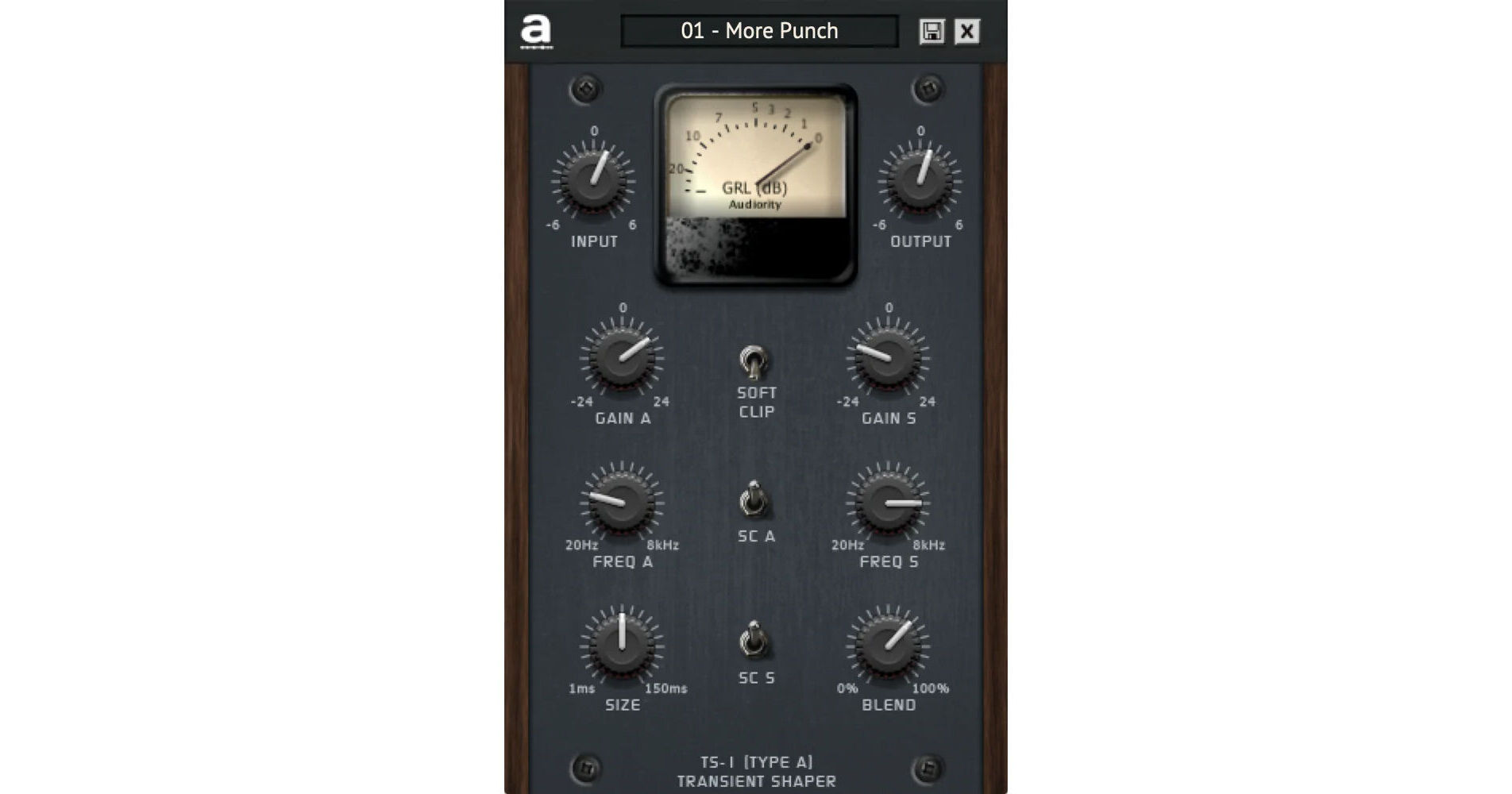
Audio engineers and music producers looking for a modern transient shaper will be impressed with Audiority TS-1, a multimode frequency-dependent transient-shaping plug-in that's designed to manage the attack and sustain of an incoming audio signal. The TS-1 employs a compression-by-saturation technique that adds warmth and punch to drum tracks without losing dynamics.
The TS-1 features two separate detection circuits for attack and sustain, whose signals can be filtered to improve the detection (SC filtering) or to color the processed audio. Like tape saturation, a soft clipping circuit with gently saturate and compress the signal. The plug-in offers two distinct modes. Type A retains the original TS-1 algorithm, while Type B features inverse envelope curves on negative gain values. The plug-in is Mac and Windows compatible and works within most major DAWs that support VST2, VST3, Audio Units, and AAX formats.
- Attack and sustain circuits
- Soft clipping
- Processed sidechain signal filtering
- Signal blend
- Double mode: Type A and B
- Reversed envelopes (Type B only)
- Input / Output: ±6 dB gain for pre-processed and post-processed signal.
- Gain A / S: Type A: ±24 dB gain for detected attack/sustain signal. Type B: like Type A, but on negative values the detected envelope signal is reversed then amplified.
- Freq A / S: Highpass filtering of either the detected attack/sustain signal or the incoming preprocessed audio signal.
- SC A / S: Turn the switch up to filter the processed audio signal and color the mix, or turn the switch down to remove unwanted frequencies from the sidechain (preprocessed) signal—this will not affect the frequencies of the processed signal, but will help the detection circuit catch the correct transients to be processed.
- Soft Clip: Enable the soft clipping circuit that will gently saturate and compress your signal in a similar way to a tape saturation.
- Size: Set the transient size for both the attack and sustain circuits—can be seen as a Hold parameter.
- Blend: Mixes the original and processed signal.
- Type (bottom label): Switch between two different algorithms. Type A is the original TS-1 mode, while Type B is brand new featuring reverse envelope curves on negative gain values.