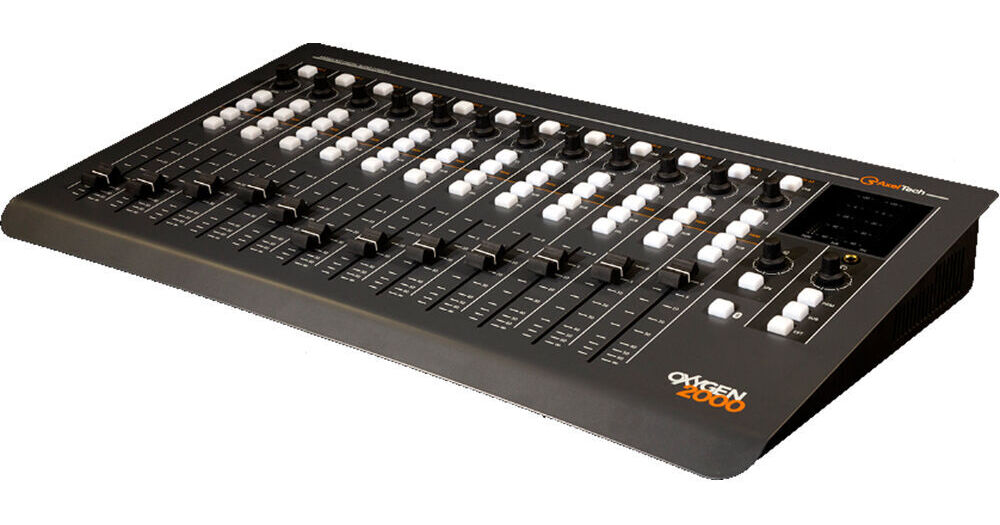
Radio stations in search of a professional-grade digital broadcast mixer will be impressed with the Axel Technology Oxygen 2000 , a fully digital broadcast console that's designed for on-air and production work. The mixer features 12 compact faders, five microphone inputs with automix, and a powerful internal audio routing with a wide range of controls and I/O in a rugged and classy steel chassis.
The integrated digital signal processing delivers high-end quality with the latest features and flexibility. The console is as reliable and easy-to-use as an analog mixing console. The Oxygen 2000 features low latency, users preset, smart keys, EQ, compressors, telephone hybrid, HDMI output, analog and digital I/O, and USB. Oxygen 2000 can be remotely controlled through a dedicated application.
- Fully digital broadcast console for radio broadcasting with 6 faders
- A/B fast source switch buttons for each fader
- 4+1 busses (PGM, SUB, Aux1, Aux2, PFL)
- Near 0 latency (< 0,7 ms I/O)
- Digital signals routing via the 48×48 internal matrix
- Complete remote control by means of an application replicating the surface
- Remote configuration and maintenance via Web interface
- User-definable presets & snapshot
- 5-band fully parametric equalizer on every input
- Dynamic processor with expander and compressor section on each microphone input
- Advanced and configurable monitor facilities for control room and studio
- Customizable RGB colored buttons
- High-resolution (120 LEDs) meter bars for outputs
- HDMI out for console status display
- 2 timers (ctrl-room and studio microphones timers on HDMI monitor)
- Talk Box for guest and presenter (optional)
- 5 microphone inputs with Automix
- 4 stereo analog inputs
- 4 stereo analog outputs
- 1 built-in telephone hybrid
- 1+4 telco interface with GPIO
- 1 digital out (AES/EBU)
- 2 USB audio interfaces (disabled with Dante option installed)
- 8 stereo inputs + 8 stereo outputs via Dante (optional)
- 5 microphone inputs with Automix
- Mic 1 on XLR, Mic 2-5 on RJ45, all balanced with + 48V phantom power and GPIO
- Independent On Air lights and cut off control, when opening control room and studio microphones
- PFL button switches to private conversation on Hybrid/Telco/Bluetooth mode
- Enable Talkback feature on any studio or control room microphone
- Parametric Compressors/Expander (drive, threshold, attack time, release time) for microphone and mono inputs
- Save and recall microphone presets, including Compressor/Expander settings
- Phase inversion on microphone inputs
- Mono inputs assignable as EXT source
- Ducking / AutoFader assignable to all sources (automatic attenuation of music on speech)
The function adds, to the existing sources, a new source called Automix, which is the sum of all enabled microphones
The Automix source has all the features of a microphone source such as:
- Studio/control room loudspeakers control
- Studio/control room light control
- Can be used as audio in private mode for phone calls
Using this new source, the user can manage in a very simple manner all the microphones of the studio with a series of benefits:
- Just 1 fader for the management of studio microphones
- A dedicated AGC section for each microphone input automatically adjusts the correct level
- Automatic management of attenuation on microphones not in use, simulating a slight closure of the fader
- Final compressor that allows an automatic leveling of the Automix source
- Possibility to use the microphones individually
This feature further simplifies the work of the mixer engineer, even in the case he/she is also the host of the show
Available settings in the Automix menu:
- MIC-1 ON/OFF
- MIC-2 ON/OFF
- MIC-3 ON/OFF
- MIC-4 ON/OFF (only for consoles with 5 Mic)
- MIC-5 ON/OFF (only for consoles with 5 Mic)
- Idle Mic Attenuation
- Attenuation Attack Speed
- Attenuation Release Speed
- Compression Threshold
- Compression Ratio
- Compression Attack Speed
- Compression Release Speed
- Autogain Speed
- Autogain Max Gain
- Autogain Max Attenuation
- Line stereo inputs: 4
- Balanced on XLR for line 1, balanced on RJ45 for line 2-4
- Channel mode selection: Stereo, Mono, L, R, INV-L, INV-R, INV
- Stereo-1 & DANTE-1 inputs can be configured as 4 Telco Inputs
- 2 built-in stereo USB (Type-B) I/O audio interfaces allow to directly connect the PC to the Oxygen 2000 console, with no need for audio cards
- In fact, the PC detects each of the console USB as a digital audio card with 1 stereo inputs and 1 stereo outputs for simultaneous playout and recording
- Telephone Hybrid: 1 POTS/PSTN telephone line with Line.In and Tel.Set connection
- Telco: 1 in/out N-1 to connect external telephone hybrid with control via TLC/GPIO
- 4 mono additional Telco can be obtained configuring analog inputs (Stereo-1 & DANTE-1) and (OUT-2 & DANTE-1) stereo outputs.
- GPI and GPO management on all 5 Telco channels
- RING and HOOK on F1 key for each TELCO channels
- N-1 on Telco outputs for all BUS (PGM, SUB, AUX-1, and AUX-2)
- OUT-1 – XLR – fixed as PGM
- OUT-2 – XLR – by default assigned as SUB
- OUT-3 – RJ45 – by default assigned as AUX-1
- OUT-4 – RJ45 – by default assigned as AUX-2
- OUT-2 stereo output can be configured as N-1 to achieve up to 2 mono additional Telco
- OUT-1 & OUT-2 outputs are both equipped with a GPO
- OUT-2-4 outputs: can be configured as studio presenter and studio guest headphones
- Unbalanced outputs: 2 line out on jack 6.3 for control room headphones
- Adjustable maximum control room and studio speakers volume (studio speaker only via SW)
- Adjustable maximum control room and studio headphones volume (studio headphones only via SW)
- Adjustable CUT or attenuation mode (-40, -30, -20, -10 dB) on control room and studio speakers
- Independent source selection (PGM, SUB, AUX1, AUX2, EXT) for control room and studio speakers, control room and studio headphones with or without PFL
- Independent Talkback management on control room and studio speakers
- Independent Talkback management on control room, studio headphones
- Same source selection for control room and studio headphones, with independent level
- GPI: 9 in total, for Talkback, Telephone Hybrid or other features
- GPO: 9 total, to control On Air lamps or provide HOOK and RING commands for external telephone Hybrid
- User custom GPIs (e.g. Ring, Talkback, channel ON/OFF, etc.)
- User custom GPOs (e.g. Hook/ON AIR, Studio-Light, Control Room-Light)
- Automatic firmware update via Internet
- WEB UI for console configuration and service features (save, restore, update, logs, etc.)
- Save and recall EQ presets (up to 10)
- New real-time EQ algorithm with graphic
- Fast and accurate LED meters display
- Save and recall control panel configuration with 10 Snapshots
- Save and recall total console configuration. The configuration can be saved to internal memory (microSD), USB and PC (via WEB interface)
- Gain adjustment knobs with adaptive speed
- Dimmable buttons light
- Adjustable fader ON/OFF threshold (from -50 to 0 dB)
- Audio input source levels
- 4+1 BUS output levels
- A/B source names assigned of 10 channels
- Display On Air sources
- Microphone on timer (control room & studio)
- Large Clock
- Audio output level (loudspeakers & headphones)
- On Air microphone
- Telephone active
Configure, for configuring all of the device features:
- HDMI output combined with 4 rotary knobs allow the fast and intuitive programming of all the mixer parameters
- The programming GUI has been designed in order to be very easy and intuitive
- Selectable home page layouts are available, with many theme icons
- The built-in telephone hybrid allows direct connection of a telephone line POTS/PSTN on RJ-11C
- The audio is processed via DSP that delivers a state-of-the-art audio processing
- It’s also available a Telco N-1 in/out, to connect Oxygen 2000 to an external telephone hybrid
- The Telco N-1 is always available on RJ45
- TLC commands are available on the same RJ45 with Hook and Ring interface
- TLC commands for Telco-2-5 are available and configurable on GPIO-DB9 connector with Hook and Ring