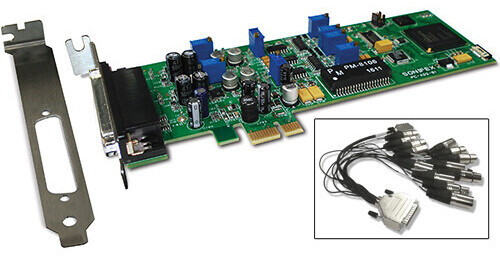
Ideal for audio workstations and recording studios, the Sonifex PC-AD2 is a professional PCIe half-height sound card that provides two stereo AES-3 I/O and two stereo balanced analog audio I/O for use in a Windows computer. One of the analog inputs can be used as a mic input with 48V phantom power. There is a dedicated AES-11 sync input and two GPIOs. The PC-AD2 is fully compatible with the Windows Wave, DirectSound, DirectShow, MCI, and Core Audio APIs, supporting audio up to 24-bit / 192 kHz. It is supplied with a Windows WDM driver to provide full sound-card functionality on Windows 7, 8, 8.1, and 10, and Windows Server 2008 R2, 2012, and 2012 R2. Many of the modern, smaller Windows systems only have space for half-height PCIe cards. The PC-AD2 card has been designed with this in mind, allowing a high channel count in a small format card.
- 2 independent, transformer-coupled stereo AES-3 inputs and outputs.
- 2 independent, high-level balanced stereo inputs and outputs.
- One of the stereo line inputs can act as a dual-mono or stereo-mic input with +48V phantom power and limiter.
- Simultaneous record/play per channel.
- 1 AES-11 synchronization input.
- 2 opto isolated GPIOs.
- 24-bit audio resolution.
- Sampling rates up to 192 kHz.
- Asynchronous sampling rate converters on each input.
- Card synchronization to any input, AES-11 input or other PC-AD2 card.
- 32- and 64-bit drivers for Windows 7/8/10, Windows Server 2008/R2, 2012/R2.
- WDM-compliant supporting Wave, DirectSound, DirectShow and Core Audio APIs.
- Compact PCIe half-height format
- The PC-AD2 has two stereo analog inputs (the first of which can be used as a dual-mono or stereo-microphone input) and two stereo analog outputs, two stereo AES-3 inputs and two AES-3 stereo outputs, a dedicated AES-11 sync input, and two general purpose (GPIO) inputs and outputs.
- When acting as a microphone input, phantom power can be applied at +48V to the microphone input connection, but is removed if Line Input 1 becomes active. An audio limiter on the mic input automatically reduces the microphone gain if the recording level approaches clipping.
- The peak analog level sets the clipping threshold for the analog inputs to one of the following settings: +15, +18, +20, +22, or +24 dBu. With the Windows endpoint faders set to maximum, these levels correspond to full scale on the software audio streams.
- The card’s core sampling rate can be synchronized to an external source chosen from either of the AES-3 inputs, the dedicated AES-11 sync input, or by using the optional inter-card cable (PC-AD2SY) for synchronizing to another PC-AD2.
- Independent asynchronous sampling-rate conversion on the inputs supports rates from 32 to 192 kHz, while the output rate can be configured as 192, 96, 88.2, 48, 44.1 or 32 kHz, either free-running or locked to an AES11 reference on any of the digital inputs. Software sampling-rate conversion is automatically inserted by Windows when the application rate does not match the hardware rate, ensuring that files of any sample rate can be played and recorded. Extended software bit depths of 32- and 24-bit are supported as well as 16- and 8-bit for playback and recording. For each AES-3 input, the received sampling rate, frame lock, and sampling-rate converter status is visible.
- The playback and recording topology is virtualized because Windows treats each input source as its own endpoint. Endpoints are the physical audio sources and destinations such as microphones, speakers, and line connectors. Each of the PC-AD2 card’s physical line inputs is represented by an endpoint device, and since the hardware has separate A/D converters or AES-3 receivers for each one, these inputs can be used simultaneously. A microphone endpoint is created, which is shared with endpoint analog Line Input 1. The Windows mixer API is virtualized for each application, providing just a mute and volume control for each endpoint, affecting only the audio going to and from that application.
- The PC-AD2 has two optically isolated general-purpose inputs and outputs, which are accessed through a programming API supplied with the driver package. A demo program is included with the driver package to illustrate the operation of the GPIO API and to quickly test the GPIO functionality.
- All the standard Windows audio APIs are available including the Core Audio API, Wave, DirectSound, DirectShow, MCI, and MIDI playback, as are a variety of audio-compression modes via the Windows Audio Compression Manager or other software compression systems.
- Multiple cards may be installed in a single PC.
- A 44-pin high-density D-type connector to XLRs and 9-pin D-type breakout cable are offered as connection options—the PC-AD2BC.