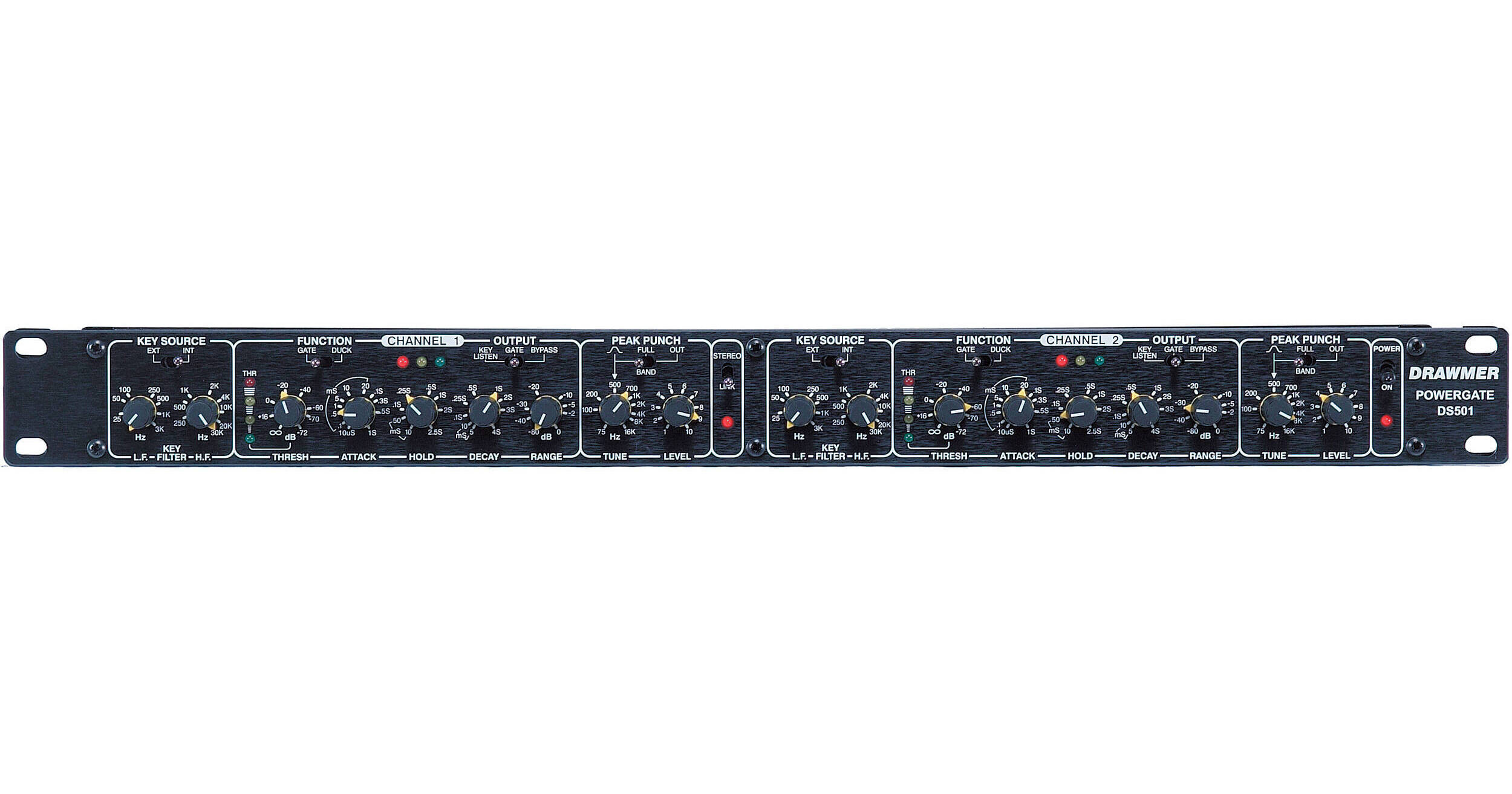
Positioned above the DS201 in Drawmer's range of industry-standard noise gates, the DS501 is a sophisticated, dual-channel noise gate with full AHDR envelope controls and, for the first time, a highly programmable Peak Punch function that lets you add transient punch to the leading edge of the envelope, fattening drums and dynamically adding emphasis to select frequencies. The DS501 doesn't stop there; you get plenty more controls with selective gating or ducking for VO applications or the removal of clicks and pops, stereo channel linking for gating two channels from one source, and much more.
With variable high- and low-pass filters, you can adjust your gating to act on high- or low-frequency material, passing through only what you want, and rejecting unwanted frequencies, such as bass drum rumble or spillage from hi-hats. Comprehensive key input facilities allow you to choose between external and internal key sources as well as a Key Listen function that lets you process output signals with the key filter. The DS501 has an internally switched power supply for global compatibility, and includes an AC power cord to get you started.
In tuneable mode, a fully variable frequency selector with a range from 75 Hz to 16 kHz allows the user to shape the transients of the gated signal and tune in to the particular area of the audio spectrum where the Peak Punch is to be active. In addition, a variable More control allows the user to tailor the amount of processing. A secondary Full-Band Peak Punch mode is also available.
- Int: this switch causes the gate to respond to the dynamics of the signal being processed
- Ext: in this position, an external audio signal fed to the key input is used to control the gate, allowing one sound to gate another
- Key Listen: this allows the effect of the key filters on the program material to be heard at the output
- Gate: this switch position is selected for normal gate use; the filters only affect the way the unit responds to the incoming program material, with no effect on the output
- Bypass: this position routes the input signal to the output with no processing