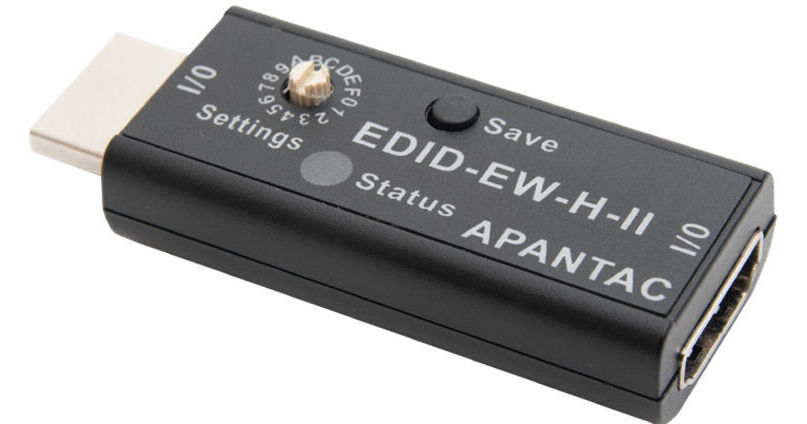
This second-generation HDMI Bidirectional EDID Emulator and Learner from Apantac features bidirectional HDMI 2.0 ports and five pre-installed EDID. The device can learn and store desired EDID from displays in up to UHD 4K resolutions at 60 Hz. The emulator has five preinstalled EDID with the opportunity to save 3 custom EDID. Easily switch between EDIDs with the rotary control and monitor status with the LED indicator. No external power is needed for the passive inline device, which is also HDCP 2.2 compliant.
Ask Our Experts800-952-1815
Hello, Log InAccount & Orders
Key Features
- Supports up to UHD 4K at 60 Hz
- 5 Preinstalled EDID, 3 Custom EDID Slots
- Passive Inline Device
- Bidirectional HDMI 2.0 Ports
This second-generation HDMI Bidirectional EDID Emulator and Learner from Apantac features bidirectional HDMI 2.0 ports and five pre-installed EDID. The device can learn and store desired EDID from displays in up to UHD 4K resolutions at 60 Hz. The emulator has five preinstalled EDID with the opportunity to save 3 custom EDID. Easily switch between EDIDs with the rotary control and monitor status with the LED indicator. No external power is needed for the passive inline device, which is also HDCP 2.2 compliant.
More DetailsApantac EDID-EW-H-II Overview
Apantac EDID-EW-H-II Specs
General
| HDCP Compliance | |
| Video Support | |
| EDID Capacity | |
| LED Indicator | |
| Control |
Inputs/Outputs
| Video I/O |
Power
| Power Source |
Physical
| Color |
Packaging Info
| Package Weight | |
| Box Dimensions (LxWxH) |
Apantac EDID-EW-H-II Reviews
Problem solving product
By Don
Rated 5 out of 5
Date: 2026-02-07
We had an unusual problem with our local cable provider's cable boxes not working well with our company's digital signage system after we had to upgrade from our 10+ year-old cable boxes to the new-generation of cable boxes for our CATV video streaming source. The new cable boxes perform self-maintenance routines, and the HDMI video output is reset, requiring a new sync with the monitor/display to negotiate the proper screen resolution. Since the cable box is not directly connected to a traditional monitor/display, there is no response to the EDID handshake to set the required video resolution format. Using this adapter solves our issue because we can choose the 1080p preset, and it will respond to the cable box and allow the EDID handshake to complete.
Not everything works right out of the box. This did.
By Kevin
Rated 5 out of 5
Date: 2023-10-12
This came in fairly minimal packaging. All I had to do was open the cardboard box and pick it out. I plugged it in between my television and the computer and let it record the EDID, then I plugged it between the computer and the capture card. The Blackmagic capture card which had stymied so many of my attempts to capture a 1080p signal started working the way I wanted it to after inserting this EDID emulator into the chain. The rotary dial, by the way, was fairly resistant to accidental nudges. IT took a bit of effort to get the dial to change its position.
See any errors on this page?