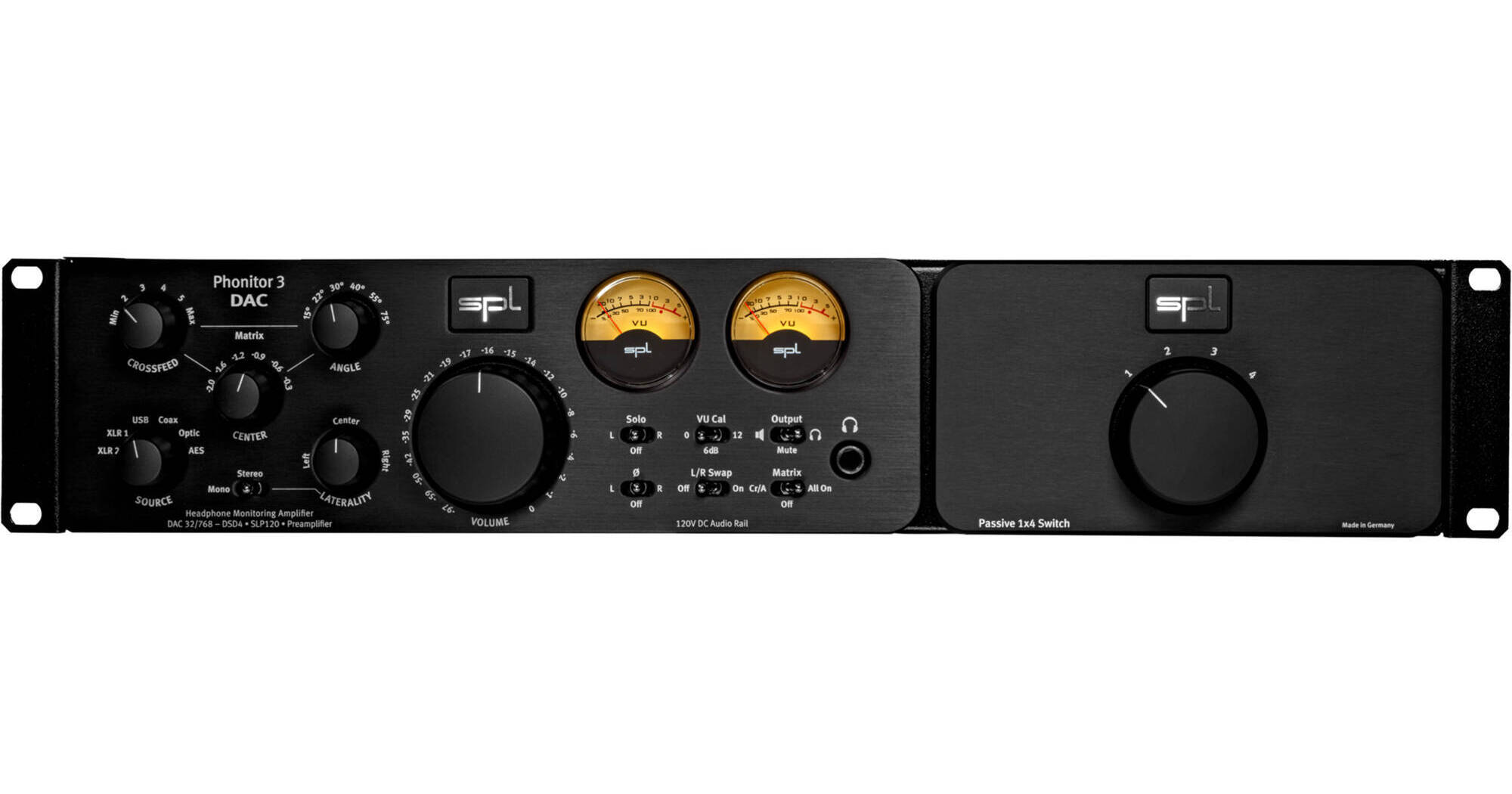
The Phonitor 3 sports a high-quality AKM4490 DAC and the op-amp-based SLP120 low-pass filter for the finest digital and analog audio details. Combined with versatile I/O ranging from analog XLR to digital AES, S/PDIF, and USB connections, you can achieve a blistering, high sample rate of 32-bit / 768 kHz and DSD256 effortlessly. And with 120V technology, the Phonitor 3 delivers greater headroom, dynamic range, and sound quality compared with your average DAC. The Phonitor 3 includes a 19", 2 RU rack expansion with extra connections for up to four stereo speaker pairs and a power cord.
The USB-B input can be used to directly connect the DAW. No driver installation is required for operation with a Mac or an iOS device. Via USB, the Phonitor 3 DAC converts PCM audio signals with a resolution of 32 bits and a sampling rate of up to 768 kHz as well as DSD signals with a resolution of up to DSD256.
This standard is defined under IEC 60958 Type I. Balanced, 3-core, 110-Ohm twisted pair cables with XLR plugs are used for connection.
Therefore, the Phonitor 3 DAC has a unique finely resolved laterality control, which rebalances the stereo image on the monitoring side.The Mono/Stereo switch can not only be used to switch between stereo or mono playback. This switch is also used to activate or deactivate the laterality control.
If the direction is not correct, you usually have to load the sample into the DAW to switch channels before you can judge whether the sample matches the image. With the L/R Swap function, this is no longer necessary. You can now adjust the direction of movement on the Phonitor 3 DAC while prelistening to an audio sample.
If the phase inversion is switched off, the mono signal corresponding to the mid signal is played back. Separate monitoring of the mid and side signals has become a widespread standard for many mixing and mastering engineers.
But the Phonitor Matrix is not only designed for professional use in the studio. It also enables the hi-fi enthusiast to enjoy music on headphones, as if it was played back on speakers.
If headphones have a rather low sensivity, no problem. With DIP switch 1 on the rear of the device, the level at the headphone output can be increased by 12 dB.
This high voltage would destroy conventional components and operational amplifiers. The 120V technology achieves exceptional technical specifications and sonic benefits; technically, in terms of dynamic range, signal-to-noise ratio, and headroom, sonically, in terms of richness of detail and a relaxed listening experience.