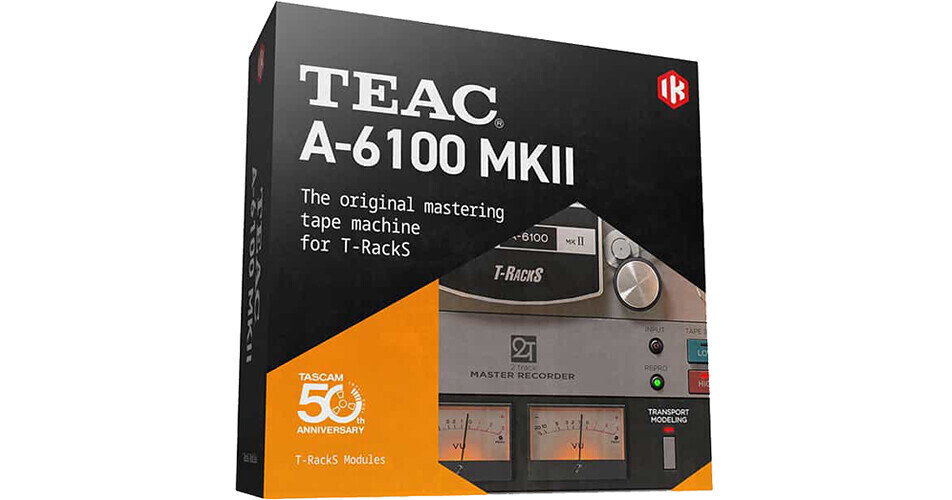
Delivering an incredibly accurate reproduction of the one of the first ever mastering tape decks, TEAC A-6100 MKII from IK Multimedia is a plug-in that provides all of the core technology and warmth of the original tape machine, but with modern additions for the working producer. With an intuitive interface modeled on the original hardware that lets you control features like record bias and EQ, TEAC A-6100 MKII makes it easier than ever to add tape color and subtle saturation to your master bus and more.
Like all IK plug-ins in the TASCAM Tape collection, you can choose your signal path, stereo alignment, and transport modeling, for an ultrarealistic experience. Support for up to 32-bit floating point / 192 kHz sampling resolutions are fully included, along with high-quality oversampling. This plug-in can be used as an individual T-RackS processor module, or as a plug-in for DAWs in AU, VST2, VST3, and AAX formats on 64-bit Windows and macOS platforms.
And so the TEAC A-6100 MKII was born. Indestructible and without compromise on any components, it was a huge success. In fact, the A-6100 with its admirable sound and Simul-Sync technology was the core unit that evolved into the famous 80-8 multitrack. And now this officially certified digital version is here to add its unique sonic textures to your music.
IK’s DSP engineering team then took each stage apart, analyzed them in depth, and produced a model of the entire magnetic tape recording process. This model works in symbiosis with a powerful dynamic convolution engine to capture the essence of the real machines, faithfully bringing the complete picture of these complex analog engineering marvels to the digital realm.
- 911: modeled after the BASF SM911, this is the formula TASCAM recommends for an optimal balance between warmth and precision.
- 456: modeled after the Ampex 456 formula, this model went into production around 1974 and is perhaps the most widely used tape, contributing to what is considered the distinctive tape sound. It offers a warm, round tone with a slight touch of saturation that greatly responds to the recording level.
- GP9: modeled after the Quantegy GP9 formula, this tape accepts higher levels of signal with minimal distortion and compression. It's very punchy and perfect for modern, high-quality analog recordings.
- 499: modeled afte the Ampex 499 formula, this tape is designed to handle a great amount of signal level with minimal distortion and compression. It also exhibits enhanced high-frequency definition that makes it ideal for printing digital-like recordings, while still maintaining an analog sound.
- Signal path selection: With Input, the signal only passes through the input and output electronic stages of the recorders, bypassing the tape. Repro passes your signal through the entire analog recording system, including the recording amp, recording head, tape, playback head, playback preamp, and output stage.
- True Stereo: Even a perfectly aligned tape machine will have slight level, EQ, and distortion differences between the left and right channels, which is a part of the analog process that many seek out. The A-6100 MKII recreates this effect, and also provides the option to disable it for a perfectly matched stereo field.
- Tape Speed: Select the speed of the tape transport between 7.5 and 15 or 15 and 30 ips. With a higher speed, you get more fidelity, while the lower speed offers a warmer, rounder tone.
- Transport Modeling: Precisely models the behavior of the mechanical transport, reproducing the small irregularities in the movement of the tape. Keep this feature on for a convincing analog performance, or turn it off for a perfectly stead performance.
- Record Bias: Ideal bias voltage settings provide maximum sensitivity and low distortion. With this setting you can intentionally overbias for producing a warmer, gently saturated sound, or underbias to get a nice boost to the high frequencies and add distortion or other nonlinear effects.
The T-RackS shell offers a unique modular system with up to 16 processor chains, series and parallel routing, easy A/B/C/D comparison, up to 192 kHz / 32-bit floating point processing, and much more, in both plug-in and standalone mastering applications.