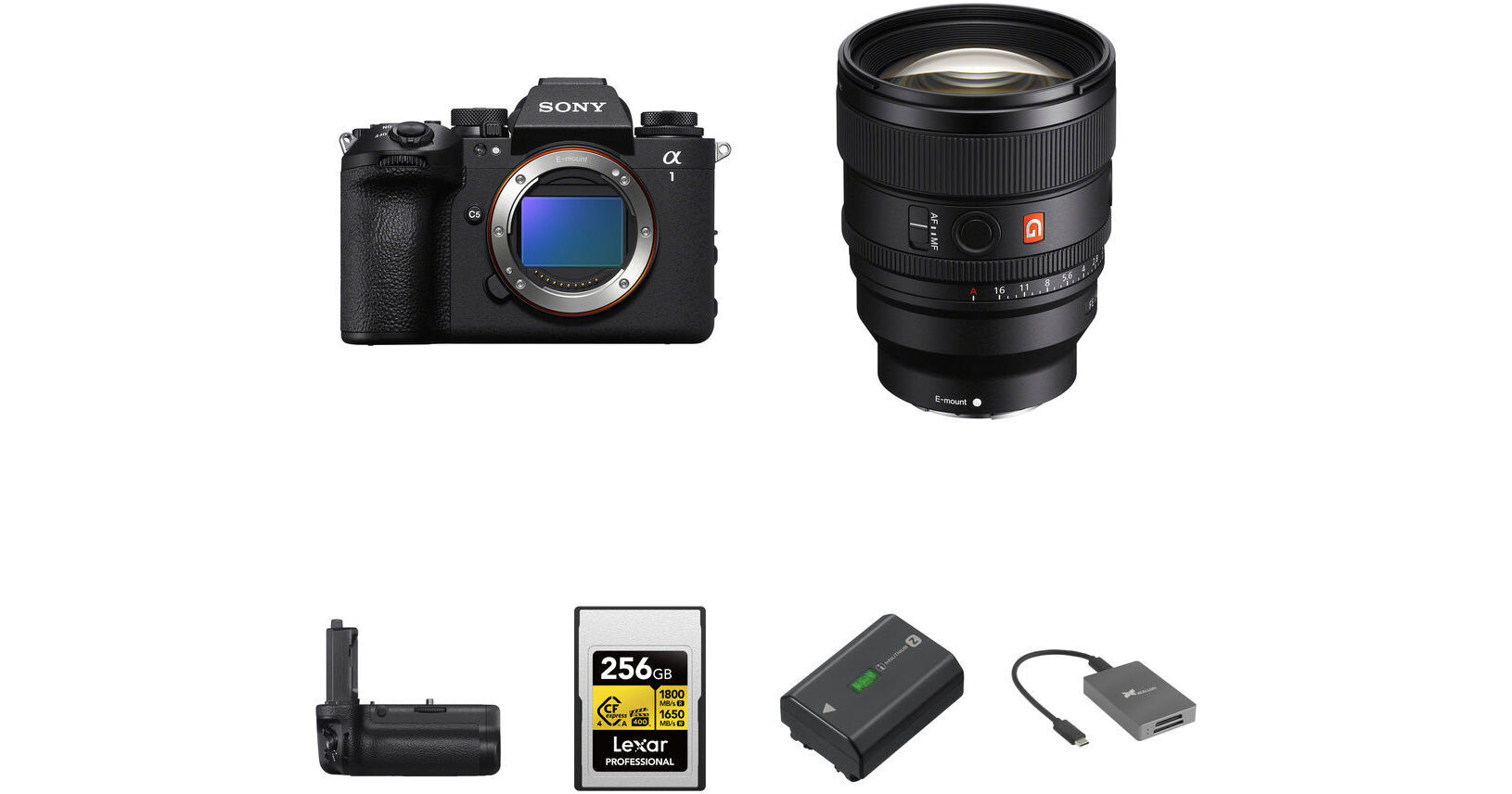


The a1 II brings Sony's best technology from every lineup into one all-encompassing camera body making it the do-anything camera solution for professionals.
- AI Processing Unit-The addition of this key piece of tech greatly improves autofocus, subject detection, and subject tracking accuracy, speed, and reliability. These new processing capabilities allow the camera to more accurately and intelligently recognize subjects, predict their movements, and generally retain critical focus on them as they move.
- Pre-Capture and Speed Boost Functions-These two features are dedicated to continuous burst-style shooting and make the a1 II an even better option for action photographers looking to use this camera in high-end sports, wildlife, and birding situations.
- 8.5-Stop IBIS-It's typical for cameras to have better IBIS figures with each new generation, but the a1 II adds a whopping 3 extra stops to its predecessor's performance, meaning it's possible to use the camera handheld in noticeably dimmer lighting conditions and with slower shutter speeds, opening even more shooting versatility.
- Video Improvements-The core video specs remain the same between the generations, but the a1 II gains some asked-for features to make it even more of a video powerhouse: Dynamic Active Mode Stabilizer, Framing Stabilizer, and Breathing Compensation are all welcomed additions for content creators.
- Overhauled Body Design-The a1 II inherits the a9 III's body design, making it more comfortable to use, more robust in terms of weather-sealing, compatibility with the latest VG-C5 Vertical Grip, and an improved LCD and EVF.
- Up to 30 fps continuous shooting with an electronic shutter, or 10 fps with the mechanical shutter, with AF and AE supported.
- Pre-Capture Shooting records at up to 30 fps for up to 1 second prior to fully pressing the shutter, helping to ensure you don't miss fleeting moments.
- Speed Boost lets you vary your continuous shooting speed mid-burst; when the C5 button is depressed while burst shooting, you can switch from the chosen continuous shooting speed to a faster or slower one to suit the pace of action you're photographing.
- Refined 5-axis in-body image stabilization compensates for up to 8.5 stops of camera shake at the center of the frame and 7 stops at the periphery; an improvement of 3 stops of shake control compared to the original a1.
- Same full-frame 50MP stacked BSI CMOS sensor as the a1, mixing high resolution with the speed and reduced rolling shutter of a stacked design to suit both meticulous and quick-working shooters.
- First seen in the a7R V and a9 III, the a1 II sports a dedicated AI Processing Unit for refined, responsive, and intelligent subject tracking and detection of humans, animals, birds, insects, cars, trains, and airplanes.
- Human pose estimation tracks body and head positions for accurate focus in portraiture and sports settings and Real-time Eye AF performance has been improved by 30%.
- Additionally, human pose estimation can distinguish between multiple people and maintain focus on the targeted subject; even if someone crosses in front, the camera maintains focus on the key person.
- Real-time Tracking benefits from AI-based subject recognition for following moving subjects, making it particularly well-suited to sports and action subjects.
- Auto Subject Recognition modes no longer necessitate selecting a subject type, letting the camera detect and track the intended subject.
- XS and XL focus area spot sizes have been added for more versatility or you can customize AF focus areas to suit uniquely sized or shaped subjects.
- Full-time DMF (Direct Manual Focus) enables using the lens's focus ring for manual focus control at any time, making it easier to switch focus to a different subject even when working with AF.
- Familiar recording formats: 8K 30p with 10-bit 4:2:0 sampling and 4K 120p with 10-bit 4:2:2 sampling. When using a Super 35 recording area, 4K footage can use 5.8K oversampling for improved detail and the full-frame area offers 8.6K oversampling for the 8K footage.
- AI subject recognition, gained from the AI Processing Unit, benefits the Framing Stabilizer mode, which can be used to automatically crop and recompose so the subject remains centered in the image.
- Dynamic Active Mode Stabilization also helps retain accurate framing while filming, especially when recording while walking or moving.
- Included S-Cinetone profile, ProRes RAW output over HDMI, and the ability to import LUTs all point to the great amount of color control the a1 II offers.
- Support for Breathing Compensation mode, which reduces the effects of focus breathing when using select lenses.
- Pre-Capture: The a1 II can be configured to begin recording images to the buffer when the shutter button is half-pressed. Users can set this between 0.03-1.0 second. Upon pressing the shutter these images will be saved to the memory card.
- Speed Boost: With Speed Boost and the C5 button, which is conveniently placed near the grip on the front of the camera, users can instantly switch their camera from their usual continuous shooting frame rate to a faster one to make sure their next shot is just right. Photographers will be able to select various frame rates up to 30 fps.
- The a1 II gains the latest Sony mirrorless body design first seen on the a9 III which includes a C5 custom button on the front of camera body and an enhanced grip.
- For transferring, an upgraded 2.5GBASE-T wired LAN port offers faster transfer speeds to suit high-profile tethered shooting applications. There is also a USB-C port and a full-size HDMI port.
- USB-C port offers fast USB 3.2 Gen 2 speeds of up to 10 Gb/s.
- Dual memory card slots both accept either CFexpress Type A or SD-type memory cards. The dual slot design allows for flexible file saving and handling and can be configured to partition file types or can be used for overflow recording. Additionally, both of the card slots are rated to support UHS-II memory cards for faster transfer speeds.
- An impressive QXGA OLED Tru-Finder EVF features a high 9.44m-dot resolution and 0.9x magnification for exceptionally bright, clear, and detailed eye-level viewing. There is also a 120-fps option that maintains the higher resolution for a better mixture of clarity and motion fluidity.
- 3.2" 2.1m-dot 4-axis multi-angle touchscreen LCD-first seen on the a7R V. This screen has a wide color gamut covering the DCI-P3 space.
- Intuitive menu structure that complements having different workflows with different settings selections for movie recording and stills shooting. The menu system also works in conjunction with the touchscreen design of the rear LCD.
- A voice memo function promises clearer recording with a microphone located close to the user. These memos can be transferred via FTP and can be converted to text using Sony's Transfer & Tagging application.
- IPTC metadata can be automatically added to images and up to 20 presets can be saved.
- Built-in Wi-Fi and Ethernet can be used for fast networked data transfer during shooting.
- Pixel Shift Multi Shooting: This unique compositing mode allows you to achieve even greater resolution than the 50.1MP sensor affords. Working in conjunction with the sensor-shift image stabilization, this mode shifts the sensor while making 16 consecutive exposures in order to acquire approximately 199MP of information for greater color accuracy and detail than possible with a single exposure. These files can then be merged together during post-production by using the Sony Imaging software suite.
- Noise Reduction: This method uses multiple images to reduce the noise in an image without sacrificing sharpness and detail. By leveraging the information of several frames, users will be able to improve the legibility of details and minimize the impact of noise without the smoothing effect common with more conventional noise reduction techniques.
- Fast f/1.4 maximum aperture benefits working in difficult lighting conditions and offers a wealth of control over focus position when using shallow depth of field techniques.
- A Nano AR II Coating has been applied to reduce surface reflections, flare, and ghosting for increased contrast and color rendering in strong lighting conditions.
- Rounded 11-blade diaphragm contributes to a pleasing bokeh quality when employing selective focus techniques.
- Two XA elements are now incorporated into the optical design, which features superior surface precision to suppress "onion ring" bokeh and for effective control over astigmatism, field curvature, coma, and other spherical aberrations.
- Two extra-low dispersion elements are featured in the lens design and help to reduce chromatic aberrations and color fringing for improved clarity and color neutrality.
- The autofocus is controlled by an XD (extreme dynamic) linear motor that contributes to greatly improved focusing performance, compared to the DDSSM system of the predecessor, including faster, quieter, and more precise AF that's ideal for both video and stills.
- Faster AF means improved focusing when working with fast-moving subjects; support is available for shooting at up to 120 fps when used with the Sony a9 III mirrorless camera.
- Internal focusing design promotes snappier, more responsive focusing performance.
- Focus tracking is precise and smooth even at frame rates up to 120p.
- Focus breathing is further minimized, with added support for the Breathing Compensation function in select cine-line and Alpha cameras.
- Linear Response MF provides natural, intuitive manual focus control.
- Physical aperture ring can be de-clicked for smooth, silent aperture switching to benefit video applications.
- Two programmable focus hold buttons and a focus mode switch for intuitive focus control.
- Hybrid construction uses both metal and plastic components to maximize both durability and a low-weight design.
- Dust- and moisture-resistant design includes rubber gaskets at each seam and a rubber ring sealing the lens mount for ensured use when working in inclement weather conditions.
- Front lens element has a fluorine coating that repels water, oil, and other contaminants and makes the lens easier to clean.
Dedicated to the Sony a9 III and a1 II mirrorless cameras, the VG-C5 Vertical Grip offers both extended battery and a more comfortable grip when shooting in the vertical orientation. The grip accepts either one or two NP-FZ100 batteries to increase the effective battery life for longer shooting sessions, and the batteries can be charged in the grip while attached to the camera via the body's USB port. Compared to previous-generation vertical grips, the VG-C5 also has refined circuitry that supports parallel power supply to provide even longer effective operation times and and the remaining battery life for both batteries can be indicated on the camera display.
The grip's design maintains the same layout as the camera body itself, and includes a secondary shutter button and Multi-Selector for intuitive use, as well as a secondary C5 front custom button. The grip is built from magnesium alloy and is dust and moisture resistant to match the weather-sealing of the camera itself.
- Sony a9 III
- Sony a1 II
Offering both strength and speed, the Sony 240GB CFexpress 4.0 Type A TOUGH Memory Card provides fast read speeds up to 1800 MB/s along with write speeds up to 1700 MB/s, thanks to its PCIe Gen 4.0 bus. This quick performance benefits recording a variety of video resolutions, bit-rates, and compressions as well as high-resolution continuous raw photo shooting.
Beyond its speed, this memory card also has a reinforced physical design to withstand falls from up to 24' and has been rigidity tested to 150 N of force. It's also resistant to extreme temperatures, X-rays, electrostatic, and UV lighting. Offering further protection, File Rescue recovery software can be downloaded for recovering lost or even accidentally deleted files and Media Scan Utility can be used to automatically scan CFexpress cards and inform you of the flash memory condition.
The 7.2 VDC, 2280mAh NP-FZ100 Battery from Sony is a high-capacity Z-series power source for select digital cameras. This battery has InfoLITHIUM support for displaying the remaining charge of the battery on the camera's LCD screen.
Sony a1 II
Sony a9 III
Sony a9 II
Sony a9
Sony a7S III
Sony a7R V
Sony a7R IVA
Sony a7R IV
Sony a7R IIIA
Sony a7R III
Sony a7CR
Sony a7C II
Sony a7C
Sony a7 V
Sony a7 IV
Sony a7 III
Sony a6700
Sony a6600
Sony ZV-E1
Sony ZV-E10 II
Sony FX3A
Sony FX3
Sony FX2
Sony FX30
Quickly transfer 4K video and other large files to your computer using the CFexpress Type A and UHS-II SD Card Reader from Xcellon. This card reader features a CFexpress Type A card slot, a UHS-II SD card slot, and operates using the 10 Gb/s USB 3.2 Gen 2 standard. Connectivity to the host system is established using the USB-C interface, as well as included USB-C to USB-C and USB-C to USB-A cables. Plug-and-play connectivity means that no additional drivers are required. Power is provided via the host system's USB port. An aluminum enclosure helps dissipate heat and keep things cool, and a nonslip rubber base helps keep the card reader in place on your desk. Thanks to push-lock security, cards are secured in their individual slots and LED indicators provide visual cues for power and data processing.
Sony a1 II Mirrorless Camera
| Lens Mount | |
| Effective Sensor Resolution | |
| Image Sensor | |
| Image Stabilization | |
| ISO Sensitivity | |
| Max Recording Modes | |
| Max Video Output | |
| Memory Card Slot | |
| Video I/O | |
| Audio I/O | |
| Power I/O | |
| Other I/O | |
| Wireless | |
| Display Type | |
| Battery |
| Lens Mount | |
| Sensor Resolution | |
| Image Sensor | |
| Sensor Crop (35mm Equivalent) | |
| Image Stabilization | |
| Capture Type |
| Shutter Type | |
| Shutter Speed | |
| Bulb/Time Mode | |
| ISO Sensitivity | |
| Metering Method | |
| Exposure Modes | |
| Exposure Compensation | |
| Metering Range | |
| White Balance | |
| Continuous Shooting | |
| Interval Recording | |
| Self-Timer |
| Aspect Ratio | |
| Image File Format | |
| Bit Depth |
| Internal Recording | |
| Video Output | |
| Fast-/Slow-Motion Support | |
| Gamma Curve | |
| Recording Limit | |
| IP Streaming | |
| Built-In Microphone | |
| Audio Recording |
| Memory Card Slot | |
| Internal Storage | |
| Video I/O | |
| Audio I/O | |
| Power I/O | |
| Other I/O | |
| Wireless | |
| Mobile App Compatible | |
| Global Positioning (GPS, GLONASS, etc.) |
| Display Type | |
| Resolution |
| Type | |
| Size | |
| Resolution | |
| Eye Point | |
| Magnification | |
| Diopter Adjustment |
| Focus Type | |
| Focus Mode | |
| Autofocus Points | |
| Autofocus Sensitivity |
| Built-In Flash/Light | |
| Flash Modes | |
| Maximum Sync Speed | |
| Flash Compensation | |
| Dedicated Flash System | |
| Shoe Mount | |
| Non-Shoe Flash Connection |
| Battery | |
| Tripod Mount | |
| Tripod Mount | |
| Operating Conditions | |
| Materials | |
| Dimensions (W x H x D) | |
| Weight |
| Package Weight | |
| Box Dimensions (LxWxH) |