Video Chat with a Pro Audio Expert - Live

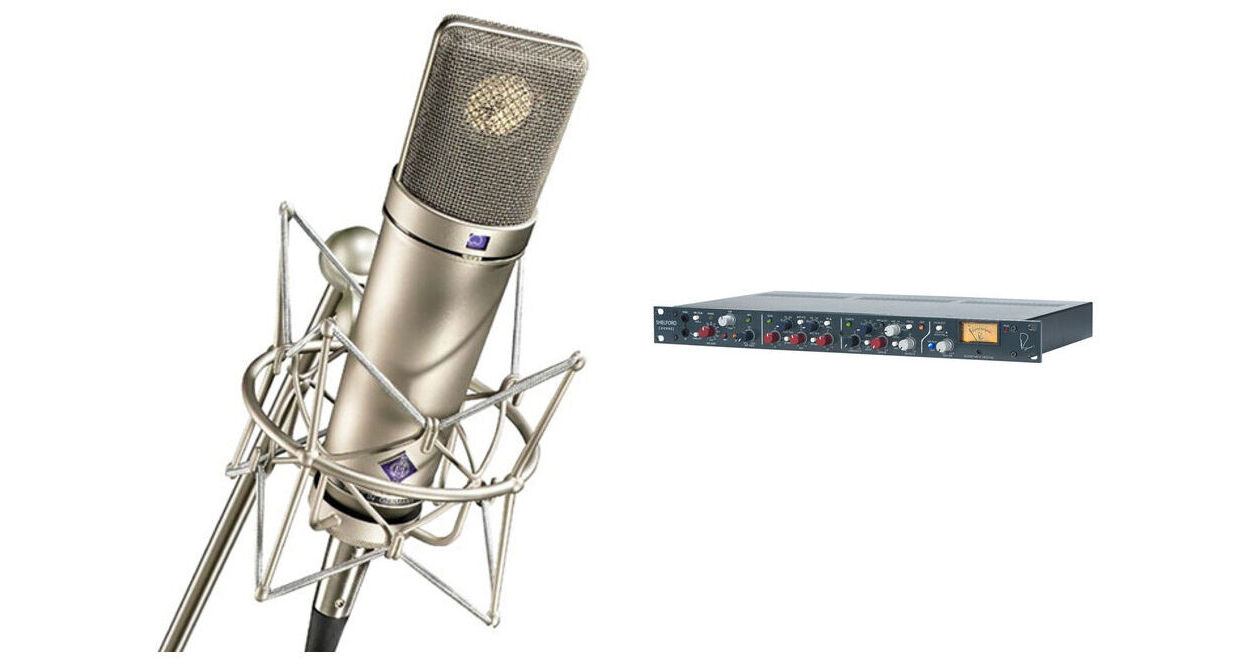
Neumann U 87 Ai Large-Diaphragm Multipattern Condenser Microphone Kit with Shelford Channel Strip (Studio Set, Nickel)

BH #NEU87AISZTK (B&H Kit)
Print
Neumann U 87 Ai Large-Diaphragm Multipattern Condenser Microphone Kit with Shelford Channel Strip (Studio Set, Nickel)
Key Features
  • Studio Standard for Vocals & Instruments
  • U 87 Ai Microphone (Studio Set, Nickel)
  • Rupert Neve Designs Shelford Channel
  • Cardioid, Omni & Figure-8 Polar Patterns
The nickel, Neumann U 87 Ai Large-Diaphragm Multipattern Condenser Microphone (Studio Set) Kit from B&H adds a Rupert Neve Designs Shelford Channel. This modern channel strip brings the classic Rupert Neve sound to your U 87 Ai mic, offering a transformer-gain, class-A microphone preamplifier, a "best-of-the-classics" inductor EQ section, a tone-packed diode bridge compressor, the power of variable Silk saturation, a custom transformer output stage, and twice the operating voltage of vintage designs.
More Details
In Stock
Free 2-Day Shipping
Protect Your Gear
Add a protection plan from $859.99

Business Financing Options

Ask an Expert
800-606-6969
Kit Contains:

The nickel, Neumann U 87 Ai Large-Diaphragm Multipattern Condenser Microphone (Studio Set) Kit from B&H adds a Rupert Neve Designs Shelford Channel. This modern channel strip brings the classic Rupert Neve sound to your U 87 Ai mic, offering a transformer-gain, class-A microphone preamplifier, a "best-of-the-classics" inductor EQ section, a tone-packed diode bridge compressor, the power of variable Silk saturation, a custom transformer output stage, and twice the operating voltage of vintage designs.

Neumann U 87 Ai Large-Diaphragm Multipattern Condenser Microphone (Studio Set, Nickel)

A definitive legend for decades, the nickel Neumann U 87 Ai Studio Set is a large-diaphragm condenser microphone offering the timeless and special sound that remains highly coveted for singers, voice-over artists, announcers, producers, and recording engineers to this day. By combining the same dual-diaphragm capsule design as the heralded U 67 with FET circuitry and a transformer-balanced output, the U 87 Ai retains the voicing that made the U 87 famous while ensuring low-noise performance and optimal signal purity.

The U 87 Ai's dual-diaphragm capsule, which is elastically suspended, affords the selection of three polar patterns (omni, cardioid, and figure-8) to enhance versatility in the studio. Additionally, the mic provides a switchable -10 dB pad that allows it to capture SPLs up to 127 dB without distortion, and a low-cut filter for controlling buildup of low-frequency content. Whether it is used for broadcast, stage, or studio applications, the U 87 Ai presents the sought-after look, sound, and reputation of a true classic.

The Gold Standard
The Neumann U 87 Ai may be the best-known and most frequently used studio microphone the world over. Its smooth and refined sound is as iconic as its elegant exterior design. The U 87 Ai is the standard microphone for speech and vocals. Three polar patterns plus pad and low-cut options make it adaptable to a wide range of applications.
Omnipresent and Special
The Neumann U 87 Ai is a true legend. Introduced in 1967, it has shaped the sound of countless hit records for the past 50 years. And when those hits were announced on the radio, many a DJ sat before a U 87 Ai.

The U 87 Ai is the epitome of a large-diaphragm condenser microphone. Its tapered body and iconic design have become part of the collective consciousness—this is what a studio microphone looks like. The same is true of its sound; the U 87 Ai represents studio quality and has become the gold standard by which other microphones are measured.

What sets the U 87 Ai apart is its special combination of linearity and character. Although its on-axis frequency response is remarkably flat, it does exert certain charisma, making the U 87 Ai both versatile and instantly recognizable.
Classic Neumann Engineering
Technically speaking, the U 87 Ai is a traditional design whose timeless formula has remained unchanged for decades. The U 87 Ai uses the same dual-diaphragm condenser capsule design as its predecessor, the no less legendary U 67 of the early 1960s. Its head amplifier, too, is based on the same design principles as its tube-driven predecessor, but the U 87 Ai realizes them by means of an FET circuit with a minimal signal path and a transformer-balanced output, ensuring maximum signal integrity and high common mode rejection.
Versatile Applications
The result is a studio microphone of unmatched clarity. Its natural sound and midrange presence make the U 87 Ai the ultimate vocal microphone, praised by singers and engineers alike as well as the prime choice for speech applications, such as voice-over, dubbing, and audio books. Due to its balanced response in each of its three directional patterns, the U 87 Ai is also a versatile microphone for anything from acoustic guitar to drums overheads. Due to its solid bass response and excellent midrange detail, it is often seen in front of bass and guitar cabinets. For classical recordings, the U 87 Ai is frequently used as a spot mic for soloists, e.g. cello. A stereo pair of U 87 Ai mics is the preferred choice of many engineers for recording piano in virtually any genre from pop and jazz to classical music.
Features at a Glance
  • The world’s most famous studio microphone
  • Classic sound, instantly recognizable and versatile
  • Balanced frequency response
  • Elastically suspended dual-diaphragm capsule
  • Omni, cardioid, and figure-8 polar patterns
  • Switchable low-cut filter and -10 dB pad
  • Low self-noise
  • XLR 3-pin output
  • 48V phantom powered
  • Includes color-matched shockmount and wooden box
Rupert Neve Designs Shelford Channel Transformer Gain Mic Preamp, Inductor EQ, and Diode Bridge Compressor

The Shelford Channel Transformer Gain Mic Preamp, Inductor EQ, and Diode Bridge Compressor from Rupert Neve Designs is the evolution of the original technologies of his classic console modules like the 1073, 1064, 1081, and 2254. The Shelford Channel has been refined for the 21st century studio and can be used as a front-end channel for controlling audio signals in studio applications and more.

Featuring a single XLR mic input with 48V phantom, a single XLR line input and XLR outputs, the Shelford Channel is built with a 1/4" line input and a thru connector. Side-chain TS send and return, and two link connectors, are also provided. Outstanding features include the inductor EQ section, the tone-packed Diode bridge compressor, the analog power of variable Silk saturation, and a dual-tap transformer output stage with twice the operating voltage of vintage designs that allows the full driving of the Channel without clipping standard converters.

With richly colored tonal options for making bold statements with your music and precisely engineered detented controls for recall, the vintage-inspired Shelford Channel maintains the soul of Rupert's Neve's classic designs with new levels of versatility.

Transformer Gain Mic Input
The Shelford Channel's mic input uses direct transformer coupling with 15 dB of gain in the transformer itself; the resulting sonic performance allows the mic pre to capture the more forward mids and slightly rounded-off high and low frequencies of vintage designs like the 1073.
Direct Input
The Hi-Z front-panel input uses the same discrete Class-A FET with transformer topology as the Rupert Neve Designs RNDI, but it utilizes the new RN4012 input transformer into the microphone preamplifier for gain. It delivers clarity to high-Z sources with a low-end presence and smooth high frequencies. The DI also includes a passive thru output to feed a separate amplifier.
Dual-Tap Output
The dual-tap output for the Channel's RN2042 square-core output transformer creates both high- and low-headroom outputs without compromising the channel's performance. Designed to capture a pristine sound at high levels while avoiding coloration of the output stage, the high-headroom tap takes full advantage of the Shelford's higher-voltage design. The low-headroom tap is optimized to allow an engineer to drive the full-voltage range of the Channel—adding dynamic tone without clipping.
Silk and Texture
The addition of the Silk and Texture circuitry allows control over the harmonic content and saturation of the output transformer. With Silk disengaged, the output is still modern and pristine, yet still retains the larger-than-life transformer sound. When engaged, the 2nd-order and 3rd-order harmonic content can be dialed up to several times beyond that found on a vintage 1073. It is further controlled with Silk Red and Blue modes, which emphasize different harmonic content generated by the source's high frequencies.
Mic, DI, and Line
Switches between microphone/direct injection input (button out) or line input (button in).
Ground Lift
This switch separates the direct connection from audio-signal ground to chassis earth.
Dual-Function Signal LED
When green, it indicates signal presence (a signal level of -20 dBu). When red, it indicates 2 to 3 dB below input-stage clipping of the mic/line stage (+23 dBu, while the mic pre clips at +25 dBu).
Mic Gain
This 12-way precision rotary switch controls gain from 0 to 66 dB in 6 dB steps.
Trim
This rotary switch provides continuous gain adjustment over a range of +/-6 dB.
48V Phantom
Provides phantom power on the microphone input.
Phase
Switches the polarity of the signal path.
HPF (High-Pass Filter)
The HPF switch engages a 12 dB per octave high-pass filter. The HPF potentiometer is variable from 20 to 250 Hz and can be used to filter out unwanted low frequencies, or can be used in conjunction with the EQ to help shape source material.
HPF Frequency
This control selects the frequency (-3 dB) at which the filter begins to roll off low-frequency signals. The filter is a 12 dB per octave Bessel filter designed to musically preserve important timing information while cutting low-frequency noise like air conditioning rumble.
EQ In
This switch engages all EQ frequency bands except the HPF.
LF
Adjusts up to 15 dB of boost or cut at the selected low frequencies. Cut can be used as a variable, as a gentle alternative to using the HPF. Remember to reduce the signal level at the source to minimize the potential for distortion when any of the 3 bands are boosted significantly.
Low Frequency
This rotary switch has 4 positions for selecting one of four corner or center frequencies for the low-band EQ section. The frequencies are 35 Hz, 60 Hz, 100 Hz, and 200 Hz. With the LF Peak button pressed the low-frequency band changes to peak mode with a bell shaped boost or cut curve. Between the LF Peak button and LF Freq rotary switch, an engineer has 8-tonal variations of EQ shapes to finesse the bottom end, plus the high-pass filter can be introduced for further tightening and manipulation.
LF Peak
When the button is out, the low frequency band operates in shelf mode, boosting or cutting below the corner frequency.
Mid Hi Q
The resonance or Q of the mid-band at maximum boost is typically 2 when the button is out. When the MID HI Q is pressed at maximum boost, the Q narrows to approximately 3.5. It widens nicely with less boos or cut as is typical for passive EQ circuits. The Q tends to be slightly wider when the frequency is set lower, and slightly higher for higher frequency selections. The Q is also narrower for cuts than it is for boosts and the mid band is non-symmetrical by design.
Mid
Adjusts up to 15 dB of boost or cut at the selected mid frequencies.
Mid Frequency
This rotary switch has 6 positions to select the center frequency of the mid-band EQ stage. It utilizes an inductor and capacitors to shape the EQ curve. The frequencies are 200 Hz, 400 Hz, 900 Hz, 1.8 kHz, 3.5 kHz, and 7.5 kHz.
HF Peak
When the button is out, the high-frequency band operates in shelf mode, boosting or cutting above the corner frequency at approximately 6 dB/octave. Below the corner frequency the amount of boost or cut gradually diminishes. With the Hi Peak button pressed, the high- frequency band changes to peak mode with a bell-shaped boost or cut curve.
8k/16K
With the switch out, the center or corner frequency of the high band is 8 kHz. With the button pressed, the center or corner frequency changes to 16 kHz. Between this switch and the HI Peak switch, you have 4 different EQ curves to finesse the high-frequency content.
HF
Adjusts up to 15 dB of boost or cut at selected high frequencies.
The Side-Chain Insert Jacks
These pairs of jacks are only used to perform some fine tuning of the compressor operation. The audio that normally controls the compressor is available on the "Sidechain Send" jack. One can take this audio and pass it through an external equalizer then return it back to the "Sidechain Return" jack.
Compressor In
The compressor-limiter section is engaged with this button. It can be useful for control of the compressor and it is there for "confidence checks." In particular, exercise it in both the quietest and the loudest sections of the song.
Threshold
Sets level where the compressor begins to react from -25 dB to +20 dB. Minimal or no compression is with this control fully clockwise, and it gets more sensitive and tends to cause more gain reduction as the knob is rotated counter-clockwise.
Ratio
Sets the "slope" of the compression from 1.5:1 (minimal) to 8:1 (significant).
SC Insert
This control inserts an external device into the side-chain signal path via the rear panel side-chain insert jacks.
HPF to S/C
It routes the high-pass filter into the circuit that the compressor uses to determine level, commonly referred to as "the side-chain."
Gain
Often referred to as make-up gain, this is a level control.
Timing
This six-position control adjusts the attack/release speed of the compressor.
Link
Links the side-chain control of multiple units for ganged operation.
Pre-EQ
Pushing this button changes the order of where the compressor is in the circuit.
Blend
Adjusts the blend of the dry, uncompressed signal and the compressed signal.
Fast
When pressed, it alters the speed of both the attack and release of the selected time constant of the compressor.
VU Meter
The VU meter is calibrated to display both average (RMS) output level and compressor gain reduction.
UPC: 752423657360
Kit Contains:

Neumann U 87 Ai Large-Diaphragm Multipattern Condenser Microphone (Studio Set, Nickel)

Key Specs
Microphone Type
Large Diaphragm
Polar Pattern
Cardioid / Figure-8 / Omnidirectional
Element Type
Condenser
Controls
Low Cut/HPF, Pad, Polar Pattern
Frequency Response
20 Hz to 20 kHz
Maximum SPL
117 dB (Cardioid, 1 kHz, .5% THD)
127 dB (Cardioid, 1 kHz, .5% THD, with Pad)
Analog Output
1x XLR 3-Pin Male
Power Sources
Phantom Power
Microphone
Microphone Type
Large Diaphragm
Polar Pattern
Cardioid / Figure-8 / Omnidirectional
Element Type
Condenser
Sound Field
Mono
Orientation
Side Address
Controls
Low Cut/HPF, Pad, Polar Pattern
Pad
-10 dB
Circuitry
Solid-State (FET)
Performance
Frequency Response
20 Hz to 20 kHz
Maximum SPL
117 dB (Cardioid, 1 kHz, .5% THD)
127 dB (Cardioid, 1 kHz, .5% THD, with Pad)
Sensitivity
20 mV/Pa (Omni)
28 mV/Pa (Cardioid)
22 mV/Pa (Figure-8)
Equivalent Noise Level
15 dB (Omnidirectional, A-Weighted)
12 dB (Cardioid, A-Weighted)
14 dB (Figure-8, A-Weighted)
26 dB (Omnidirectional, CCIR)
23 dB (Cardioid, CCIR)
25 dB (Figure-8, CCIR)
Connectivity
Analog Output Connector
1x XLR 3-Pin Male
Power
Power Sources
Phantom Power
Operating Voltage
48 V (Phantom Power)
Physical
Color
Nickel
Dimensions
ø: 2.2 x L: 7.9" / ø: 5.6 x L: 20.1 cm
Weight
1.1 lb / 500 g
Packaging Info
Package Weight
5.26 lb
Box Dimensions (LxWxH)
11.8 x 11.7 x 6.1"

Neumann U 87 Ai Set Z Reviews

See any errors on this page?
Whatever You Need, We've Got It