Video Chat with a Pro Audio Expert - Live

Studio Technologies Model 348 8-Channel Dante Tabletop Intercom Station

BH #STM348 • MFR #M348
Print
Studio Technologies Model 348 8-Channel Dante Tabletop Intercom Station
Key Features
  • For Broadcast Applications
  • Dante Audio-over-Ethernet Technology
  • Eight Independent Talk & Listen Channels
  • 5-Pin Female XLR Headset Connector
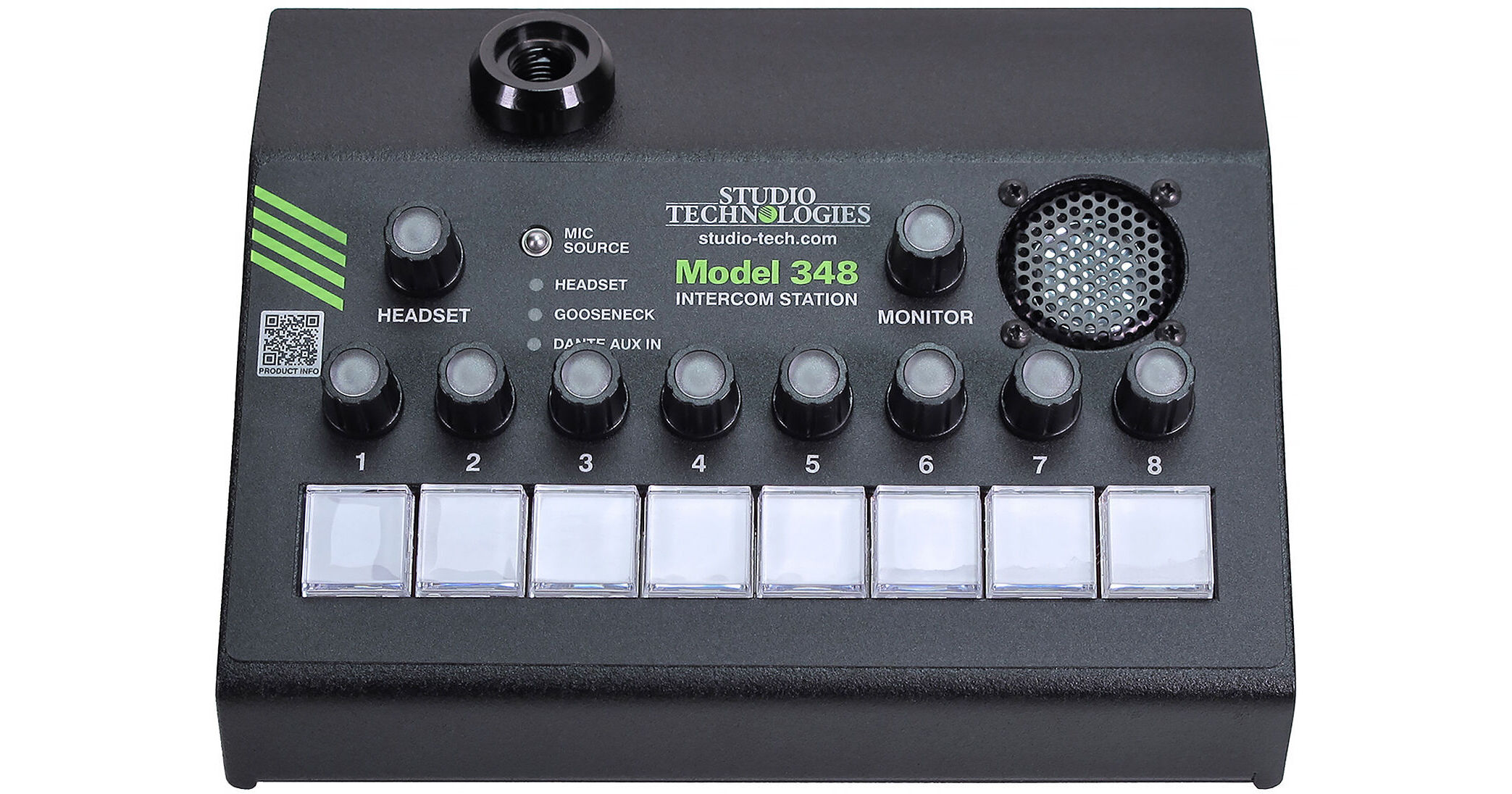
Whether you need full audio control in broadcast, live events, theater, or even aerospace applications, the Model 348 8-Channel Dante Tabletop Intercom Station from Studio Technologies provides an impressive set of features. Eight independent talk and listen channels are controllable for virtual party lines via Dante audio-over-Ethernet protocol. Built-in features, including support for 5-pin female XLR headsets, 3.5mm 4-conductor TRRS CTIA headsets, and 1/4" gooseneck microphones, allow you to communicate with on-air talent. The built-in speaker makes this unit great for hearing talent right out of the box.
More Details
Special Order
Expected availability: 2-4 Weeks
No Store Display
Free Standard Shipping
Protect Your Gear
Add a protection plan from $235.99
Ask an Expert
800-606-6969

Studio Technologies Model 348 Overview

Whether you need full audio control in broadcast, live events, theater, or even aerospace applications, the Model 348 8-Channel Dante Tabletop Intercom Station from Studio Technologies provides an impressive set of features. Eight independent talk and listen channels are controllable for virtual party lines via Dante audio-over-Ethernet protocol. Built-in features, including support for 5-pin female XLR headsets, 3.5mm 4-conductor TRRS CTIA headsets, and 1/4" gooseneck microphones, allow you to communicate with on-air talent. The built-in speaker makes this unit great for hearing talent right out of the box.

Call send and receive functions can be used to discreetly communicate with talent with the RGB buttons on the front of the unit. The rear panel contains two RJ45 connectors for primary and secondary redundant Dante connections, while power is handled either with Power-over-Ethernet (PoE) or a standard 4-pin DC connector (10-18 volts). And for further compatibility, the Model 348 supports Quindar tones. With a plethora of routing and connection options, the Model 348 is a mainstay for wide ranges of broadcast applications.

Audio Channels and Headset Connections
On the front of the unit lie eight independent controls for on-air talent to adjust talk channel levels. Each channel has an associated RGB LED button that can mute, solo, and indicate associated audio inputs.

Connections for a 5-pin female XLR headset, 3.5mm 4-conductor TRRS CTIA headset, and 1/4" gooseneck microphone are provided for communicating with talent. As an added bonus, a built-in speaker on the right side of the front panel lets you hear talent right out of the box.

Dante Audio-over-Ethernet
At the heart of Model 348's operation is the Dante Audio-over-Ethernet protocol. With a single Ethernet cable connected to the primary RJ45 port, located on the rear panel, up to 16 inputs and 12 outputs are available for channel routing. For redundant backup, a secondary RJ45 port can be utilized in case of potential power issues from other equipment.

While also compliant with AES67 and Dante Domain Manager, further configurations can be managed via the STcontroller and Dante Controller applications.

Audio Fidelity
Quality and resolution are not an issue with Model 348, thanks to a supported sample rate of 48 kHz and bit depth of up to 32. Regarding the analog portion of the unit, each microphone/headset input features a low-noise, wide dynamic range preamplifier and a voltage controller amplifier (VCA) compressor to minimize the chance of signal overload. Lastly, for specific configurations, Quindar tones are available for sending intro and outro cues to talent.
Versatile Power Options
The Model 348 can be powered by Power-over-Ethernet (PoE) via the RJ45 connection or a standard 4-pin XLR female DC power supply (10-18 volts).

Studio Technologies Model 348 Specs

Applications
Dante-Based Intercom, Broadcast IFB (Talent Cue) Master Station, Audio Monitor Mixer, Aerospace (Including Capsule Communicator (CapCom)), and Specialized Tone Generation
Network Audio Technology
Type: Dante Audio-Over-Ethernet
AES67-2018 Support: Yes, Selectable On/Off
Dante Domain Manager (DDM) Support: Yes
Ethernet Interface Configuration: Switched or Redundant
Bit Depth: 16, 24, or 32
Sample Rate: 48 kHz
Number of Dante Receiver (Input) Channels: 16
Number of Dante Transmitter (Output) Channels: 12
Number of Dante Flows: 16 Receiver, 16 Transmitter
Internal Digital Audio Processing: 32-Bit, Fixed
Input-to-Output Audio Processing Latency: <200 uSec
Nominal Input and Output Level: -20 dBFS
Network Interface
2, Primary (PRI) and Secondary (SEC)
Type: 1000BASE-T Gigabit Ethernet (GbE) per IEEE 802.3ab (10 and 100 Mb/s Not Supported)
Microphone Input
Compatibility–Headset A: Single or Dual-Ear Broadcast-Style with Dynamic or Electret (Low-Voltage DC-Powered) Microphone: Pin 1 Mic Common; Pin 2 Mic; Pin 3 Phones Common; Pin 4 Phones Left; Pin 5 Phones Right
Compatibility–Headset B: CTIA/AHJ Configuration (Typically Uses Electret Powered Mic): Tip Phones Left; Ring 1 Phones Right; Ring 2 Common; Sleeve Mic
Type: Unbalanced
Microphone Power: 3.3 Volts DC Via 2.00 Kilohms Resistor, Selectable On/Off
Impedance: 1 Kilohms, Nominal, Microphone Power Off; 690 Ohms, Nominal, Microphone Power On
Gain: 26, 32, 38, 44, 50 dB, Selectable
Frequency Response: -4 dB at 30 Hz, -2.6 dB at 40 Hz, -1.8 dB at 50 Hz, -2.4 dB at 10 kHz, -3.8 dB at 20 kHz
Distortion (THD+N): <0.09%, Measured at -20 dBFS, 22 Hz to 22 kHz Bandwidth, 38 dB of Gain
Dynamic Range: >93 dB, A-Weighted, 26 dB Gain
Microphone Input
Compatibility: Gooseneck, Studio Technologies' GME-3-12
Microphone Power: 3.3 VDC via 2.49 Kilohms Resistor
Impedance: 3.3 Kilohms, Nominal
Gain: 12, 18, 24, 30, 36, 42 dB, Selectable
Frequency Response: -3.0 dB at 40 Hz, -2.0 dB at 50 Hz, -2.0 dB at 16 kHz, -3.0 dB at 20 kHz
Distortion (THD+N): <0.04%, Measured at -20 dBFS, 22 Hz to 22 kHz Bandwidth, 36 dB of Gain
Dynamic Range: >97 dB, A-Weighted, 12 dB Gain
Compressor
Application: Applies to Headset and Gooseneck Microphone Audio
Threshold: 1 dB Above Nominal Dante Transmitter (Output) Level (-19 dBFS or -13 dBFS when Gooseneck Mic Gain Selected for 42 dB)
Slope: 2:1
Dante / AES67 Channels
8 Monitor
7 Auxiliary
2 Monitor Outputs
Headphone Output
Type: 2-Channel (Stereo)
Compatibility: Intended for Connection to Stereo (Dual-Channel) or Monaural (Single-Channel) Headsets with a Nominal Impedance of 50 Ohms or Greater
Maximum Output Voltage: 3.0 Vrms, 1 kHz, 150 Ohms Load
Frequency Response: 20 Hz to 20 kHz, +0/-1 dB
Distortion (THD+N): <0.02%
Dynamic Range: >93 dB
Dim (Attenuation): 0, 6, 12, 18 dB, Configurable
Speaker Output
Type: Single-Channel (Monaural)
Speaker: 1.3" / 32 mm Diameter
Maximum Power: 4 Watts RMS, Nominal
Frequency Response: 250 Hz to 20 kHz, ±3 dB
Dim (Attenuation): 0, 6, 12, 18 dB, Configurable
Call Functions
Receive Frequency: 20 kHz, ±800 Hz, within Audio Channel
Receive Level: -27 dBFS Minimum
Send Frequency: 20 kHz
Send Level: -20 dBFS
Audible Alert: 3-Burst Sequence, 524 Hz, Sine Wave, Selectable Level Range
Remote Control Input
Inputs: 2
Function: Configurable, Can Mimic the Action of Two Talk Buttons
Type: Active Low, 1 mA Maximum, Input Pulled up to 3.3 Volts DC via 3.4-Kilohm Resistors
Power Sources
Power-over-Ethernet (PoE): Class 3 Mid-Power, less than or equal to 12.94 Watts) per IEEE 802.3af
DC Input: 10 to 18 VDC, 1.1 A Maximum at 12 VDC
Connectors
Headset A: 5-Pin Female XLR
Headset B: 3.5 mm 4-Conductor TRRS Jack, per Japanese Standard JEITA/EIAJ RC-5325A
Gooseneck Microphone: 3-Conductor 1/4" with 7/16-20 UNF Threaded Bushing; 4-40 UNC Hex Head Socket Set Screw Allows Microphone to Be Secured into Bushing
Ethernet: 2, Neutrik NE8FBH etherCON RJ45 Jacks (Compatible with etherCON CAT 5 Plugs)
DC Input: 4-Pin Male XLR (Pin 1 Negative, Pin 4 Positive)
USB A Receptacle (Used Only for Updating Firmware)
Remote Control Inputs: 3-Pin Header Located on the Main "Broadway" Circuit Board
Headset Microphone Input: 3-Pin Header Located on the Analog Circuit Board
Headset Phones Output: 3-Pin Header Located on the Analog Circuit Board
Configuration
Requires Studio Technologies' STcontroller Software Application
Software Update
USB Flash Drive Supports Updating of Main MCU, Secondary MCU, and FPGA Firmware (Embedded Software); Dante Interface Firmware Updated via Ethernet Interface
Environmental
Operating Temperature: 32 to 122°F / 0 to 50°C
Storage Temperature: -40 to 158°F / -40 to 70°C
Humidity: 5 to 95%, Non-Condensing
Dimensions
6.5 x 4.9 x 2.9" / 16.5 x 12.5 x 7.4 cm
Weight
2.1 lb / 1 kg
Packaging Info
Package Weight
2.47 lb
Box Dimensions (LxWxH)
9.2 x 7.2 x 5.7"

Studio Technologies Model 348 Reviews

See any errors on this page?

Can this act like a Dante intercom Engine? Or ...

Can this act like a Dante intercom Engine? Or does that need to be added to the system as well?
Asked by: Jacob
The Studio Technologies Model 348 8-Channel Dante Tabletop Intercom Station would be added to an intercom system that also has Dante capability, connected to a managed ethernet switch with the other Dante compatible intercom components.
Answered by: David M
Date published: 2026-02-15
  • y_2026, m_6, d_5, h_14CST
  • bvseo_bulk, prod_bvqa, vn_bulk_3.0.46
  • cp_1, bvpage1
  • co_hasquestionsanswers, tq_1
  • loc_en_US, sid_1872939, prod, sort_[SortEntry(order=HAS_STAFF_ANSWERS, direction=DESCENDING)]
  • clientName_bhphotovideo
Whatever You Need, We've Got It