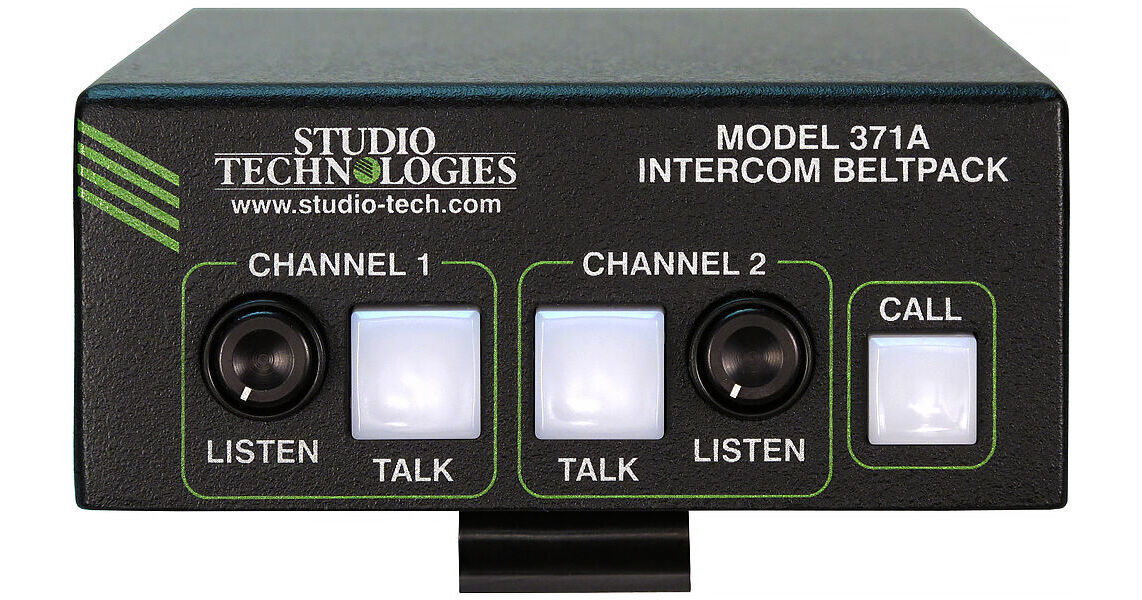
Model 371A includes a range of new capabilities, along with the advanced performance and flexibility that Dante® audio-over-Ethernet provides. Over a standard IP network, multiple Model 371A units can be used in party-line (PL) intercom applications with help from an external Dante-enabled audio matrix such as the Studio Technologies Model 5422 Dante Intercom Audio Engine. Alternately, units can be used "point-to-point" or interfaced with Dante-compatible matrix intercom systems.
Only a single Power-over-Ethernet (PoE) connection is required for operation. Key user features can be easily configured using the STcontroller software application. Configurable parameters include electret microphone powering, microphone preamplifier gain, sidetone level, and talk button operation. User features include microphone dynamic range control, call function, and remote mic kill ("talk off"). The wide range of capabilities, along with the excellent audio quality provided by the digital audio signal path, offers a unique and powerful user experience.
Set up and configuration of the Model 371A is simple. An etherCON RJ45 receptacle is used to interconnect with a standard twisted-pair Ethernet port associated with a local-area network (LAN). This connection provides both power and bidirectional digital audio. A broadcast or intercom-style headset with a dynamic or electret (low-voltage DC-powered) microphone interfaces with unit using a 4-pin XLR connector. Model 371A's enclosure is made from an aluminum alloy which offers both light weight and ruggedness. A stainless steel "belt clip," located on the back of the unit, allows direct attachment to a user's clothing.
The audio quality of Model 371A's audio channels is excellent, with low distortion, low noise, and high headroom. Careful circuit design and rugged components ensure long, reliable operation. A wide range of applications can be supported, including theater facilities, over-the-air and streaming broadcasting, corporate and government AV installations, aerospace command and control, and post-production facilities.
Two bi-color LEDs provide an indication of the Dante connection status. The Dante Controller's Identify command takes on a unique role with Model 371A. Not only will it cause the talk and call button LEDs to light in a unique highly visible sequence, it can also be configured to turn off any active talk channels.
Audio input signals arrive via two Dante receiver channels. The supported sampling rate is 48 kHz with a bit depth of up to 24. The audio signals pass into Model 371A's processor where channel routing, headphone level control, and sidetone creation are performed within the digital domain. Two push-in/push-out ("pop out") rotary controls make it easy to set and maintain the desired headphone output level. The audio signal destined for the headphone output is sent to a high-performance digital-to-analog converter and then on to a robust driver circuit. A high signal level can be provided to a variety of headsets, headphones, and earpieces.
The microphone input can be selected for compatibility with dynamic or elected (DC-powered) microphones. The gain of the microphone preamplifier can be selected from among four choices. These allow compatibility with the variety of microphones that are part of broadcast and intercom headsets.
A unique Model 371A feature is the ability to individually configure the way in which the two talk pushbutton switch’s function; four choices are available. For standard intercom belt pack operation it's typical to select Push to Talk, Latching, or Push to Talk/Tap to Latch. For situations where only monitoring of an intercom channel is desired a Disabled mode is available.
The Model 371A's operating power is provided by way of the Ethernet interface using the 802.3af Power-over-Ethernet (PoE) standard. This allows fast and efficient interconnection with the associated data network. To support PoE power management, Model 371A's PoE interface reports to the power sourcing equipment (PSE) that it's a class 1 (very low power) device.
The Model 371A uses Audinate's Ultimo™ integrated circuit to implement the Dante interface. The firmware in this integrated circuit can be updated via the Ethernet connection, helping to ensure that its capabilities remain up to date.