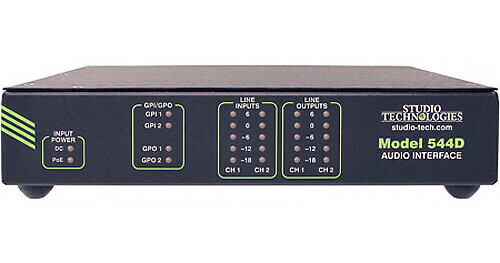
Ideal for 24-hour, on-air, and commercial applications, the Studio Technologies Model 544D is a compact audio interface for connecting analog audio systems with Dante AoIP infrastructure. Sporting stereo XLR 3-pin I/O, a rugged etherCON Dante port, and GPIO connectivity, this flexible device supports numerous setups and offers redundant power via PoE and DC power input options.
- The most basic application for Model 544D is for sending analog audio signals to and from one location to another, using the data transport resources of a local area network—there’s really no simper means of getting high-quality audio from point A to point B, and back. With standard connectors and PoE power, setup can be completed in just a few minutes. This makes Model 544D units effective in both fixed and portable applications.
- The Model 544D can also find use when an application already supports Dante. For example, ports on a matrix intercom system that directly supports Dante, such as the RTS ODIN or ADAM with OMNEO can be routed to a Model 544D’s Dante transmitter (output) and receiver (input) channels.
- The Model 544D will then provide two analog line inputs and two analog line outputs for use in a variety of applications. These can include interfacing with audio inputs and outputs associated with audio consoles, providing talent cueing (IFB) feeds, and interfacing with the audio outputs of aerial camera systems.
- The GPI and GPO functions allow Model 544D units to transport contact closures using high-frequency audio tones that are embedded as part of the unit’s audio channels.
- Two independent contact closures can be repeated across a network using Dante audio paths. Provided for installer-specified applications, having the ability to transport status signals, or contact closures, over significant distances can be a unique and valuable resource.
This 18 kHz tone can be used by a matrix intercom system to facilitate creation of voice-with-tone interruptible foldback (IFB) signals.When routed to Model 5422A interrupt inputs, these specialized IFB interrupt signals will allow creation of excellent talent cueing channels.The 20 kHz tone option is provided for use in applications where generation of a party-line call signal is desired. For example, the 20 kHz tone can be connected to a matrix intercom system which would be configured such that a button press will cause 20 kHz to be sent out an intercom channel. This can serve as a trigger signal for visual or audible alerting devices, such as the Studio Technologies’ Model 391 Dante Alerting Unit.
The -10 dBu configuration is provided for semi-pro applications, where sources are typically unbalanced (single-ended). Using this selection, an analog signal with a level of -10 dBu will result in a Dante digital output signal with a level of -20 dBFS. The electronically balanced (differential) input circuits are capacitor-coupled and ESD (static) protected, for reliable operation in a variety of applications. They are also protected from damage should a moderate DC voltage be accidentally connected. Sources can include analog I/O cards on matrix intercom systems, audio consoles, wireless microphone receivers, and broadcast routers.
The -10 dBu setting can be useful for semi-pro applications where a lower nominal level is necessary. The line outputs are electronically balanced, capacitor-coupled, and ESD (static) protected. The outputs are compatible with virtually all balanced and unbalanced inputs with an impedance of 2 kilohms or greater.
During normal operation the meters offer a real-time confirmation of the unit’s audio signal levels, helping to ensure that optimal audio quality is maintained. Additional LED indicators are provided on the front panel, offering status indications of the incoming power, GPI, and GPO functions.
To assist in implementing specialized GPI and GPO applications, a source of low-current DC power is also provided. The GPI and GPO functions can be especially useful in party-line intercom applications where call-light signals are utilized. Contact closures on matrix intercom systems can be repeated by Model 544D units that are located anywhere on the same local area network (LAN). The Model 544D is also directly compatible with the call-light signal support provided by the Studio Technologies’ Model 545DC and Model 545DR Intercom Interface units. With a Model 544D appropriately interconnected with a matrix intercom system full call-light support can be provided to and from RTS and Clear-Com party-line intercom circuits.
The Model 544D’s operating power can be provided by way of the Ethernet interface using the Power-over-Ethernet (PoE) standard. This allows fast and efficient interconnection with the associated data network. To support PoE power management, the Model 544D’s PoE interface reports to the power sourcing equipment (PSE) that it is a class 1 (very low power) device. The unit can also be powered using an external source of 12 VDC. For redundancy, both power sources can be connected simultaneously. Three LEDs on the unit’s back panel display the status of the network connection and the Dante interface. Two LEDs on the unit’s front panel provide a real-time indication of the connected power sources.