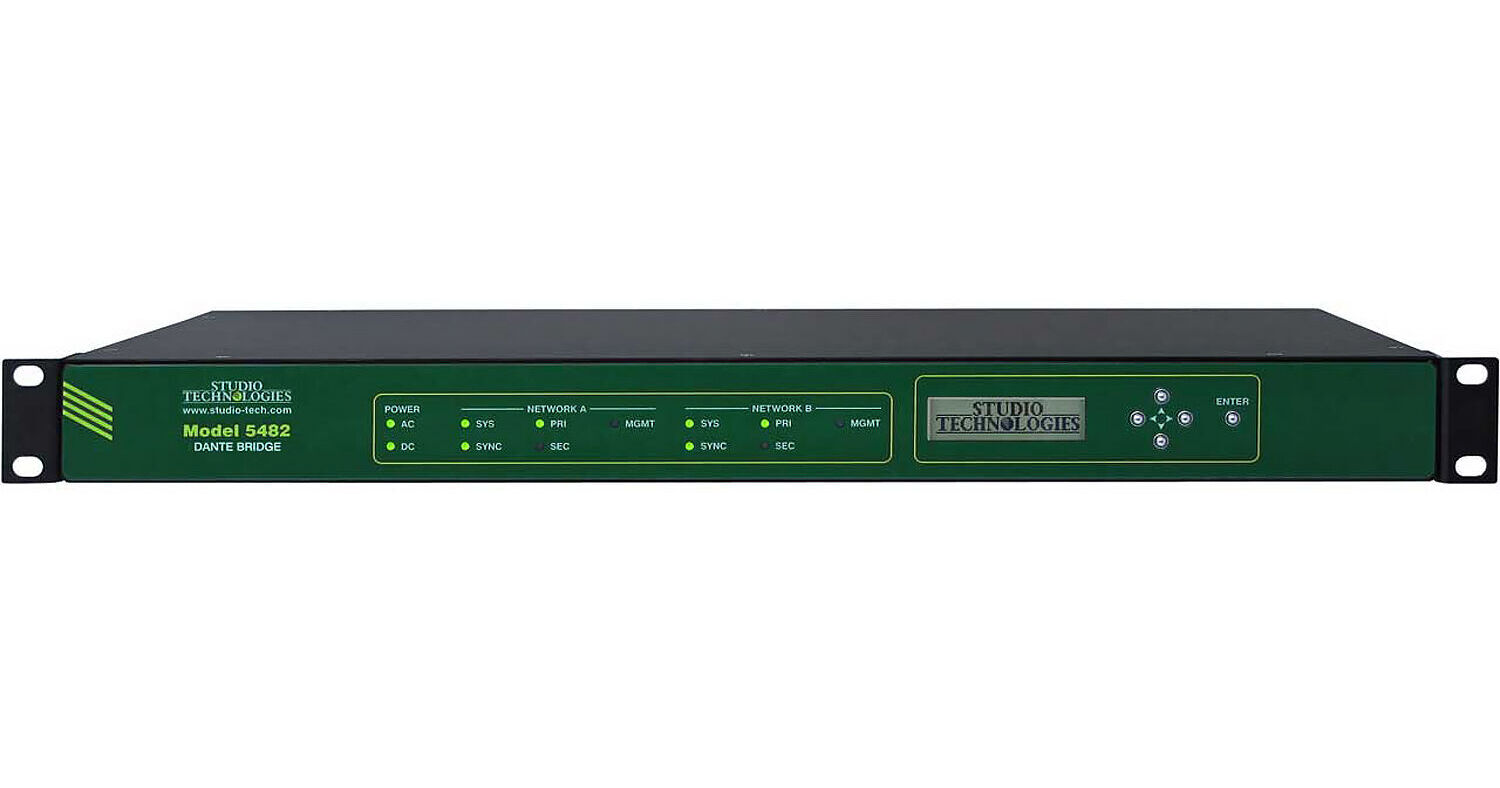
Interconnect Dante signals between two different LAN networks or Dante domains with the Studio Technologies Model 5482, a Dante audio bridge that provides 64 channels in and out at up to 24-bit / 96 kHz sampling. With AES67 and Dante Domain Manager support and integrated sample-rate conversion, the Model 5482 makes it easy to interconnect and match two Dante AoIP networks.
Model 5482-02 allows up to 64 channels of bridging at sample rates of 44.1 or 48 kHz, and 32 channels of bridging at 88.2 or 96 kHz. If desired, a special function allows the timing reference from one interface to be used as the reference timing for the Leader Clock on the other. This will result in the Dante synchronization on one LAN to be utilized as the synchronization source on the other.
Each interface in a Model 5482-02 has 64 Dante receiver (input) and 64 Dante transmitter (output) channels. They are associated on a one-to-one basis with the channels in both interfaces. For example, input 1 on Network A is associated with output 1 on Network B. Routing (subscribing) the Dante receiver (input) and transmitter (output) channels to related devices is performed using the Dante Controller software applications.
One of the Model 5482’s network interfaces can utilize the security resources of DDM while the other remains open. Each interface can be configured to support, or not support, AES67 digital audio signals. This allows a Model 5482 to serve in a unique Dante-to-AES67 bridge function. However, note that when AES67 support is enabled for an interface, the sample rate will be fixed at 48 kHz and only multicast operation will be active.
To achieve audio data synchronization between the two network interfaces bi-directional sample-rate-converter (SRC) logic functions are implemented in high-speed programmable (FPGA) logic. This allows compatibility between the two network interfaces, even if they have widely divergent sample rates and independent reference clock sources.
This ensures that the loss of one network resource will not result in the interruption of networked audio signals. For application flexibility one interface can be configured for Switched Dante operation while the other is configured for Redundant Dante operation. As previously mentioned, a third GigE port is associated with each Model 5482 interface. These, named Management, are provided for factory use only. All six of the Model 5482’s Gigabit Ethernet ports support twisted-pair signals, each with Auto MDI / MDI-X capability, so reversing cables are never required.
- On the Model 5482’s front panel are 12 LED indicator lights, a backlit graphic display, and five push-button switches.
- Two of the LEDs indicate the status of the AC and DC input power sources.
- A set of five LEDs are associated with each of the two network interfaces. These reflect the status of the interface’s Dante and management network connections.
- The graphics display allows the monitoring of a number of operating conditions, including Dante names and network configurations, product firmware versions, and interface audio sample rates.
- The five push-button switches can be used to select which information is displayed and for allowing key network parameters to be revised for each interface; these include the Dante primary IP configuration method, IP addresses, and subnet mask values.
- LEDs on the Model 5482’s back panel indicate the status of the two network interfaces—two for each of the six Gigabit Ethernet connections.
- Two additional LEDs reflect the status of the USB host interfaces, which are used to update the Model 5482’s firmware.
It can also be powered using a 10 to 18 VDC source that is connected via a broadcast-standard 4-pin XLR connector. If both AC and DC power sources are connected, the Model 5482 will be powered by the AC mains supply. Should the AC mains source fail, the DC source will provide operating power with no interruption in the performance of the unit.
To implement its two Dante interfaces the Model 5482 uses two of Audinate Brooklyn modules. The firmware in these modules can be updated via the unit’s Ethernet connections, helping to ensure that the Dante capabilities remain up to date.