From Manufacturer
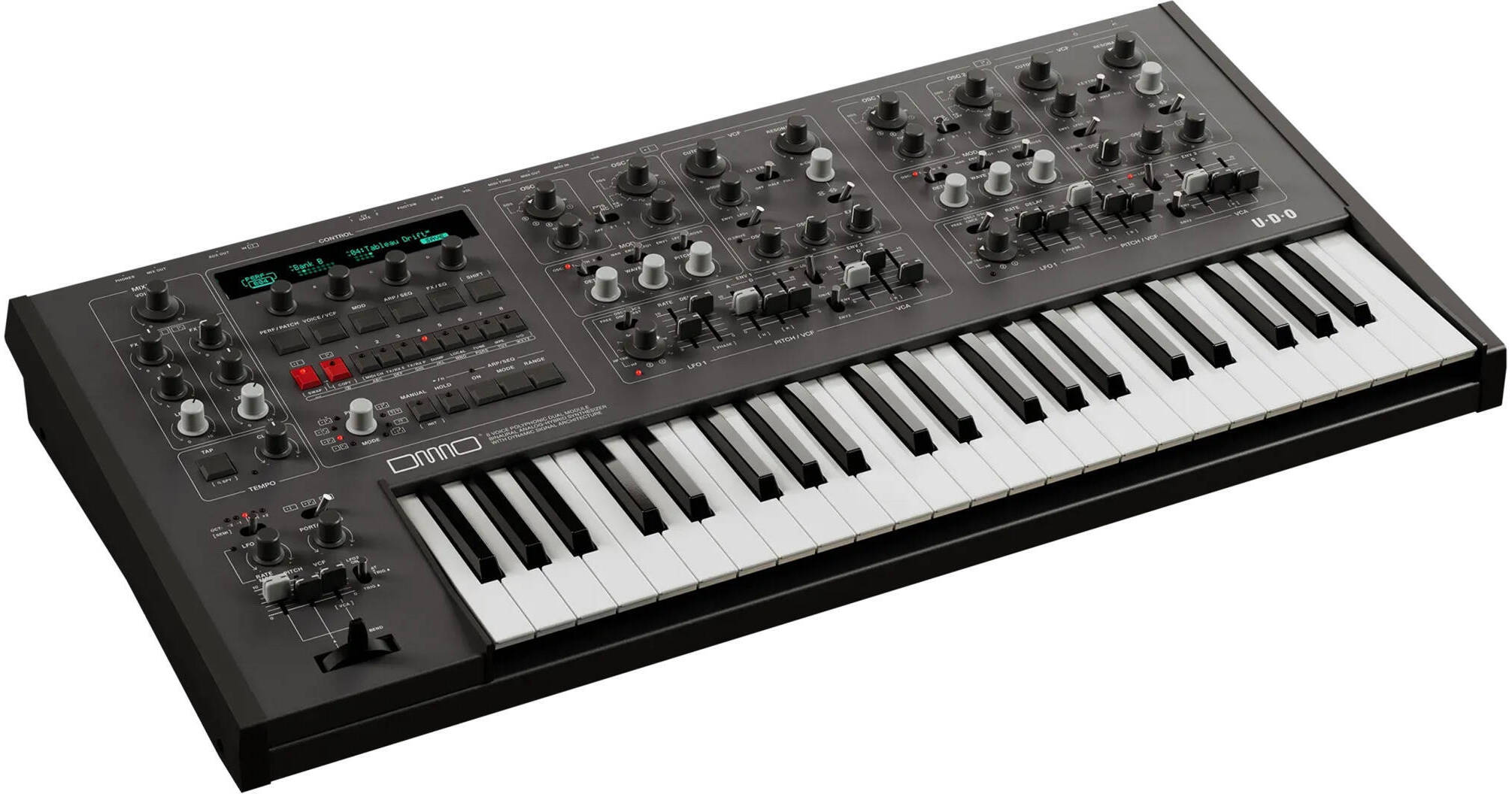
Designed with a highly flexible and dynamic signal architecture, the UDO Audio DMNO is an 8-voice, 2-part multitimbral powerhouse featuring two independent 4-voice analog-hybrid synthesizers, each equipped with the latest dynamic multi-core stereo VCF. With its eight creative Play Modes, DMNO unlocks dynamic interactions between the two timbres at the touch of a single control, while its flexible analog and digital audio connectivity makes it a truly expansive and immediate sound design sandbox.
Stack Up and Knock Down
The two fully featured independent synthesizers (DMNO 1 and 2) take center stage, each complete with its own dedicated set of front panel controls. Both DMNOs (timbres) are driven by two ultra high sample rate, high resolution FPGA-powered digital oscillators, each routed through an exceptionally powerful and versatile stereo analog filter.
Play Modes: Change Your Game
DMNO features eight user-selectable Play Modes that redefine how its two synth engines interact, ranging from classic splits and layers to dynamic, creative, and unexpected routings. With the touch of a single control, voices and timbres can be stacked or divided, letting Play Modes instantly transform the instrument’s behavior—unlocking new sounds, new interactions, and entirely happy accidents.
- Single: Play only one DMNO.
- Dual: Play both DMNOs simultaneously.
- Split: Split keyboard into DMNOs 1 and 2.
- One-Two: First key press is DMNO 1, following are DMNO 2.
- Cycle: Alternate between DMNO 1 and 2.
- Random: Random DMNO 1 and 2.
- Chaos: Random DMNO and curated note randomisation.
- Series: DMNO 1 audio output is used as a complex oscillator and routed into the DMNO2 oscillator mixer.
Flexible Filters
The twin analog Dynamic Multi-Core Stereo filters are uniquely powerful and flexible. Utilizing a novel, reconfigurable voltage-controlled topology, with a beautiful warm sound and comprehensive configuration options. The filter pairs can be in series, parallel, or stereo mode, with each configuration offering a wealth of filter modes, ranging from classic, recognizable shapes to bold, experimental options, all while maintaining a deeply musical character.
Connect Completely
Integrate seamlessly into any setup with DMNO's comprehensive and meticulously designed suite of studio connectivity capabilities. Built-in USB audio interface functionality enables a direct 2-in 2-out connection to your computer or DAW, whilst the flexible audio I/O options include creative features such as an external audio input with variable-gain preamplifier, gate generator, and envelope-follower integrated into the mod matrix.
Crystal Clear
DMNO's display puts everything at your fingertips, from patch and performance management to instrument voicing, filter exploration, effects controls, and a powerful sequencer. Every parameter is exactly where you need it—no deep menus, no digging. All presented on the best screen UDO could get their hands on—a beautifully high-contrast, long lasting, electroluminescent glass vacuum fluorescent display (VFD) with an ultrawide viewing angle.
Technology
FPGA Digital Oscillators
- DMNO leverages the power of ultraprecision FPGA digital oscillators for a direct and alias-free sound source. This cutting-edge technology combined with archetypal analog components and sound sources provides a rich and flexible sonic canvas that can be sculpted for warm basses, expansive pads, and sparkling leads.
Binaural Analog Signal Path
- Binaural refers to the twin synthesizer signal paths. In Binaural mode, each channel (ear) has a complete synthesizer voice. You can detune and de-phase the left and right oscillators, amplitude and filter (and indeed other parameters) relative to each-other. Ranging from subtle to extreme, this unique feature allows for experimenting with the width of the sound and creates an improved sense of 3D positioning. It has in this sense one super voice for every two conventional voices.
Eight Polyphonic Voices
- DMNO employs a \eight voices in standard mode, with the option of twinning them to create four voices in Binaural mode. In this mode, the synthesizer offers four super voices, compared to the full eight in Standard mode, allowing for rich spatial effects while maintaining polyphonic performance.
Two-Part Multitimbral
- Multitimbral refers to a synthesizer's ability to play two or more different sounds (or timbres) simultaneously. This means you can split the keyboard to play one sound on the left and another on the right, or layer two sounds together for a richer, more complex tone. Multitimbrality offers more creative flexibility, especially for live performance or complex sound design.
Keyboard Aftertouch
- Aftertouch allows players to apply additional pressure to the keyboard after a note or chord has been pressed, enabling modulation of the played sound. Affecting all played notes equally, this feature unlocks an extra level of dynamic expression when performing with the keyboard.
No-Compromise Build
- An instrument is cherished not just for the way it sounds but also for the way it feels to play. UDO builds instruments to the highest standards, with precision engineering alongside premium materials and components. Every detail is designed for durability, reliability, and a truly hands-on experience.
Synthesizer Overview
- Eight voice polyphonic, with four super voices when in Binaural mode. Binaural mode gives each channel (ear) a full synthesizer voice with independent detuning and modulation, creating an expansive, rich, and texturally wide sound.
- Two-Part Multitimbral, comprising two independent hybrid synthesizers, each with its own dedicated set of front-panel controls.
- Eight selectable Play Modes that immediately reconfigure DMNO’s signal flow, redefining how its two independent synth engines interact with one another.
- Dynamic multi-core stereo analog VCF with parallel, series, and stereo connection modes—featuring multiple filter modes for each connection type.
- Hybrid architecture: FPGA-based high-resolution digital oscillators paired with an analog signal path and a high-quality DSP effects engine.
- 44-key FATAR keybed with aftertouch.
- 2-in / 2-out 24-bit USB digital audio interface.
Additional Details
- Stereo external audio input with a variable-gain preamplifier, gate level detector, and envelope-follower input to the modulation matrix.
- Stereo auxiliary output that can be assigned to either DMNO 1/2, USB digital audio from the connected host, or the effects send bus.
- Two individual user-assignable CV and gate/clock outputs via 3.5mm sockets.
- High quality long-lasting electroluminescent glass vacuum fluorescent display (VFD) with dedicated rotary controls. Designed for immediacy with no deep menus and limited hidden controls.
- 32-bit DSP digital effects chain including delay, reverb, EQ, overdrive, distortion, and chorus.
- Onboard 64-step sequencer with intuitive control via onboard display.
UPC: 850078728074