Video Chat with a Pro Audio Expert - Live

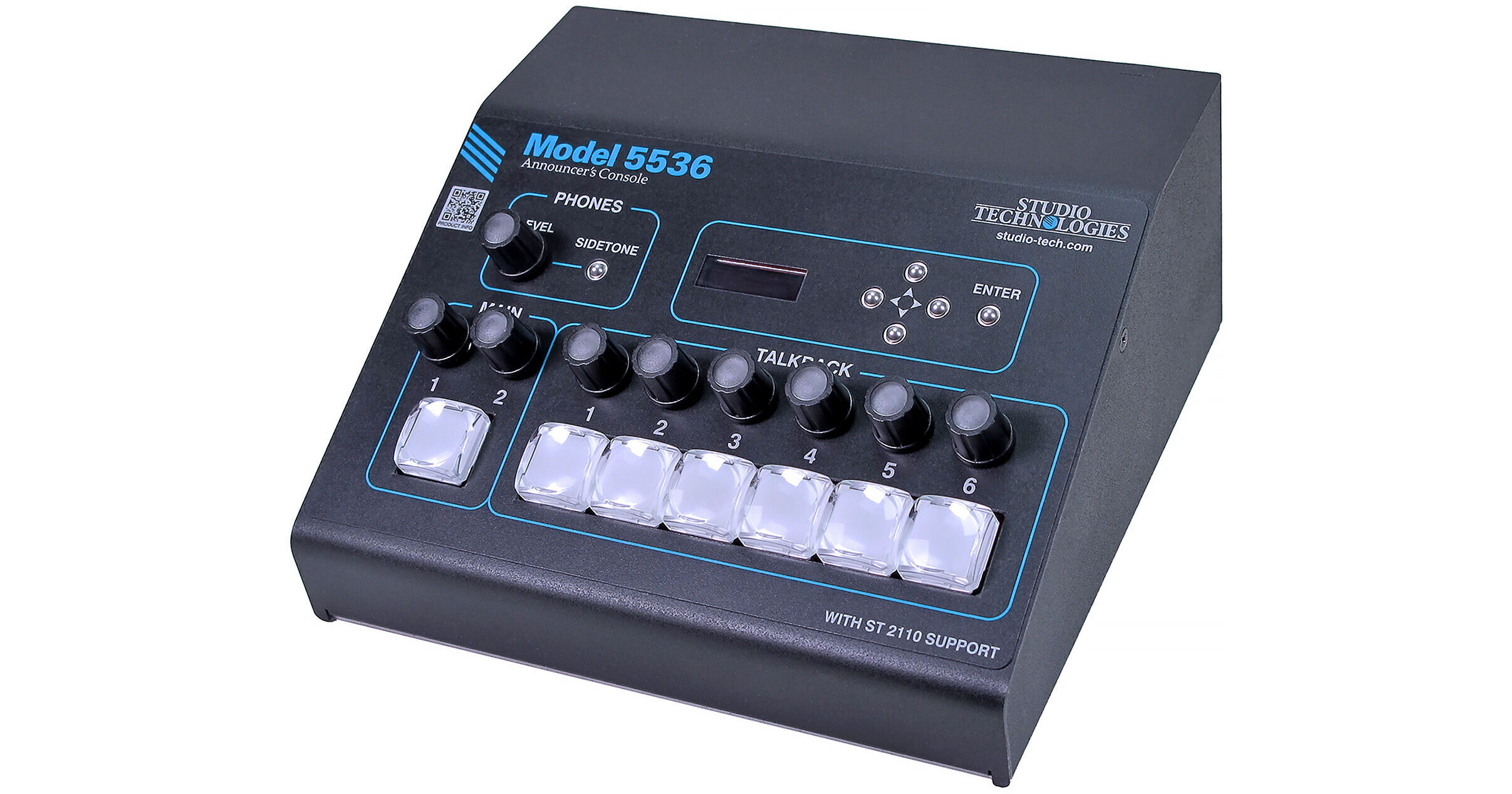
Studio Technologies Model 5536 Announcers Console with One Main and Six Talkback Channels

BH #STM5536 • MFR #M5536
Print
Studio Technologies Model 5536 Announcers Console with One Main and Six Talkback Channels
Key Features
  • For On-Air Location
  • Supports REMI/At-Home Applications
  • One Main & Six Talkback Channels
  • Mic Pre with Gain & P48 Power
Whether for broadcast sports, eSports, live events, entertainment, and streaming broadcast applications, the Studio Technologies Model 5536 Announcer's Console with One Main and Six Talkback Channels provides an unparalleled set of features. Compatibility standards aren't an issue for the Model 5536 thanks to it being SMPTE ST 22110 and 2022-7 ready via the rear RJ45 input jacks. Thanks to the six talkback output channels, on-air talent have flexibility with their overall broadcast applications. The unit sports a 1/4" headphone jack with independent level control, allowing flexibility for separate output levels.
More Details
Special Order
Expected availability: 7-14 Business Days
No Store Display
Free Standard Shipping
Protect Your Gear
Add a protection plan from $109.99
Ask an Expert
800-606-6969

Studio Technologies Model 5536 Overview

Whether for broadcast sports, eSports, live events, entertainment, and streaming broadcast applications, the Studio Technologies Model 5536 Announcer's Console with One Main and Six Talkback Channels provides an unparalleled set of features. Compatibility standards aren't an issue for the Model 5536 thanks to it being SMPTE ST 22110 and 2022-7 ready via the rear RJ45 input jacks. Thanks to the six talkback output channels, on-air talent have flexibility with their overall broadcast applications. The unit sports a 1/4" headphone jack with independent level control, allowing flexibility for separate output levels.

All configurations are fully customizable using a standard web browser, adding advanced customization options. With just a single PoE Ethernet Gigabit network connection, a microphone, and a pair of headphones, a complete broadcast on-air workstation can be created. Plus, the Model 5536's compact and rugged enclosure is small enough to transport and setup in many different environments.

ST2110 Audio-over-Ethernet
Using ST 2110 Audio-over-Ethernet protocol, the Model 5536's ten sender (output) channels and eleven receiver (input) channels can be routed using applications that support NMOS, ANEMAN, and a JSON API. Both the sender and receiver channels support 128, 64 in each direction, allowing for complex configurations to be organized. And if AES67 protocol is being used in an existing setup, the Model 5536 is capable of accommodating.
Flexible Power and Data Solutions
The Model 5536's ST 2110 interface can connect to one or two LAN networks by way of Gigabit Ethernet, while the third Ethernet interface is used for accessing the management webpage. Flexible power options is accommodated thanks to its PoE standards over the primary and or secondary ST 2110 interfaces, which also creates a redundant data and power backup. And alternatively, an external power source of 12 VDC can be connected using a 4-pin XLR male connector.
Talkback I/O & Controls
A broadcast headset or handheld microphone can be directly connected to the unit thanks to the unit's 3-pin XLR female input connector located on the rear panel. The input can accommodate both dynamic and condenser microphones, with built-in phantom power (P48) for the later. For headphone use, you can utilize the onboard 1/4" headphone output jack on the rear panel.

The Model 5536's front panel includes eight rotary controls, which are used to adjust the level of the ST 2110 receiver (input) channels that are then sent to the analog headphone output channels. In addition to the stereo analog headphone output, two ST 2110 sender (output) channels provide a digital version of the headphone output function for specialized applications.

Impressive Audio Quality
Starting with the onboard microphone preamp, gain can be adjusted over a range of 20 to 65 dB in 1 dB increments. A digitally controlled analog limiter, applied only to the connected microphone input, is able to adjust the signal level from overloading. The microphone signal is then routed to the analog-to-digital converter (ADC) that supports sample rates of 48 and 96 kHz. From here, the signal is routed through a 32-bit processor and sent over Ethernet.
Firmware Updating
The Model 5536's firmware can be updated via an Ethernet connection or by loading the firmware update onto a USB stick, and plugging into the rear panel's USB A connector.

Studio Technologies Model 5536 Specs

General
Management
Web User Interface, NMOS, Merging Technologies' ANEMAN, JSON API
Display
Panel Type
MicroLED
Size
Not Specified by Manufacturer
Touchscreen
No
Inputs/Outputs
USB I/O
1 x USB-A (Firmware Only) Female Input
Audio I/O
1x XLR 3-Pin Mic Input
1x 1/4" TRS Headphone Output
2x RJ45/etherCON AES67/RAVENNA Input (Primary and Secondary)
1x RJ45/etherCON Input (Management)
Audio Inputs
Network Audio: 11
Audio Outputs
Network Audio: 10
Sample Rate
48 and 96 kHz
Bit Depth
24
Frequency Response
Mic Input: 20 Hz to 22 kHz (+0/-1 dB)
Headphone Output: 20 Hz to 20 kHz (+0/-1 dB)
Impedance
Mic Input: 3.6 Kilohms, Nominal
Dynamic Range
Mic Input: 120 dB, A-Weighted
Headphone Output: > 110 dB, A-Weighted
Total Harmonic Distortion (THD)
Mic Input: < 0.0004% at 1 kHz
Headphone Output: < 0.002 a 1 kHz
Phantom Power
48 VDC (Selectable)
Network Protocols
Type: SMPTE ST 2110-10:2017, ST 2110-30:2017, AES67
Upgradeable Firmware
Via USB Type A
Power
Power Source
DC Input (Not Included), PoE
DC Input Power
10 to 16 VDC
Physical
Color
Black
Operating Conditions
32 to 122°F / 0 to 50°C up to 25 to 85% Humidity
Storage Conditions
-22 to 158°F / -30 to 70°C up to 5 to 85% Humidity
Dimensions
6.7 x 6.1 x 3.2" / 17 x 15.5 x 8.1 cm
Weight
2.4 lb / 1.1 kg

Studio Technologies Model 5536 Reviews

See any errors on this page?
Whatever You Need, We've Got It