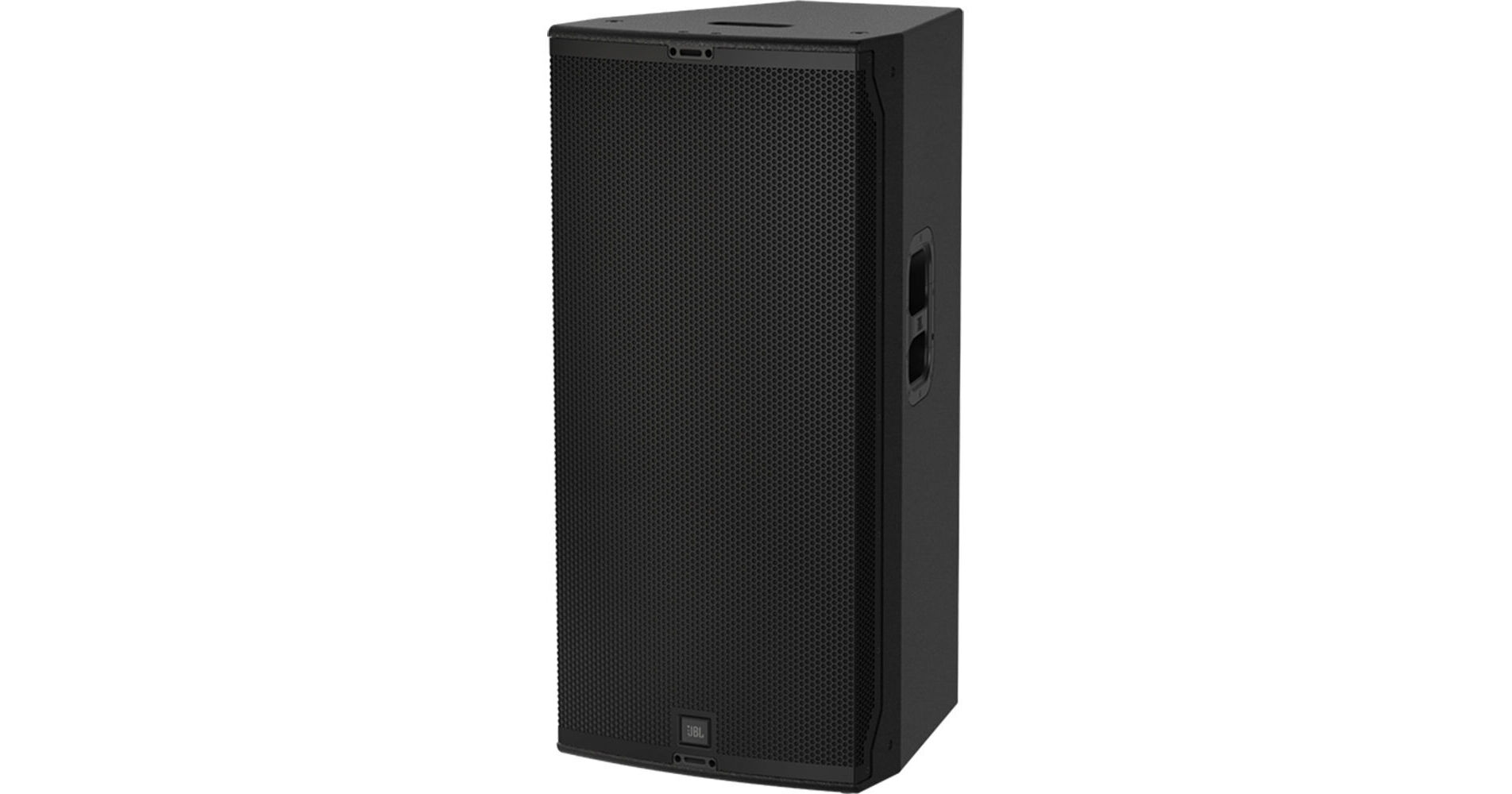
Engineered for applications requiring high output and precise directivity control from a trapezoidal full-range enclosure, the JBL SRX922 is a dual 12", powered 3-way point-source loudspeaker well suited for rental companies, touring artists, DJs, and installations. The integrated DSP and amplification offer a true plug-and-play experience while providing consistency and optimum performance anywhere in the world.
The dual 12" woofers feature a dipole configuration for enhanced vertical directivity control, while the 6.5" mid driver and 1.5" compression driver feature dual 90x60° Progressive Transition waveguides for smooth, predictable coverage. The drivers are powered by the built-in Class-D amplifier and with the four large, flared ports, extend the frequency response down to 50 Hz. The enclosure is made from outdoor-grade Baltic birch materials for excellent durability, while the eight M10 rigging points allow for flexibility in deployment whether in ground stacking or rigging. A full-featured software package provides users control of the system on various platforms including Windows, Mac, and iOS for iPad.
- Includes dual 12" LF woofers, a 6.5" horn-loaded MF driver, and a 1.5" annular-diaphragm compression driver
- Symmetrically arranged dual LF section provides double the low-frequency headroom of traditional single-woofer designs
- Dipole configuration delivers enhanced vertical directivity control
- Horn-loaded MF section enables LF drivers to operate in their most efficient and controlled bandwidth
- Dual 90 x 60° Progressive Transition waveguides provide smooth, predictable coverage
- Four large, flared ports extend low-frequency response down to 50 Hz
- 80 Hz high-pass preset available for applications using SRX900 subwoofers
- Voicing and phase response carefully optimized to match SRX900 line-source products
- Integrated amplification delivers plug-and-play operation
- Rear LCD enables fast configuration
- DSP includes 24 user-adjustable filters, 2000 ms delay, and essential loudspeaker management tools
- Eight M10 Quick-Link attachment points are provided for suspension using standard M10 eyebolts
- Constructed from outdoor-grade Baltic birch plywood for excellent durability
- Sound quality is the foundation of the SRX900 Series. Drawing on transducer technologies developed for JBL’s flagship touring systems, SRX900 delivers clean, detailed sound typically associated with top-tier touring systems.
- The SRX922's woofers are built on JBL’s proprietary Differential Drive dual-voice-coil, dual-gap design, which provides better heat dissipation, reduced power compression, and a wider dynamic range compared to conventional single-coil designs. This advanced motor architecture provides an ideal balance of output, weight, and thermal performance in an ultracompact form factor.
- SRX900 loudspeakers use proven JBL Professional compression drivers, selected to match the performance requirements of each loudspeaker. Line arrays use the 2432H-3 3" dome compression driver, taking advantage of its extended low-frequency capability to ensure a smooth transition between the HF and LF sections. Point-source models use the 2408H-1 1.5" compression driver, which offers smooth high-frequency extension in a compact package. Both drivers use neodymium motor structures that maximize efficiency while keeping overall weight and size to a minimum.
- Directivity has been in JBL Professional’s DNA for decades, with the company pioneering numerous technologies to perfect the science of controlling sound. A system that sounds great at front of house is good, but one that delivers excellent sound throughout the entire venue is truly exceptional.
- Point-source models use JBL’s patented Progressive Transition (PT) horns, developed to deliver improved real-world performance by balancing frequency response, pattern control, and distortion. A defining characteristic of this waveguide technology is the absence of a traditional diffraction slot; instead, the horn’s sidewalls transition smoothly from the driver throat to the rectangular mounting flange. This design enables constant beamwidth and constant directivity while improving frequency response, reducing distortion, and avoiding the typical “horn sound."