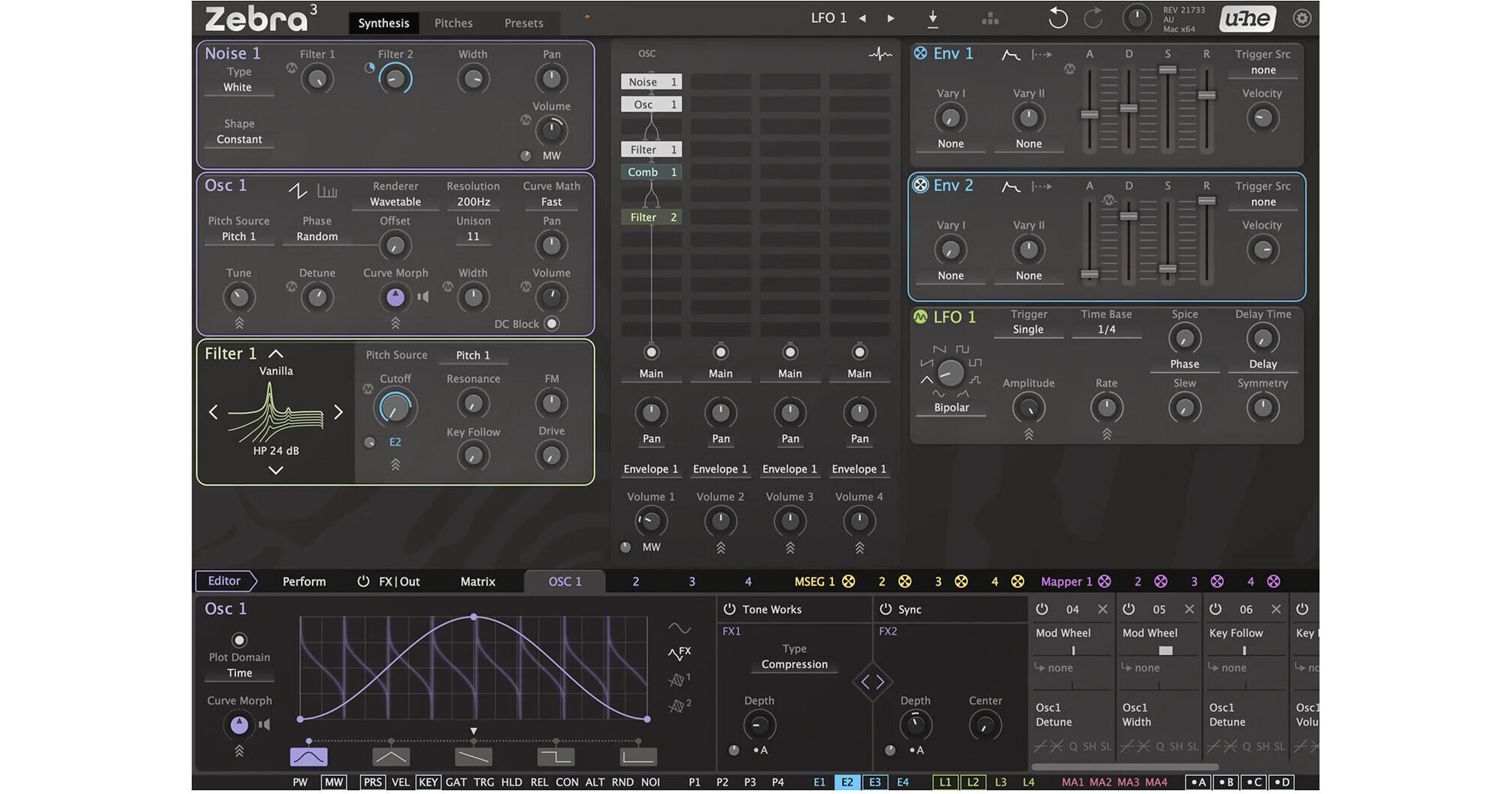
The Zebra 3 Deep Synthesis Plug-In from u-he is a powerful and innovative software synthesizer that combines pure digital synthesis, analog modeing, and physical modelng to give users a wide palette of both traditional and out-of-the-box sound tools to use in song building.
With dedicated Generator, Modulation, and Effects racks, the workflow is intuitive and simple while offering all of the tools demanded by professional engineers. Two oscillator engines (wavetable and additive), 20 oscillator effects, more than 1200 factory presets, and a Unified spline editor make up the backbone of this creative workhorse. Additional processing includes FM oscillation, modal resonation, ring modulation, noise, and exciter modules, among many others. With Vector mixing, up to 4 sources can be crossfaded or XY-morphed, letting you use automation to create funky alien sound character and motion. Zebra 3 combines the tools and powerful workflows of many of the industry's most popular soft synths into a professional and sleek graphical user interface.
- Four main oscillators morph between hand-drawn spline waveforms
- Render classic wavetables with up to 16-voice unison, or additive engines with up to 1024 sine partials
- Each oscillator has two serial FX slots offering 20 processes, from spectral filtering and phase distortion to animated spectral decay
- Four FM oscillators (comprising modulator and carrier pair) chain freely, with each accepting any rack signal as third operator
- Build complex FM algorithms without fixed topology
- Noise generators, exciters, and modal resonators designed to work together
- Dedicated wavefolder, ring modulator, and distortion modules
- Add harmonics anywhere in the signal path
- Vector mixing lets you crossfade or XY morph between four sources and almost any parameter in the rack
- Filter cutoff, fold depth, comb detune, resonator position
- Single voice architecture can go from pristine additive pads to gnarly physically modeled textures
- Treats modulation as seriously as sound generation
- Four ADSR envelopes offer velocity sensitivity and one-shot mode, with two parameters adding delay, curvature (self-modulation), stretching, or key scaling
- Four LFOs cover sine, triangle, saw, square, sample-and-hold, and smooth random, with tempo sync, phase offset and delay ramp for gradual onset
- Four MSEGs: up to eight morphable curves along a shared timeline with freely positioned loop points, using the same spline editor as the oscillator
- Attack, loop, and release macros dynamically scale speed and amplitude
- Beyond the Rack, on their own page, four dedicated Pitch modules give detailed control over tuning, glide, and quantization, independently managing up to four pitched parts within a single voice
- Many modulators double as triggers: an MSEG to sequentially trigger or modulate an Exciter, for dynamic physical modeling, bringing rhythmic and melodic structure into the voice itself
- Pitch and gates live on equal footing with regular modulations
- Shaping and combining modulation sources: Four Mappers let you reshape any modulation signal through a custom transfer curve, turning a linear ramp into a logarithmic sweep or a smooth fade into a stepped pattern
- Trigger signals can transform Mapper into a step sequencer
- Four Mod Math modules combine, multiply, and transform sources before they reach their target, so you can ring-modulate two LFOs against each other, or gate randomness with an envelope, without touching the signal chain
- FX Grid receives audio from the four voice lanes via four global buses: main plus three auxiliary sends
- Send levels from the voice grid are modulatable per voice; effect depth becomes part of the polyphonic expression, even though effects themselves are global
- ModFX units cover chorus, flanging, and phasing with their own internal LFOs, going beyond typical stage counts
- Up to eight-voice choruses and 24-stage phasers with choice of digital or analog feel
- Delays offer mono, stereo, and ping-pong modes with tempo-synced note divisions, feedback filtering, modulation and Diffusion (smearing) option, available in both analogue-modelled and digital modes
- Two Reverb models: Classic and Lush reverb models offer everything from tight rooms to vast halls, while the TextureVerb effect scatters granular microfragments of audio, shimmering, and abstract ambiences
- Compressors placed anywhere in the grid can glue reverb tails, tame dynamics after deep modulation effects, or produce side-chain-style pumping entirely within the patch
- EQs, Filters, Distortion, Ring Modulator, and Wavefolder modules share naming conventions with the Generator Rack, so tonal options you know from voice-level processing are also available for post-mix shaping
- Two stereo mixers, a 4-in-1 mixer with vector and scan function, plus a complex 4-in-4 mixer are available in the FX section
- Adaptive interface: Modules only appear when added to the patch, organized via drag and drop
- Over 1200 factory presets
- Unified spline editor for oscillator waveforms and MSEG curves with geometric morphing
- Two oscillator engines: Wavetable (up to 16× unison) or additive (up to 1024 partials, can be inharmonic)
- 20 oscillator effects including spectral decay, sync, phase remapping and more
- Filters with 13 models, both classic and original (Ladder, Cascade, SVF etc.) each offering up to 12 responses (e.g. LP, HP, BP, with 6/12/18/24 dB/oct)
- FM oscillators with two operators plus an audio input as a third operator
- Modal resonators and comb filters with detailed control over feedback and damping for physical modelling synthesis
- Noise and Exciter modules for realistic transient and physically modeled sources
- Vector and Scan mixers: Blend four sources with the XY pad (loopable), or scan through them sequentially
- Pitch, gate, and trigger signals for triggering and modulation
- Modular-style routing freedom
- Mod Math modules for combining and transforming modulation signals
- Mappers that act as step sequencers or as freely drawable transfer curves for other modulators
- Ring modulators, distortions, wavefolders, and equalizers (as global effects and per voice)
- Delays, multitap delay, reverbs, compressors etc. in global FX grid with per voice send amounts
- Available as CLAP, VST3, AU, and AAX on macOS, Windows and Linux support for MPE, microtuning, MTS-ESP (real-time tuning)