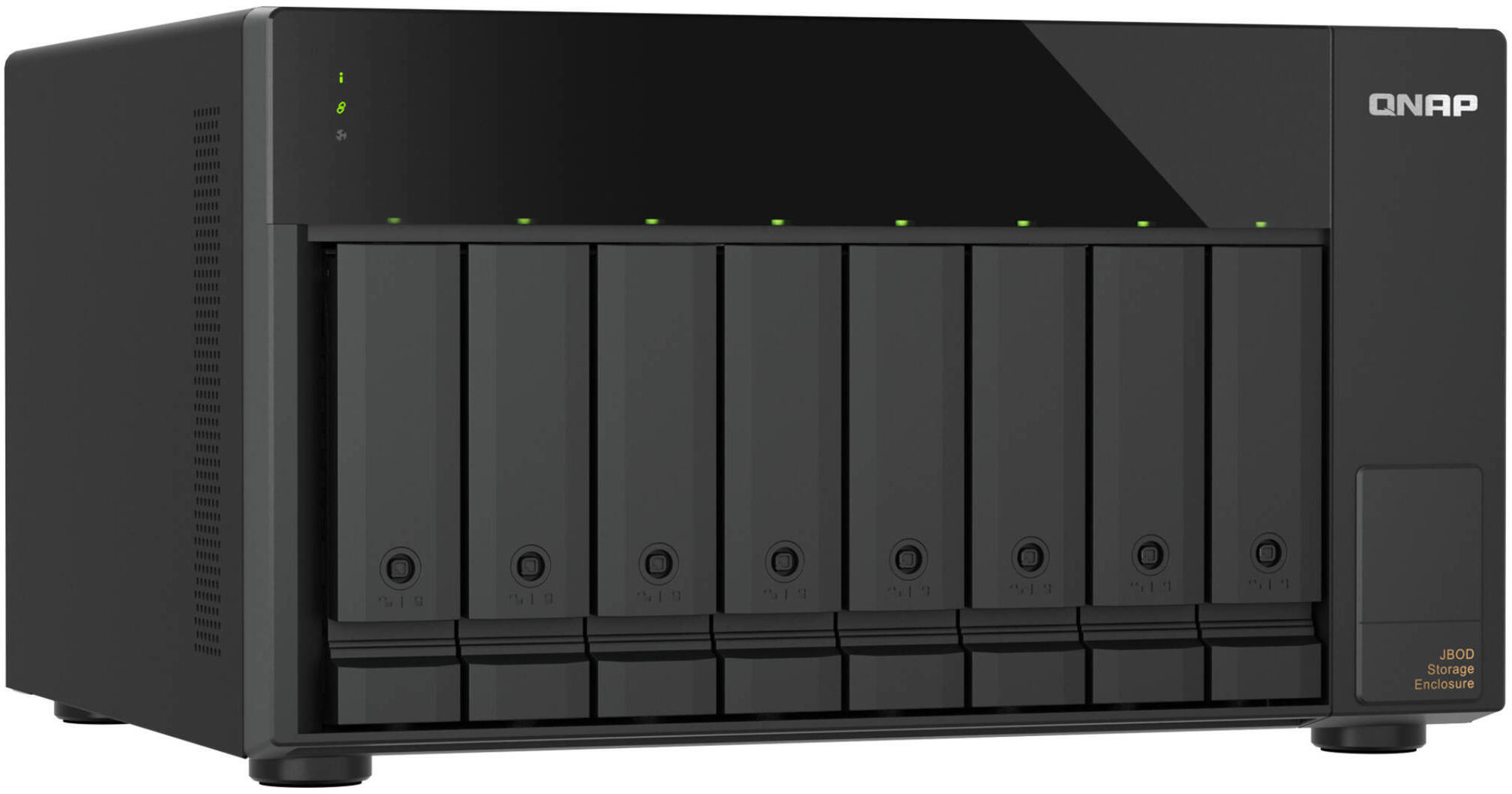
The TL-D810TC4 8-Bay JBOD Expansion Enclosure from QNAP is an expansion solution for creators and personal users with high storage demands, providing high speed access, convenient deployment, and easy management of data and backups. It connects to your Windows, Mac, Ubuntu, or NAS host device via plug-and-play using a 40 Gb/s USB4 port. Its eight 2.5"/3.5" drive bays support SATA III 6 Gb/s and SATA II 3 Gb/s drives, which may be set up as a JBOD or software-controlled RAID. If you need to upgrade your storage performance, there is an available PCIe slot which accommodates a QXP-40G2UC expansion card, which provides two additional USB4 ports. Read speeds are supported up to 2997 MB/s, while write speeds max out at 2272 MB/s.
Please note that the TL-D810TC4 is compatible with USB4, Thunderbolt 4, and Thunderbolt 3 only. USB 3 and earlier versions are not supported.
Note: To utilize UASP, your computer and OS must support it.
Read speeds up to 2976 MB/s, write speeds up to 2236 MB/s.
QTS RAID 5
Read speeds up to 2977 MB/s, write speeds up to 1802 MB/s.
Windows RAID 0
Read speeds up to 2734 MB/s, write speeds up to 2272 MB/s.
Windows RAID 5
Read speeds up to 2720 MB/s, write speeds up to 717 MB/s.
Ubuntu RAID 0
Read speeds up to 2997 MB/s, write speeds up to 2191 MB/s.
Ubuntu RAID 5
Read speeds up to 2977 MB/s, write speeds up to 1339 MB/s.
Create an Independent Storage Pool
Using QNAP software RAID, you can create an independent storage pool in TL-D810TC4, supporting RAID migration and disk replacement. Enjoy the same management experience as your NAS's main storage pool.
Note: The TL-D810TC4 can only be used as an independent storage pool or disk area. It cannot be merged with the NAS's main storage pool or disk area, and system applications can only be installed on the NAS itself.
Set as External Disk Mode
Alternatively, use it as an independent storage box (each hard drive is seen as an independent space), providing additional storage space for quick transfer or short-term backup needs, improving efficiency and data security.
Whether it's large files, 4K videos, or work materials, you can easily store them, freeing up space on your local storage.
Software RAID Setup
Use the built-in tools in your system (Windows Storage Spaces) to combine multiple hard drives into a software RAID, improving data security or read/write performance as needed.
Note: Due to platform incompatibilities, once configured in software RAID mode, the storage cannot be used across different platforms.
Single Disk Mode
Each hard drive can be read and written independently, like a large multi-bay hard drive system. When one disk is full, you can remove it and replace it with a new one. You can also reinsert a disk with existing data to access its contents, ideal for large data batch storage and archiving.
1. Mac users can manage TL-D810TC4 using the latest JBOD Manager v1.3.
2. Windows users can easily manage TL-D810TC4 with the latest JBOD Manager v1.3.
3. Linux users can easily manage TL-D810TC4 with the latest JBOD Manager v1.1.
Note: If a software RAID is configured, TL-D810TC4 data migration only supports use on another host with the same system.
- TL-D810TC4 currently supports QTS 5.2.x (or later) and QuTS hero 5.2.8 (or later) operating systems only.
- When connecting this product via the QXP-40G2UC, some NAS models require a minimum BIOS version update. Please refer to the Compatibility List.
- The TL-D810TC4 is compatible with USB4 (for NAS, Windows, and Mac),Thunderbolt 3 (for NAS and Mac), and Thunderbolt 4 (for NAS, Windows, and Mac) ports.
- The TL-D810TC4 is compatible with USB4 and Thunderbolt 4 only. USB 3 and earlier versions are not supported.
- The TL-D810TC4 can only be migrated with TL USB series JBODs, and not with other JBODs or devices.
- To avoid abnormal performance, you must follow the proper power-on and power-off procedures as per the user manual.
- To ensure optimal system compatibility, transfer performance, and data integrity, please connect the external enclosure directly to the USB port of your NAS, PC, or Mac. Do not connect a USB hub or docking station between the host system and the expansion unit.