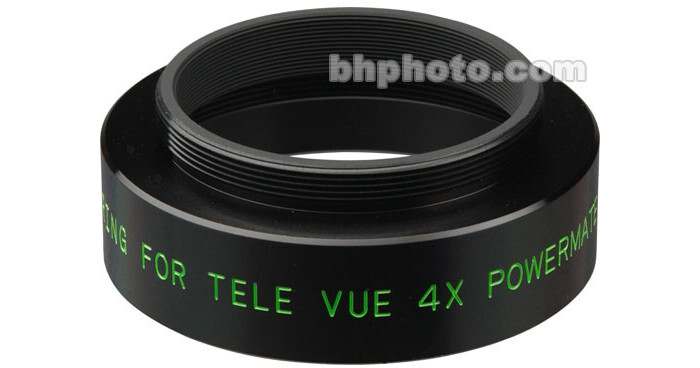
The T-Ring Adapter for 4x Powermate from Tele Vue is used to attach a DSLR camera to the 4x Powermate. One end of the adapter attaches to the Powermate, and a camera-specific T-Ring goes on the other end to mount your camera.
Ask Our Experts866-264-7509
Hello, Log InAccount & Orders
Key Features
- For Use with 4x Powermate
- Requires Camera-Specific T-Ring
The T-Ring Adapter for 4x Powermate from Tele Vue is used to attach a DSLR camera to the 4x Powermate. One end of the adapter attaches to the Powermate, and a camera-specific T-Ring goes on the other end to mount your camera.
Tele Vue PTR-4201 Overview
Tele Vue PTR-4201 Reviews
Great image train solution.
By Michael
Rated 5 out of 5
Date: 2020-09-06
Perfect match for the 4x Powermate, just as expected. Clean, tight, perfect.
High quality barlow accessorie
By ENALNAPA
Rated 5 out of 5
Date: 2012-03-04
I'm using 4x Powermate for astrophotography with an E0N 72mm. The SLR Camera Adapter makes easier the use of the 4x Powermate and eliminates some weight of the barlow.
See any errors on this page?
Is the thread size 42mm .75 pitch?
Yes, the Tele Vue T-Ring Adapter for 4x Powermate has a M42x0.75 threading.
Date published: 2022-05-06
What is the thread size is it 42mm x .75 pitch?
It has T-threads. T_threads are approximately 42mm
Date published: 2021-04-06
question
what size IR and UV cut filter you suggest with this and 4X powermate(2 )?.
First, note that this adapter is of no use unless you have the newer version of the 4x Powermate that separates in the middle. This adapter replaces the half of the Powermate that normally holds the eyepiece and allows the Powermate optics to be more rigidly mounted to the camera. The male threads of this adapter mate with female threads of the T-ring mounted in place of the lens on your camera. If you are using a camera that you know lacks a UV-IR cut filter, a 48mm UV-IR cut filter can be screwed into the bottom end of the Powermate where light enters from your telescope. Note that off the shelf DSLRs generally have built-in UV-IR cut filters so that colors come out close to the intensity seen by the human eye and therefore generally don't need another UV-IR cut-filter. Astronomical CCD cameras, and DSLRs that have had their UV-IR cut filter removed, and security cameras (with extended IR sensitivity) may give sharper images with a UV-IR cut filter, especially when using a refractor (lens based) telescope, since refractor optics often aren't corrected well for UV and IR light.
Date published: 2020-07-11