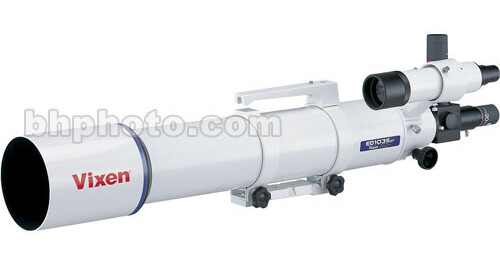
- 795mm f/7.7 Apochromatic Refractor
- Made in Japan
With its refractor design benefitted from ED glass elements, chromatic aberration has been reduced to nearly undetectable levels-permitting a more practical use of the higher magnifications quoted in the specifications than a similarly-sized normal achromatic refractor. ED Glass has returned refractors as a premium telescope choice, competing with ubiquitous 8" and larger Schmidt-Cassegrain designs. While the catadioptric scopes do bring in enormous quantities of light, they simply cannot deliver the contrast, dark backgrounds, and wide viewing fields of the apochromatic refractor. There is a place in the market for both; the 'big cats' allow you to see the faint deep sky stuff, but for many other objects the ED refractors yield the better viewing.
Vixen's ED103S, like all of their premium apochromatic refractors, has a 60mm inner diameter focuser drawtube. Vixen chooses this size because the scopes are intended to be as good at imaging as they are as observing devices-a large focuser inner diameter permits use of larger CCD cameras and benefits typical SLR cameras by reducing internal vignetting and reflections. Vixen has a complete lineup of imaging accessories, and their scopes remain a popular worldwide choice for serious astrophotographers. Provided your mount can keep things stationary, the big ED refractors make superior images than nearly any Cassegrain model-much more intense color with crisper star pinpoints and inky-dark sky backgrounds.
The ED103S is delivered with Vixen's tube rings and a dovetail tube plate, ready to mount on any Vixen equatorial mount (as well as upon the less expensive Celestron CG-5 or Meade LXD 75 mounts if you're focusing the budget on the optics). The rear tube ring has an attached handle to facilitate easier setup. Rounding out the package is a fine 7x50 finderscope with bracket and mounting shoe, and Vixen's flip mirror diagonal. The flip mirror can be configured to accept a 1.25" eyepiece on the 90° axis and an SLR camera on the straight-through axis, and you can choose to image with or without an eyepiece in the optical path (no eyepiece results in lower magnifications and shorter exposures). For an observing experience that truly justifies choosing an apochromatic refractor you can convert to 2" eyepieces with an optional 2" star diagonal, so that you can use a 25-40mm 2" eyepiece for a breathtaking wide field view.