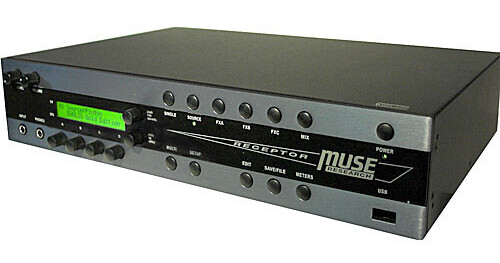
Various manufacturers have developed solutions to running power hungry software audio processors, either inside the computer or as external DSP processors. Muse Research has gone a step further with their Receptor Pro Jr. Rev C2, by allowing the external hardware unit to function as a DSP addition to a computer set up, or as a stand-alone, self-contained sound and effects module with dedicated analog and digital I/O. MIDI I/O is also included.
The Receptor comes loaded with a selection of virtual instruments and plug-ins along with software that functions fully for a thirty-day demo period, at the expiration of which the plug-ins required by the user can be easily purchased. Additionally, certain Windows-based VST instruments and plug-ins already owned by the user can also be installed on the unit. (The company is actively working with VST plug-in manufacturers to allow their products to be downloaded to the unit.)
When used with a Mac or PC computer setup, the processor communicates with the host computer via Ethernet and functions just like an additional DSP processor. In stand-alone mode, the unit can either be controlled from the front panel, or the user can hook up a monitor, keyboard and mouse and interact with the Receptor as if it were a computer (which it is, running a proprietary Linux operating system.)
In stand-alone mode, the unit functions just like any other hardware sound module or effects processor, and can be accessed by vocalists, guitarists, drummers, keyboard players, even by several players at once. Aside from stereo analog input and output, the Receptor has ADAT output along with coaxial S/PDIF I/O.
The unit has a sixteen-part multi-timbral software mixer that includes two dedicated stereo effects busses, each of which contains three "insert" type effects to which the user can assign any VST plug-in. Receptor supports virtual instruments that have multiple output assignments and multi-timbral plug-ins.