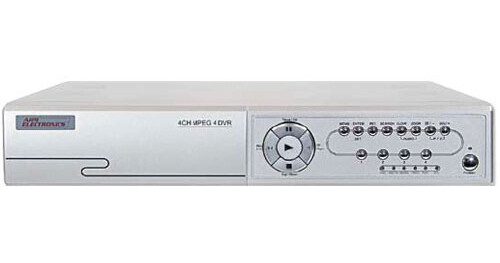
In a sea of surveillance DVRs, the ARM Electronics RT4250G stands out with its ability to record a full 30 FPS per camera, resulting in natural looking motion without the choppy images inherent to slower speed DVRs. Aside from making it easier on the eyes of a security operator, a higher recording speed also means a better chance of finding the frame exhibiting the most identifying characteristics.
Real Time Recording of FPS Per Camera
Video is captured at speeds up to 120 FPS for the combined channels. This means that even with all channels occupied, users will get a maximum recording speed of 30 FPS per camera. The primary benefit of this is that the more frames there are available, the better the chances are of finding one exhibiting the most identifying characteristics. Naturally, an operator can choose a lower frame rate in order to conserve hard drive or network resources.
MPEG-4 Compression
Given its ability to generate quality video images while keeping file sizes to a minimum, MPEG-4 is the preferred compression method for use in DVRs. In practical terms this means that demanding CCTV environments will get the high resolution images they need to better identify people and objects. At the same they won't have to worry about prematurely running out of hard drive space or getting bogged down in a network traffic jam.
Loop-Through Video Inputs
Each video input is paired with a loop-through video output, allowing its signal to be independently sent to an auxiliary monitor or DVR.
Pentaplex Operation
A built-in multiplexer allows video from all connected cameras to be simultaneously viewed live, recorded, played back and archived both locally and over a network.
Local and Remote PTZ Control
Users can access the DVR from a remote network location to view live and recorded images as well as to operate the motorized PTZ functions of compatible dome cameras.
Advanced Motion Detection with Email Alerts
An elaborate motion detection function can be applied to each video channel. Motion detection parameters can be individually set for each camera input. In practical terms, this will allow a camera pointing at a bank entrance, for example, to be set at a lower intensity level than a camera pointing at the bank's safe. Alarm events triggered by motion detection or by an external sensor can be sent in the form of an Email alert to designated PCs over the network.
Loop-Through Video Inputs
Each video input is paired with a loop-through video output, allowing its signal to be independently sent to an auxiliary monitor or DVR.
Covert Camera Function
Any camera can be selected to record in the background without actually visually appearing on the monitor.
Watermark Function
A watermark stamp can be applied to recorded images to prevent them from being digitally altered, thus preserving their legal integrity.