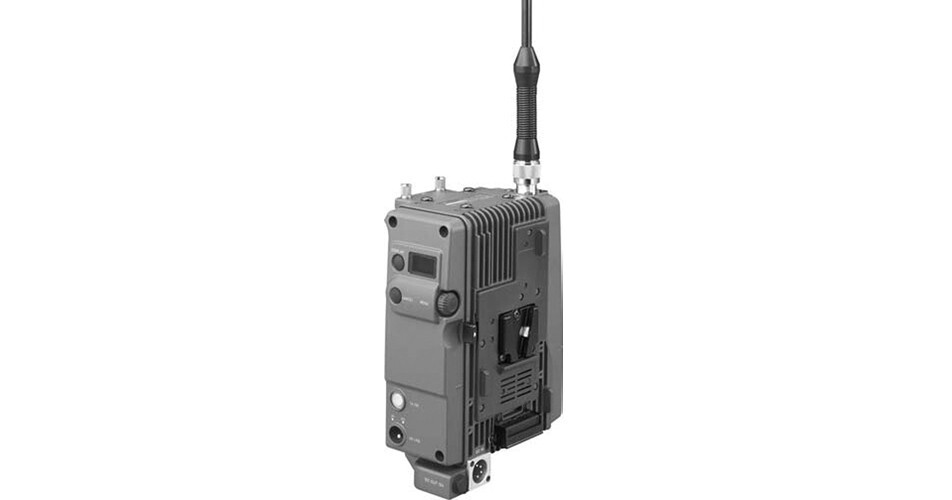
The Sony WLL-CA50 MPEG Wireless Adapter is part of a wireless camera system that allows the digital transmission of broadcast-quality MPEG-2 video from a Sony camera to an OB van or other mobile studio. With the increased gain in mobility that untethering the camera from its base provides, the WLL-CA50 brings new levels of accessibility to covering live events such as news and sports. This compact unit docks easily to the back of nearly any SD camera with a standard V-mount interface and Sony 40-pin camcorder output.
Note:
Requires use of WLL-RX50 or WLL-RX55 receiver, which must be purchased separately.
Compact Construction
The WLL-CA50 is a compact adapter which fits directly on most Sony camcorders to provide very quick and easy conversion to wireless mode. It weighs just 2.6 lbs (1.2kg), and adds only 2.6" (6.5cm) to the length of the camcorder. A standard Sony battery fits directly to the rear of the adapter.
Compatible w/Most Sony Broadcast Camcorders
Compatible camcorders include:
MPEG IMX: MSW-900P
Digital Betacam: DVW-700WSP, 707P, 709WSP, 790WSP
Betacam SX: DNW-7P, 9WSP, 90P, 90WSP
Optical Disc: PDW-510P, 530P
Simple Menu Operation
All transmitting parameters are controlled using an LCD display on the side of the adapter, and operation is simple to use for efficient field operation. Operating frequencies, modulation parameters, interleaving modes, etc., can be quickly recalled using a variety of preset operating modes.
Secure Encryption Key
To ensure that the transmitted signal can only be received by an authorized person, a three digit Encryption Key code can be added to the transmitted signal. The signal is then scrambled, and the same key must be entered in the receiver in order to receive the signal.
Programmable Operating Frequency
The Wireless Link system can be set to one of 7 preset operating frequencies in the 2.4 GHz band. These frequencies are set with 12 MHz channel spacing. The actual occupied bandwidth is only 8MHz, which leaves a 2 MHz guard band at both ends of the channel. If required (to avoid interference, for example), the center frequency can be manually adjusted in 1 MHz steps within each channel.