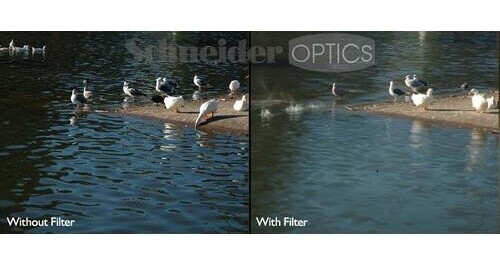
A B&W 46mm Digital Pro 101 Neutral Density (ND) 0.3 Filter has several uses and offers the possibility to achieve otherwise unachievable results. ND filters appear grey and reduce the amount of light reaching the film. They have no effect on color balance.
Neutral Density filters permit you to create unique effects. When using high speed film in bright light, an ND filter will allow you to blur motion such as speeding cars or moving water. This permits adjustments in aperture and exposure that would normally not be possible without the filter.
Determining which neutral density filter yields ideal results for any given lighting situation takes knowledge, experience and a collection of such filters. Speaking generally, the 2-stop value (ND 0.6) effectively compensates average situations.
The reputation of B+W's Schott glass is world renowned. The high production standards combined with a sturdy brass filter ring make B+W filters hard to beat. Schott Glass used in the manufacture of this filter is legendary and synonymous with the highest standards of filter production. It comes with a solid 10-year warranty.These filters have a "heft" to them that is impressive. They may feel heavier but the benefit is in the construction and results. Not only is the glass exceptional but so is the seal between the ring and glass.
The filter ring is made from brass yielding a stronger product. Brass filter rings are also less prone to jamming. In addition, the seal between the glass and filter ring is exceptionally strong giving the filter added strength and durability.
In production, the filter glass is dropped into the empty filter ring from the rear and held in place with a threaded retaining ring; this is a definite advantage over a competitor who uses a spring clip to hold the glass in place. A threaded retaining ring will hold the glass firmly and securely in place to avoid the possibility of rattling and provide perfect parallelity and flatness to your front lens element for ideal optics. The part about additional filters not binding is due to the fact that brass is a very stable metal and does not contract or expand like alloy.