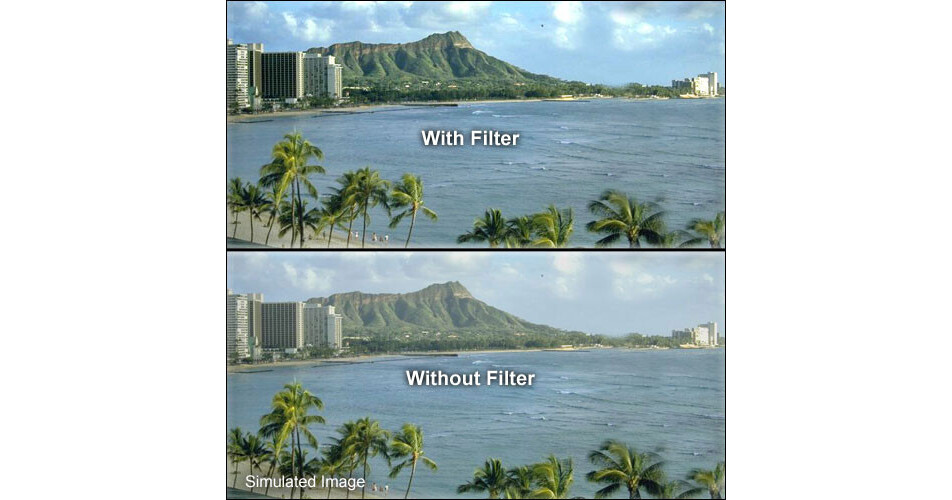
The B+W 55mm Digital-Pro UV/IR Cut (486M) MRC Filter is an interference filter designed to reflect and break up wavelengths on both sides of the visible spectrum (infrared and ultraviolet) in order to gain a more pure transmittance of the visible spectrum. The filter is completely colorless and is comprised of thin layers with varying thicknesses, similar to a multi-coating. By utilizing this method of construction, unwanted UV and IR radiation is not absorbed but rather repeatedly reflected in order to affect and skew the wavelengths in order to provide a steep cutoff between spectrums.
This filter is mainly used with digital and video cameras with a CCD sensor without an internal IR protection filter. A CCD sensor is especially prone to infrared radiation that can result in color shifts and un-sharpness. These effects are due to chromatic aberrations from lenses which are only corrected for visible light that offer no protection to non-visible wavelengths. In the visible range, the transmission curve is very high and straight for a clear, abrupt separation between the visible and non-visible ranges of the spectrum. Since it is optically clear, there is no need for exposure compensation.
The Multi-Resistant Coating (MRC) is both an anti-reflection coating as well as a protective surface. It helps to increase light transmission by reducing reflections, scattered light, and ghosting. Additionally, it offers greater protection to the filter substrate and stays cleaner for longer than uncoated filters.
B+W filters are constructed from high quality Schott glass for increased optical clarity and color fidelity. They feature a brass filter ring for durability as well as jamming prevention. The Digital-Pro mount refers to the brushed chrome filter ring opposed to a standard black ring.
Note: This filter is not suitable for wide-angle lenses with an angle of view greater than 60°.
Unlike mass integrally colored filters, this filter is based on thin-film technology. More than 30 interference coatings are vapor-deposited on one side, while the opposite side is MRC-coated. In wide-angle lenses, the laws of physics lead to shallower incidence angles for peripheral rays. For geometric reasons these rays have to travel further through the interference coatings than rays traveling vertically through the coatings in the center of the lens. With increasing angle of incidence, this leads to a change in light color towards blue. This effect can clearly be seen by looking at an UV/IR barrier filter from an angle. The color of the reflected light changes, with a similar effect on the light traveling through the filter. If paired with a wide-angle lens, there will likely be false color shifts or undesired effects.