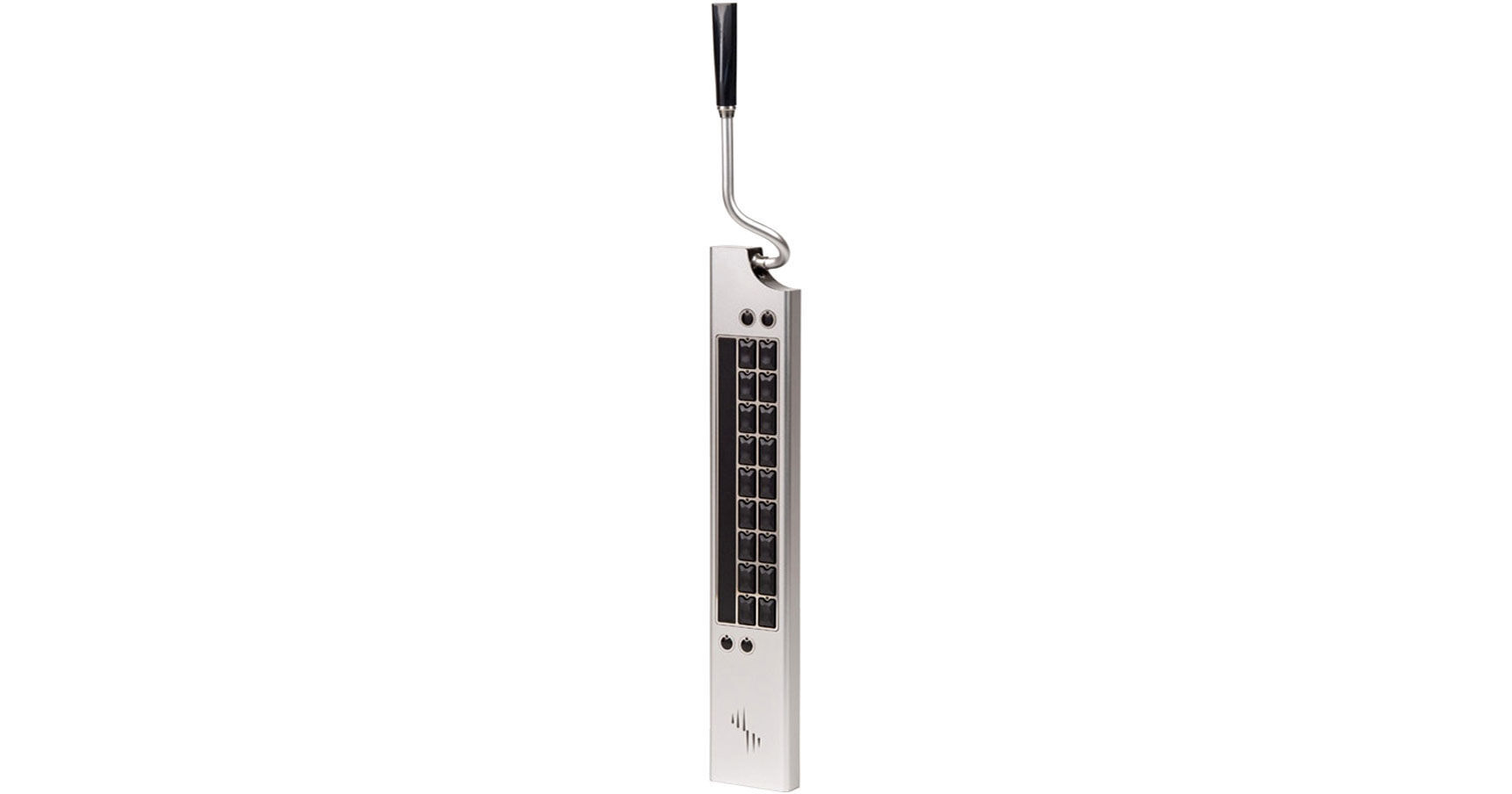
The Eigenharp Pico from Eigenlabs is a simple to use performance instrument/controller that allows a musician to play and improvise using a limitless range of sounds with virtuosic skill. It delivers endless permutations for control and expression of either the supplied instrument sounds, or of virtual instruments from other manufacturers. Light and portable, the instrument is ideal as a solo instrument or for playing in a band.
The instrument consists of a unique control "surface" containing a total of 18 highly sensitive playing keys that are internally sampled at 2,000 samples per second to deliver incredibly detailed control nuances. The sampling is also applied to the strip controller and the breath controller, providing almost endless possibilities for flexible keyboard layouts, fast instrument switching, and expressive musical control.
The Pico, when connected to a required Mac computer, can play and record loops, change scale and key, transpose, alter tempo, program beats, create arrangements, switch and layer multiple sounds, all while the musician is performing live on stage. Additionally for the solo performer, it can control an entire set. A very comprehensive built-in sequencer works for both percussion sounds and pitched instruments.
A feature rich software system provides a wealth of musical performance features that includes the already mentioned playback of the instrument's own native sounds, along with many common software plug-ins, Soundfonts, or external MIDI instruments via the MIDI outputs available on the included base station. The entire system has been built to withstand the rigors of live performance, and since all sound generation takes place on the computer, the controller will never become obsolete.
- Soundfont oscillator (SF2 files, other sampler formats such as ESX24 can be used via CDXtract) with ability to cross fade between two sample sets on key yaw
- AHDSR envelope generator (with complex functions for key press shaping)
- Drummer (plays AIFF loop files with tempo time stretching)
- Sine/Sawtooth/Square oscillator
- High-, Low-, Band-pass filter
- Ladder filter
- Gain control
- Mixer with effects sends/returns and stereo panning
- Cello physical model (can be bowed via strip controllers, breath pipe or a key)
- Clarinet physical model
- Audio Units host
- Hardware MIDI Output interface
- Hardware MIDI Input interface
- Convolution engine
- Multi-tap, multi-line delay
- Value range changer
- Keyboard splitting, routing, and course definition
- Recording and playback of takes
- Musical Scales and pitch bending
- Metronome for musical clock generation (including a tap tempo function to set tempo from a key)
- String model to impose string-like or wind instrument type monophony
- Grouping of modules into defined software instruments
- Scales can be defined in an instrument, or can be associated with a key routing so that the scale, octave and tonic change according to how the instrument is being played
- 86 built-in scales
- Global and individual instrument mixer channel volume changes
- Parameter and configuration changes
- Various actions in the graphical interface
- Starting and Stopping of the metronomes
- Playback of recorded takes
- Initiation of a new recording
- Starting and stopping drum loops
- Playback of a single note
- Changing key
- Changing scale
- Changing tempo
These actions can be triggered by various modules, which currently include:
- Talkers - triggering an action mapped to a specific keypress
- Scheduler - triggering actions at times within a song
- Arranger - triggering according to a repeated pattern (i.e. step sequencing)
- Talker actions can also be triggered by MIDI input notes from external MIDI hardware, so MIDI foot boards can be used, for example, to change key or tonic, or tempo, while playing