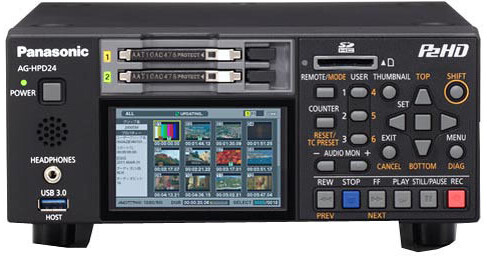
The Panasonic AG-HPD24PJ Solid-State P2 Portable Deck is a lightweight (at 4.4 lb) yet extremely powerful recording device for professional HD production. With outputs for HDMI and HD-SDI as well as composite video, the 1/2 rack-wide, 2 RU-high HPD24PJ deck can serve a versatile monitoring station as well as the heart of a logging station for production in the studio or, with its included battery, in the field.
The deck has two slots for P2 cards and acts as a USB 3.0 device, so you can easily & quickly offload files to compatible hard drives. The AJ-HPD24PJ has a 3.5" LCD screen that shows not only thumbnails and live playback video, but also a waveform and vectorscope.
The AG-HPD24PJ supports AVC-Intra recording at 50 and 100 Mb/s. This intraframe codec offers extremely high-quality compression that produces high-definition files whose quality can stand firm against multiple post-production passes. The deck also supports DVCPRO HD and, for standard-definition compatibility, DVCPRO50, DVCPRO, and DV. The HD codecs support 1080p, 1080i, and 720p formats, and with the deck's HD-SDI inputs, the HPD24PJ can input 1080/24PsF (progressive segmented frame) material and output it, making the deck appropriate for digital cinema productions.
Featuring time code in and out as well as RS-422 control, the HDP24PJ thrives as an NLE deck as well as a component in a live-event environment, recording the feed of a switcher. Recording options are manifold, thanks the dual P2 slots: You can record to both cards simultaneously or in-line, and you can hot-swap the P2 cards. Auto Rec responds automatically to the presence of an HD-SDI signal, and Loop Rec keeps the recording going non-stop, recording over each card's existing contents in turn. Using the HDMI output and the HD-SDI input of two identical AG-HPD24PJ portable decks, you can set up a system that can record and play back separate left-eye/right-eye channels of 3D video.
AVC-Intra 100: With the same bit rate as DVCPRO HD, this mode gives you full 10-bit recording with 1920 x 1080 pixels. It captures master-quality video for high-end image production.
AVC-Intra 50: This mode delivers video quality very similar to that of DVCPRO HD with 1440 x 1080 pixels, yet is able to do so at bit rates usually associated with standard definition (e.g. DVCPRO 50). AVC-Intra 50's lower bit rate doubles the recording time and cuts the data transfer time in half
Hot-Swap Rec: Thanks to the two card slots, you can hot-swap P2 cards for continuous non-stop recording. With multiple cards you can record for hours without interruption.
Auto Rec: This function automatically starts recording in response to SDI video input.
Loop Rec: This function continuously records video data onto available memory card areas. When the card becomes full, older data is deleted to free up the recording area, resulting in loss-less, endless recording. When used with cameras for time-sensitive information gathering like weather and news reporting, the Loop Rec function holds the latest video data for a predetermined time period
Shot Marker: During or after recording, you can mark each clip with OK, NG, or another designation.
Clip Metadata: This function lets you browse and edit metadata, such as the name of the camera operator and reporter, shooting location, and text memos. Text data can also be easily inserted by connecting a USB or software keyboard, and metadata files can be uploaded from an SD/SDHC card
Variable Speed Playback: For slow-motion and double-speed playback.
PB Position Selection: This lets you select the playback position when playing from a thumbnail image. You can select from three different options: Previous playback position, thumbnail time code position, or the beginning of the clip.
Repeat Playback: This plays the selected clip (single or multiple) repeatedly
USB 2.0 (Device): Device mode allows its use as a P2 card drive for a PC (nonlinear editor).
Playback: P2 MXF files on an external storage device can be displayed as thumbnails and played back. P2 audio playback is uninterrupted by slow hard disk performance, or when vibration temporarily delays data reading