Please update your browser to take advantage of the latest technology security enhancements to ensure your B&H Shopping experience is as safe as it is enjoyable:
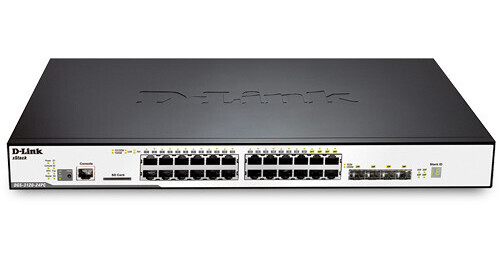
The DGS-3120 24-Port xStack L2 Managed Stackable PoE Gigabit Switch from D-Link is an enhanced L2 stackable switch designed to connect end-users in a secure SMB or enterprise network. This switch support physical stacking, multicast and enhanced security, making it an ideal Gigabit access layer solution for any network. The DGS-3120-24PC switch is embedded with two different software images - Standard Image and Enhanced Image.
The DGS-3120 24-Port xStack L2 Managed Stackable PoE Gigabit Switch from D-Link is an enhanced L2 stackable switch designed to connect end-users in a secure SMB or enterprise network. This switch support physical stacking, multicast and enhanced security, making it an ideal Gigabit access layer solution for any network. The DGS-3120-24PC switch is embedded with two different software images - Standard Image and Enhanced Image.
The DGS-3120-24PC provides 20 10/100/1000 Mbps Gigabit Ethernet ports and 4 combo 1000BASE-T/SFP Gigabit Ethernet ports. It provides 24 10/100/1000 Mbps PoE Gigabit Ethernet ports and 4 combo 1000BASE-T/SFP Gigabit Ethernet ports. Each10/100/1000 Mbps port of DGS-3120-24PC supports 802.3af and 802.3at Power over Ethernet standard.
The default power budget is 370W and can be expanded to 740W with the DPS-700 RPS. The switch is also equipped with an SD Card slot, allowing the user to boot images and upload configuration files directly from an SD Card. Furthermore, syslog files can also be conveniently saved to a card.
Standard and Enhanced Images
The DGS-3120 is available with two different software images - Standard Image and Enhanced Image. The Standard Image provides sophisticated features for campus, or enterprise. It includes advanced quality of service, traffic shaping, L2 multicasting and robust security features. The Enhanced Image supports ERPS, Double VLAN, Ethernet OAM, Static Route, IMPB, sFlow, IPv6 features which are suitable for the next generation IPv6 networks or triple play applications in Metro Ethernet.
Enhanced Network Reliability
The DGS-3120 targets enterprise and customers who require a high level of network security and maximum uptime. It supports an external redundant power supply so that continued operation can be assured. Also includes other features, such as 802.1D Spanning Tree, 802.1w Rapid Spanning Tree and 802.1s Multiple Spanning Tree, Loopback Detection and Broadcast Storm Control, that enhance network resilience. The G.8032 Ethernet Ring Protection Switching function minimizes the recovery time to 50 ms. For load sharing and redundancy backup in switch cascading/server attachment configuration, the DGS-3120 provides dynamic 802.3ad Link Aggregation Port Trunking.
Comprehensive Security
The DGS-3120 provides users with the latest security features such as Multi-layer and Packet Content Access Control Lists, Storm Control, and IP-MAC-Port Binding with DHCP Snooping. The IP-MAC-Port Binding feature allows administrators to bind a source IP address with an associated MAC and also define the port number to enhance user access control. With the DHCP Snooping feature, the switch automatically learns IP/MAC pairs by snooping DHCP packets and saving them to the IMPB white list. In addition, the D-Link Safeguard Engine identifies and prioritizes CPU interested packets to prevent malicious traffic from interrupting normal network flows, and to protect switch operation.
Identity Driven Network Policies
The DGS-3120 supports authentication mechanisms such as 802.1X, web-based Access Control and MAC-based Access Control for strict access control and easy deployment. After authentication, individual policies such as VLAN membership, QoS policies, and ACL rules can be assigned to each host. In addition, the switch also supports Microsoft NAP. NAP is a policy enforcement technology that allows customers to protect network assets from unhealthy computers by enforcing compliance with network health policies.
Traffic Management for Triple Play
The DGS-3120 implements a rich set of multilayer QoS/CoS features to ensure that critical network services like VoIP, video conference, IPTV and IP surveillance are served with high priority. The Traffic Shaping features guarantee bandwidth of these services when the network is busy. With L2 Multicast support, the DGS-3120 shows its ability to handle growing IPTV applications. Host-based IGMP/MLD Snooping allows multiple multicast subscribers per physical interface and ISM VLAN sends multicast streams in a multicast VLAN to save bandwidth and to provide better security to the backbone network. The ISM VLAN profiles allow users to bind/replace the pre-defined multicast registration information to subscriber ports quickly and easily.
Proactive, Effective Network Management
To uphold enterprise customers' Service Level Agreements, service providers must reduce the Mean Time to Repair and increase service availability. Ethernet OAM features address these challenges and enable service providers to offer carrier-grade services. The DGS-3120 supports industry-standard OAM tools, including IEEE 802.3ah, IEEE802.1ag, and ITU-T Y.1731. Connectivity Fault Management provides tools to monitor and troubleshoot end-to-end Ethernet networks, allowing service providers to check connectivity, isolate network issues and identify customers affected by network issues.
IPv6 Technology
The DGS-3120 is fully compliant with the future IPv6 networks. It supports remote IPv6 manageability from telnet, HTTP, or SNMP. To create secure IPv6 networks, the DGS-3120 uses IPv6 ACL, DHCPv6 Snooping and Neighbor Discovery Snooping functions to protect the network from illegal IPv6 clients. The DGS-3120 has been certified with IPv6 Ready Logo Phase 2 from the IPv6 forum, a worldwide IPv6 advocacy consortium. The IPv6 Ready Logo Program provides conformance and interoperability of IPv6 products.
Green Technology
D-Link is striving to take the lead in developing innovative and power-saving technology that does not sacrifice operational performance or functionality. The DGS-3120 implements the Green Technology, which includes a power saving mode, smart fan, reduced heat dissipation and cable length detection. The power saving feature automatically powers down ports that have no link or link partner. The Smart Fan feature allows for the built-in fans to automatically adjust their speed at a certain temperature, providing continuous, reliable and eco-friendly operation of the switch.
Manageability
Single IP Management simplifies and speeds up management tasks, allowing multiple switches to be configured, monitored and maintained from any workstation running a web browser through one unique IP address. This virtual stack is managed as a single object, having all units maintained by one IP address. The DGS-3120 also supports standard-based management protocols such as SNMP, RMON, Telnet, Console, Web-based GUI and SSH/SSL security authentication.
Physical Stacking - Up to 40G Stacking Bandwidth - Up to 6 units per Stack Virtual Stacking - D-Link Single IP Management - Up to 32 units per Virtual Stack
L2 Features
MAC Address Table: 16K Flow Control - 802.3x Flow Control HOL Blocking Prevention Jumbo Frame up to 13K Bytes Spanning Tree Protocol - 802.1D STP - 802.1w RSTP - 802.1s MSTP - BPDU Filtering - Root Restriction Loopback Detection 802.3ad Link Aggregation - Max. 32 groups per device/ 8 Gigabit ports per group Port Mirroring -One-to-One - Many-to-One - Flow-based - RSPAN Mirroring
L2 Multicasting
IGMP Snooping - IGMP v1/v2/v3 Snooping - Supports 1024 IGMP groups - Port/Host-based IGMP Snooping Fast Leave Limited IP Multicast - Up to 24 IGMP filtering profiles, 32 ranges per profile MLD Snooping - MLD v1/v2 Snooping - Support 1024 MLD Groups - Host-based MLD Snooping Fast Leave
VLAN
VLAN Group - Max. 4K VLAN Groups GVRP - Max. 255 Dynamic VLAN Groups 802.1Q Tagged VLAN Port-based VLAN 802.1v Protocol VLAN Voice VLAN MAC-based VLAN ISM VLAN Asymmetric VLAN Private VLAN VLAN Trunking
Quality of Service
802.1p 8 queues per port Queue Handling - Strict Priority - Weighted Round Robin (WRR) - Strict + WRR CoS based on - Switch Port - VLAN ID - 802.1p Priority Queues - MAC Address - IPv4 Address - DSCP - Protocol Type - TCP/UDP Port - User-Defined Packet Content - IPv6 Address - IPv6 Traffic Class - IPv6 Flow Label Supports following actions for flows - Remark 802.1p Priority Tag - Remark TOS/DSCP Tag - Bandwidth Control Bandwidth Control -Port-based (Ingress/Egress, Min. Granularity 64 Kbps) - Flow-based (Ingress/Egress, Min. Granularity 64 Kbps)
Access Control List
Supports up to 1.5K Ingress access rules ACL based on - 802.1p Priority - VLAN ID MAC Address - Ether Type - IPv4 Address - DSCP - Protocol Type - TCP/UDP Port Number - User-Defined Packet Content- IPv6 Address - IPv6 Flow Label - IPv6 Traffic Class Time-based ACL CPU Interface Filtering
Security
SSH v2 SSL v1/v2/v3 Port Security - Up to 64 MAC addresses per port/VLAN Broadcast/Multicast/Unicast Storm Control Traffic Segmentation D-Link Safeguard Engine NetBIOS/NetBEUI Filtering DHCP Server Screening ARP Spoofing Prevention BPDU Attack Protection
AAA
802.1X: - Port-based Access Control - Host-based Access Control - Identity-driven Policy (VLAN, ACL or QoS) Assignment - Authentication Database Failover Web-based Access Control (WAC): - Port-based Access Control - Host-based Access Control - Identity-driven Policy (VLAN, ACL or QoS) Assignment - Authentication Database Failover MAC-based Access Control (MAC): - Port-based Access Control - Host-based Access Control - Identity-driven Policy (VLAN, ACL or QoS) Assignment - Authentication Database Failover Japan Web-based Access Control (Host-based JWAC) Guest VLAN Microsoft NAP - Support 802.1X NAP - Support DHCP NAP RADIUS Accounting RADIUS and TACACS authentication for switch access 4 Level User Account
Green Features
Compliant with RoHSPower Saving by Link StatusPower Saving by Link StatusTime-based PoE
Administration & Management
Cable Diagnostics
Management
Web-based GUI Command Line Interface Telnet Server Telnet Client TFTP Client ZModem SNMP v1/v2c/v3 SNMP v1/v2c/v3 SNMP Traps System Log RMON v1: - Supports 1,2,3,9 groups RMON v2: - Supports ProbeConfig group LLDP BootP/DHCP Client DHCP Auto-Configuration DHCP Relay DHCP Relay Option 12 DHCP Relay Option 82 Flash File System Multiple Images Multiple Configurations CPU Monitoring Debug Command SNTP Password Recovery Password Encryption Trusted Host Microsoft NLB Support