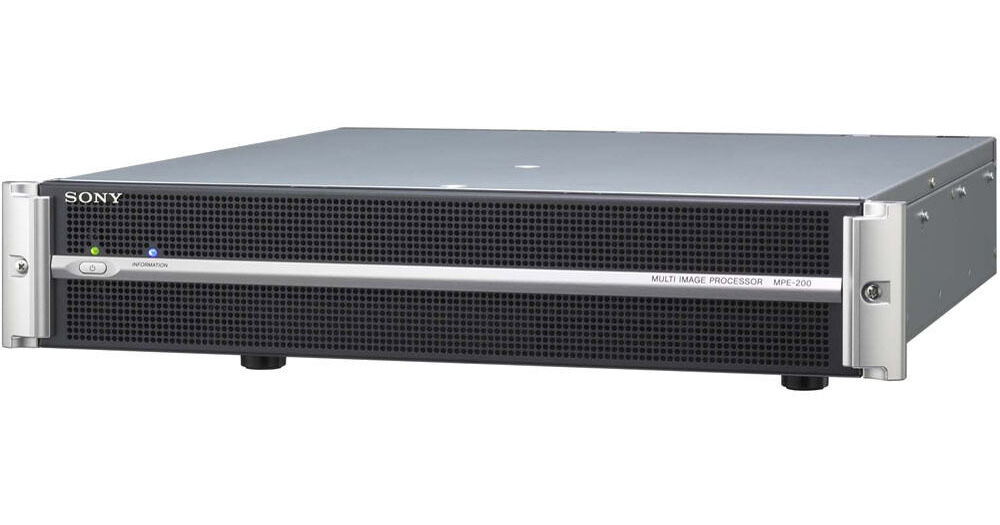
The Sony 3D Quality Check v1.0 + 2D to 3D Converter v1.1 Promotion Bundle includes the MPE-200 Multi-image Processor Unit, licensed MPES-3DQC1 3D Quality Control Software, and MPES-2D3D1 2D/3D Converter Software.
The MPE-200 unit is a versatile, multi-image, high-speed processor that can
perform real-time signal processing of HD (High-Definition) live image inputs and outputs. Equipped with a Cell / B.E. (Cell Broadband Engine) high-performance microprocessor and RSX graphics processor, it receives up to 4 HD signal inputs and performs real-time signal processing via the software. Several software applications can be installed together in this single multi-image processor, and users can switch between applications as required via a computer’s GUI.
The MPES-3DQC1 3D Quality Control Software is operated via a web browser from a computer connected to the MPE-200 Processor. This software allows users to control the quality of 3D images by analyzing disparities and distortions in the 3D image signals in real time. Using the measurement and analysis results to correct errors, it greatly improves efficiency during post-production.
The MPES-2D3D1 - 2D/3D Converter Software converts 2D images into 3D in real time. 2D image inputs from video devices connected to the MPE-200 unit are converted into natural-looking 3D images with minimal faults by Sony's proprietary algorithm. With versatile and user-friendly operability, this solution is suitable for incorporating 2D elements into a 3D production.
- Features a high performance micro-processing engine.
- Supports various HD video signal formats.
- Consists of 2 Ethernet for connecting to the MVS switcher network for signal processing in combination with the MVS switchers and to connect with client PC.
- Processor unit can store multiple software application and application data on its internal HDD.
- The software provides highly accurate 3D image quality analysis of every single frame or field for alignment errors, excessive depth, color and brightness differences, and focus differences, which were previously checked by the naked eye, and displays the analysis results in real time on a display connected to the MPE-200 unit.
- Measurement data for disparities and 3D image distortion are output together with time code information as log data and problem points are clearly displayed in a list. By using this information, the software greatly reduces post-production editing procedures.
- Users can control a VTR from a Web browser to go back to any analysis point and check the video.
- Analysis results for each frame or field are output in the XML file format and summaries are output as reports in the PDF format. In addition, by reading XML files in spreadsheet software to create highly accurate graphs or other indexes, content producers and graphic operators can use the mathematical analysis results of 3D effects to improve content quality.
- Depth Perception Adjustment via a Computer: Operated via a GUI from a computer connected to the MPE-200 unit, this software allows users to adjust the depth perception of a part of the image as well as that of the entire image.
- Video Signal Inputs: Up to 4 input signal lines are available, one of which can be switched to output
- Monitor Display Method: The output image can be checked on 2D or 3D monitors connected to the MPE-200 unit and recorded on a VTR. Three image monitoring display methods are available for 2D monitors.
- 3D Output: Dual Link 2D Output: Side by Side, L/R Mix, Anaglyph
- Snapshot: Snapshot is a function to save the settings configured by users. By saving a specific setting as a snapshot, users can easily return to a given setup later, as required. Up to 255 snapshots can be registered.