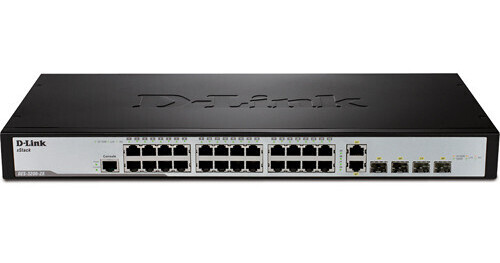
The 24 Port 10/100 xStack PoE L2 Managed Switch from D-Link is designed for the metro ETTX, FTTX and enterprise market. It offers 24x 10/100 Mbps faster Ethernet ports with available PoE, plus 2x combo Gigabit/ SFP ports and 2x dedicated SFP ports which provides up to 4 Gbps uplink bandwidth or dual Ethernet ring topology support. It supports 802.1X port-based/host-based access control, guest VLAN and RADIUS and TACAS+ authentication. It also supports 802.1D-2004 edition, 802.1w and 802.1s Spanning Tree Protocols (STP). The switch is compatible with D-Link's D-View 6.0 software. This software is a network management system that allows for the central management of critical network characteristics.
Security and Availability
The 24 Port PoE L2 Managed Switch supports 802.1X port-based/host-based access control, guest VLAN and RADIUS and TACAS+ authentication for strict access control over the network. The IP-MAC-port binding feature allows administrators to bind a source IP address with an associated MAC for a defined port number. It enhances user access control. With the DHCP snooping feature, the switch automatically understands the IP/MAC pairs by snooping DHCP packets and saves them to the IMPB white list. These features play a significant role in keeping the network secure and auditable. The built-in D-Link safeguard engine identifies and prioritizes CPU interested packets. It prevents malicious traffic from interrupting normal network flows and protects switch operation. Additionally, the Access Control List (ACL) feature enhances the network security and switch performance.
Resilience and Quality of Service
The 24 Port 10/100 xStack PoE L2 Managed Switch supports 802.1D-2004 edition, 802.1w and 802.1s STP. The STP allows you to configure the switch with a redundant backup bridge path. This guarantees transmission and reception of packets in the event of any failed switch on the network. The switch also supports 802.1AX (formerly 802.3ad) link aggregation that enables you to group multiple ports in parallel. This allows you to form a single port, increasing bandwidth and redundancy for higher availability. This switch supports 802.1p for Quality of Service (QoS). This standard is a mechanism that allows real-time traffic classification into 8 priority levels mapped to 4 queues. The packet classification is based on TOS, DSCP, MAC addresses, IP addresses, VLAN ID, TCP/UDP port number, protocol type and user defined packet content. This enables flexible configuration especially for real-time streaming multimedia applications such as voice over IP.
Traffic and Bandwidth Control
The bandwidth control feature allows network administrators to define the throughput levels for each port in order to manage bandwidth. It also provides fine granularity to define the ingress/egress traffic limits down to 8 kbps segments. The switch also supports the broadcast storm control feature which minimizes the chance of a virus attack within the network. The port mirroring helps administrators facilitate traffic diagnostics or track switch performance and make changes if necessary. Q-in-Q, also known as VLAN stacking, is a powerful yet simple and cost-effective solution. The VLAN stacking can be used to provide multiple virtual connections and access to multiple services available over the Metro Ethernet.
Multicast Applications
The 24 Port PoE L2 Managed Switch provides IGMP snooping to reduce multicast traffic and to optimize network performance. The MLD snooping feature minimizes multicast IPv6 packets at the port level to conserve network bandwidth.
Management Capabilities
This switch supports standard management protocols such as SNMP, RMON, Telnet, SSH/SSL security authentication and DHCP Relay Option 82. It also supports a web-based GUI for user-friendly interface and easy management. The DHCP auto-configuration is an enhanced management feature that allows administrators to pre-set configuration and save them to a TFTP server. Individual switches can then get IP addresses from the server for booting up and loading the pre-set configuration. The Link Layer Discovery Protocol (LLDP) allows a network device to promote its identity and capabilities on the local network. This helps businesses to better manage their network topology. Each port on the switch supports the Cable Diagnostics feature that helps to detect cable-related information such as cable length status or cable functionality.
The D-Link Single IP Management (SIM) simplifies and speeds up management tasks. The SIM allows multiple switches to be configured, monitored and maintained from any workstation running a web browser through one unique IP address. This switch also works with D-Link's D-View 6.0 software. The D-View 6.0 is a network management system that allows the central management of critical network characteristics such as availability, reliability, resilience and security. It also provides a useful set of tools for network administrators. It effectively manages device configurations, fault tolerance, performance and security.