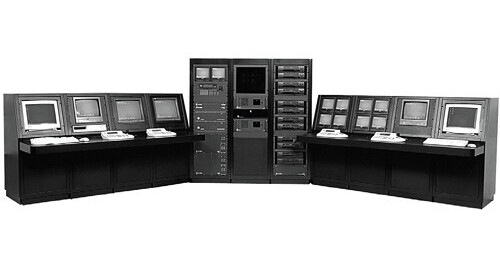
The Pelco CM9780 Microprocessor-Based Switcher (256 Inputs, 32 Outputs) is a fully featured video matrix switching control system that allows users to view and control up to 4,096 cameras and 512 monitors on a single node. Expanded monitor capacity in the matrix bay allows implementation of larger systems with a small footprint (less hardware).
The base configuration for this switcher is made up of a central processing unit (CC1), matrix switching bay(s) (MXBs) with video input / output modules, and keyboard controllers (KBDs). Optional components can be added to enhance system capabilities.
Preconfigured, prepackaged systems make installation fast and simple. The microprocessor-based switcher features a user-friendly windows-based management system, which allows for easy system programming and maintenance.
The central processing unit communicates with external devices and accepts commands from external computers, keyboards, graphical user interfaces (GUIs), access control systems, casino data systems, programmable logic controllers (PLCs), and lighting and intercom systems. An internal VGA card is included for displaying system diagnostics and programming. RS-422 COM ports are provided for communication with external devices such as matrix switching bays, pan / tilt, or dome receivers, and keyboards.
Each bay includes a power supply and mounting baffle, and will support modules for up to 512 camera inputs and 32 monitor outputs. Cameras are connected to CM9700-VPP patch panels, which are then connected to the matrix bay with video ribbon cables. Monitors connect directly to rear panel BNC cards installed on the matrix bay. Multiple bays can be used to expand a single CPU system to a maximum of 4,096 camera inputs and 512 monitor outputs. An optional backup power supply module (MPS) can be installed in each bay to provide redundancy.
Macros allow activation of events based on schedule or alarm. Macros may call system-wide sequences (tours); activate preset positions on properly equipped cameras; and activate external relays to control auxiliary functions such as locking doors (additional equipment may be required). The 9780 system also includes built-in video loss detection and system diagnostic features, indicated by LEDs on the front panel of the matrix bay. Flash technology incorporated into the system design allows for easier system maintenance and upgrades.
Optional DVR management allows DVRs to be controlled directly from the system keyboards. Suitable DVRs can be monitored for operational conditions ensuring continuous recording.