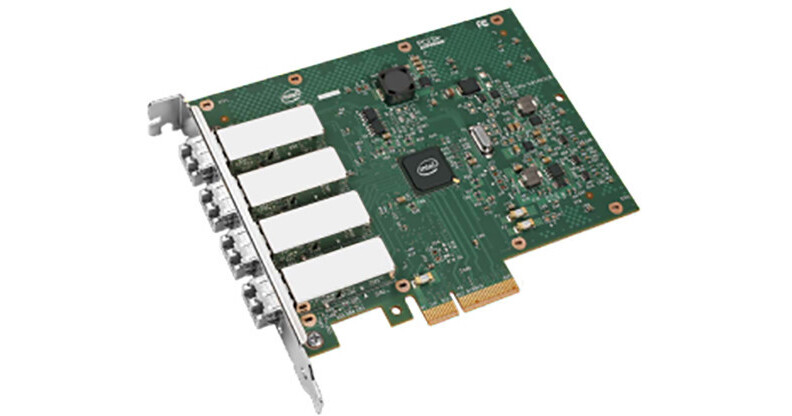
The I340-F4 Quad-Port PCIe Ethernet Server Adapter (Pack of 5) from Intel features a fully integrated quad-port and a PCIe Gen2 GbE controller, providing a smaller footprint and lower power dissipation. In addition, it offers advanced features like support for multi-core processors and server virtualization as well as a scalable PCI Express Gen 2.0 interface
Designed for Multi-Core Processors This quad-port adapter provides high-performing, multi-port Gigabit connectivity in multi-core platforms as well as virtualized environments. In a multi-core platform, the adapter supports technologies such as MSI-X and Low Latency Interrupts, which help accelerate data across the platform, improving application response times. The I/O technologies on a multi-core platform utilize the multiple queues and multiple interrupt vectors available on the network controller. These queues and interrupt vectors help in load balancing the data and interrupts amongst themselves in order to lower the load on the processor and improve overall system performance. For example, depending upon the latency sensitivity of the data, the "Low Latency Interrupts" feature can bypass the time interval for specific TCP ports or for flagged packets to give certain types of data streams the least amount of latency to the application.
Intel I/O Acceleration Technology (Intel I/OAT) is a suite of features that improves data acceleration across the platform, from networking devices to the chipset and processors, which helps to improve system performance and application response times. The different features include MSI-X and Low Latency Interrupts. MSI-X helps in load balancing I/O interrupts across multiple processor cores, while Low Latency Interrupts can provide certain data streams a non-modulated path directly to the application.
Support for iSCSI With native iSCSI initiators built into Microsoft Windows, Linux and VMware ESX platforms, Intel Ethernet server adapters provide a simple, dependable and cost-effective way to connect to LANs and iSCSI SANs. These native initiators are broadly tested using multiple generations of operating systems, storage systems and OS tools to ensure reliability and ease-of-use. Standardizing on Intel Ethernet server adapters for iSCSI allows administrators to use a single initiator, TCP/IP stack and set of management tools and IT policies. In addition, the I340 server adapter includes a number of hardware features designed to accelerate iSCSI traffic and enhance data processing. For example, TCP segmentation offload, receive side coalescing (RSC) and checksum offload capabilities help reduce processor utilization, increase throughput and deliver exceptional iSCSI performance. The adapters are designed to flexibly scale workloads across multi-core processor-based systems. Finally, using native OS initiators, an Intel Ethernet I340 Server Adapter enables support for the CRC-32 digest instruction set included in the Intel Xeon processor 5500 series, which improves transmission reliability and thus delivers an enterprise-class iSCSI solution for the IT customer.
Optimized for Virtualization The Intel Ethernet I340 Server Adapter showcases a suite of hardware assists that improves overall system performance by lowering the I/O overhead in a virtualized environment. This optimizes CPU usage, reduces system latency and improves I/O throughput. These features include: • Virtual Machine Device Queues (VMDq) • Intel I/O Acceleration Technology (Intel I/OAT) Use of multi-port adapters in a virtualized environment provides redundancy and data connectivity for applications/workloads in the virtual machines. Due to the need for redundancy and data connectivity, it is recommended that a virtualized physical server needs at least six GbE ports to satisfy the I/O requirement demands.
Virtual Machine Device Queues (VMDq) VMDq reduces I/O overhead on the hypervisor in a virtualized server by performing data sorting and coalescing in the network silicon. VMDq technology makes use of multiple queues in the network controller. As data packets enter the network adapter, they are sorted, and packets traveling to the same destination (or virtual machine) are grouped together in a single queue. The packets are then sent to the hypervisor, which directs them to their respective virtual machines. Relieving the hypervisor of packet filtering and sorting improves overall CPU usage and throughput levels.
Reliable Performance The server adapter includes a number of advanced features that enables it to provide industry-leading quad-port 1GbE performance and reliability. • PCIe* v2.0 (5 GT/s) PCIe v2.0 (5 GT/s) support enables customers to take full advantage of the 1 GbE by providing a maximum of 2.0 Gbps bi-directional throughput per port on a single quad-port card. The new Intel Ethernet I340 Server Adapter delivers ultimate flexibility and scalability for today's demanding virtualized data center environments.