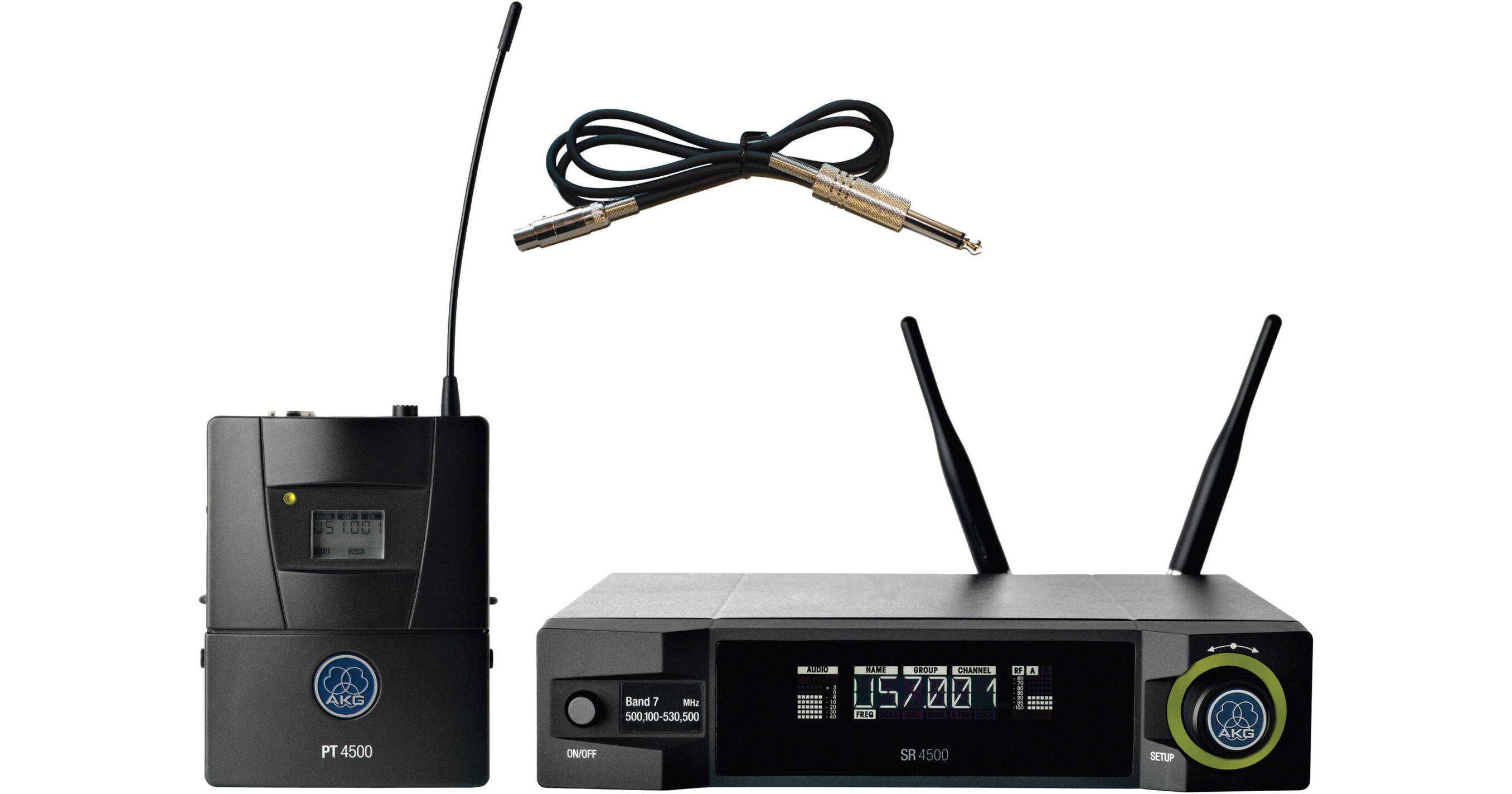
The WMS4500 Instrumental Set from AKG contains the PT4500 Pocket Transmitter, the SR4500 Receiver and the MKG L Instrument Cable. It is designed as an all-purpose wireless set for electric guitar, bass and keyboards for rehearsals, stage and other applications. The MKG L Instrument Cable allows simple connection of these instruments to the PT4500 transmitter with its mini XLR and 1/4" jacks.
The PT4500 is a pocket transmitter with an aluminum body. It has an RF output power of up to 50mW to maximize resistance to interference and dropouts. It also has a backlit display and a pilot tone system that sends transmitter status data to the receiver, including mute switch position and remaining battery life. The unit can operate for up to 15 hours on standard AA batteries, or up to 12 hours on the optional BP 4000 battery pack.
The SR4500 is a true diversity UHF receiver that is designed to provide maximum ease of use and a wide range of functions. It operates in a 30 MHz wide UHF band and each frequency preset provides up to 19 intermodulation-free channels. The maximum number of selectable frequencies is 1200. Using several frequency bands allows you to operate as many as 70 channels simultaneously. A large, backlit color display and a jog wheel are in place to make the SR4500 easy to use, and a programmable LED ring indicates important system parameters at a glance. The SR4500's transmitter battery life readout is designed for accuracy, which is especially useful in live sound applications. The SR4500 receives a pilot tone from the transmitter which contains status data including the remaining battery capacity. The pilot tone decoder also allows the detection and display of other important information including the current position of the transmitter's MUTE switch. The SR4500 also features Auto Setup and Environment Scan functions which automatically analyze the local RF environment, find usable frequency groups, and set frequencies. The optional HUB4000 Q integrates the SR4500 into the HiQnet audio networking system.