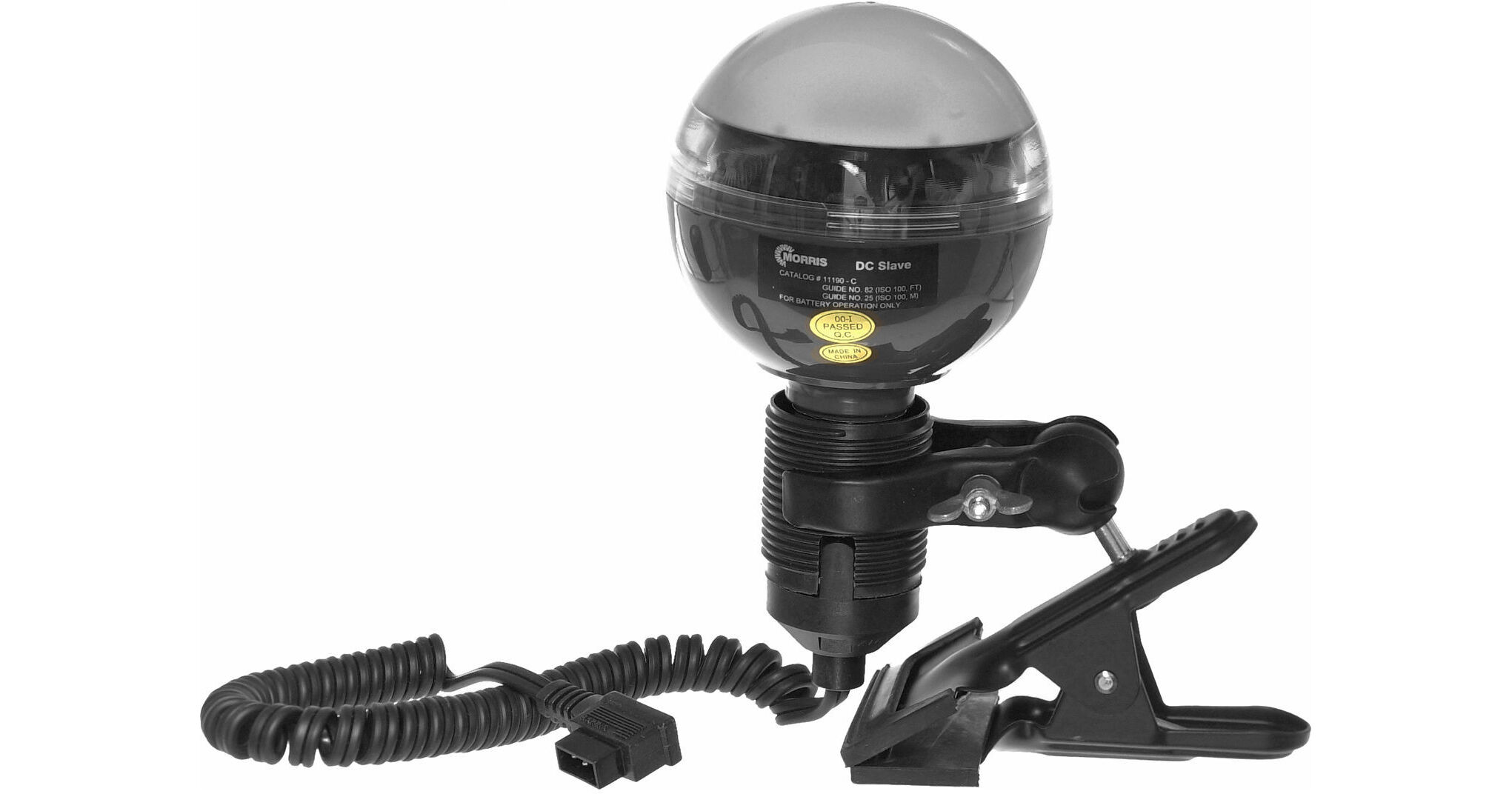
Take the flexibility of Morris slaves anywhere with the DC Super Slave. Like the AC slaves, it is triggered by any flash unit through its built-in slave sensor or a radio slave. The compact power supply case uses 8 AA alkaline batteries (available separately) and comes with shoulder and belt straps and a 4' power cord to give you freedom of movement. Green and red LEDs, mounted under the dome indicate DC power and recycle status.
Morris 690435 Overview
Morris 690435 Specs
| Package Weight | |
| Box Dimensions (LxWxH) |
Morris 690435 Reviews
Convenient but primitive.
I use two of those kits triggered by photocell from the flash triggered by radio. This sounds convoluted, and I would prefer a simpler solution, but no radio receiver supports multiple flashes, and multiple receivers would double the cost of setup with marginal improvement of convenience. The kit is hard to modify -- I needed a mounting option on a stud, so it can be placed on a standard light stand, and it taken a minor DIY project to remove the clamp and replace it with a stud. The modified version worked without problems, so I have left it that way. The power supply works well but can't be adapted for anything but alkaline AA cells -- the manual insists that it can be damaged if used with rechargeable batteries, and my examination of the power supply board confirms that it is designed for a battery with particular internal resistance. Within those limitations, power supply (and the box with batteries is actually a high-voltage power supply) works well, though an engineer like myself can see that design was intended to be simple but not necessarily most efficient. The recharge time increases as batteries are depleted, similar to other battery-powered flashes. Triggering works either by photocell or cable -- as I have mentioned, I ended up using the photocell. There is no output power control, so position of the kit and direction of the bulb are the only ways of regulating the amount of light reaching the subject. What is not bad considering its 25m / 82ft guide number. Adjusting the direction is actually another weak point -- a single screw with winged nut holds two halves of the main bracket together, squeezing the ball mount and the bulb socket. Loosening this nut releases both, and should be done carefully -- enough to move the assembly, not enough for it to fall apart. If it will fall apart, it's easy to re-assemble, it's just annoying that the manufacturer didn't opt for a much more convenient and only slightly more expensive option of using two separate clamps, one permanently installed on the bulb socket, another holding the ball mount. With all those shortcomings, the kit performs its primary function -- providing light synchronized with flash -- very well, and it uses the most common kind of battery available, so I consider it to be a useful device as it is.
These are cool toys!!
I've never used slave flashes before myself, seen friends use them and know what they are for but never owned a set. THIS was a good purchase, I bought two of them for use in our furniture studio and in client's homes and other locations for product shots and images of us working on projects. Immediate return, I can easily clamp them anywhere to provide that extra boost of light. I would have never managed to get several shots I have in our portfolio within just a few weeks owning them. I'm certain I've only just started to get the ROI, the more I learn what these will do the better it gets. Planning a night shoot next weekend and looking forward to having some unique lighting angles and options. Batteries last about 100 flashes - that can go reasonably quickly if you are hitting hard. Recycle time does slow down as the batteries get expended. I have shot pictures faster than the recycle time you do have to keep an eye on that. The LED indicators are handy. As long as things are moving slow they work great. These are NOT for fast action photography, they just won't recycle fast enough for burst photography or even fast single shots.
