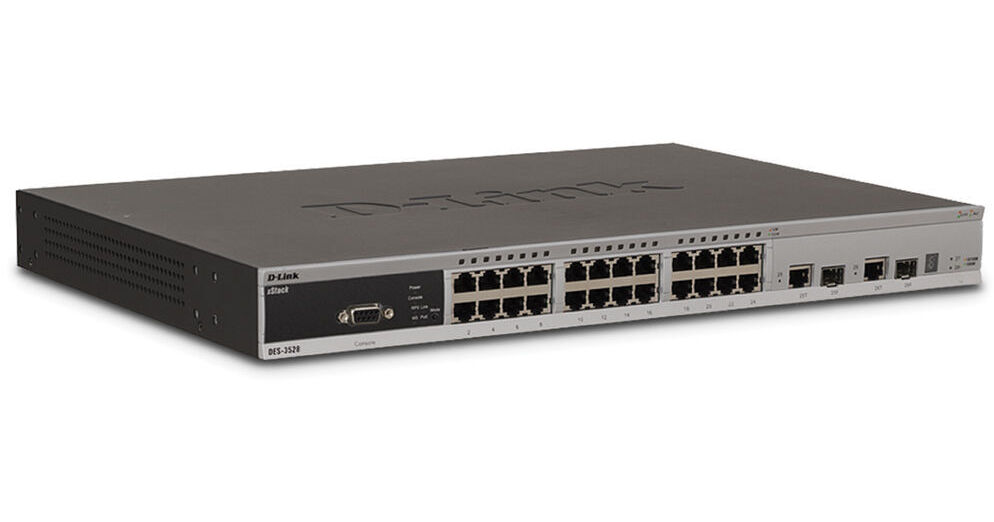
The DES-3528 xStack Managed 24-Port 10/100 Gigabit Layer 2 Switch from D-Link is a high-performance, managed, stackable Layer 2 switch that provides an ideal solution for workgroups and edge deployments of a network. It features 24 10/100BASE-TX ports, 2 Gigabit 10/100/1000BASE-T stacking ports and 2 1000BASE-X combo SFP slots. The D-Link Single IP Management (SIM) allows administrators to cluster up a virtual stack of up to 32 DES-3528 dispersed switches with fewer distance limitations through a single IP address.
The clustering environment spans buildings, making it perfect for businesses that require multiple building deployments. The DES-3528 also supports physical stacking of up to eight units in a stack, so that the entire stack can act as a single logical unit with up to 4 Gb/s of stacking backplane. The DES-3528 also provides comprehensive security for edge access such as Access Control List, DHCP server screening and DoS attack prevention. The switch includes security features like D-Link Safeguard Engine, SSHv2, SSLv3 Microsoft NAP, TACACS+, RADIUS, MAC-based Access Control (MAC) and more. Additionally, 802.1p Priority (8 Queues), L2/L3/L4 QoS, 802.1X (Port/MAC-based), MAC-based VLAN are some of the advanced standard-based enterprise features supported by DES-3528.Non-Blocking Switching
The DES-3528 provides a non-blocking switching solution for 10/100 Fast Ethernet connections. It supports 24 10/100 Mb/s ports, with four Gigabit 10/100/1000BASE-T ports. Two of these copper Gigabit ports are disabled when the two 1000BASE-X SFP are used which are also known as dual personality or combo ports. The DES-3528 features a non-blocking bandwidth of 12.8 Gb/s and has a redundant power option for mission-critical applications.
Advanced Network Security
For edge network security, the DES-3528 supports DHCP server screening, client filtering and IP-MAC-port binding to prevent security breaches such as rogue DHCP server, man-in-the-middle attacks and IP spoofing. For clients with Windows XP SP3, Windows Vista or servers with Windows Server 2008, the DES-3528 works in conjunction with Microsoft's Network Access Protection (NAP) as part of an ecosystem that enforces compliance with network health policies.
The DES-3528 will grant a network host access only if it complies with IT security policies such as up-to-date anti-virus signatures and operating system patches. This prevents a virus-infested client or server from gaining access and furthering contamination. The DES-3528 also supports loopback detection, which detects a loop in the network even though the end device causing the loop is without Spanning Tree. When the switch detects a loop in the connected node, the DES-3528 shuts down the port with the loop so that the entire system continues to function normally. This feature can also be VLAN based.
The DES-3528 incorporates advanced mechanisms to detect an attack against the switch's central processing unit and take corrective action on the attacking interface. When a Denial-of-Service attack is waged against the xStack switch, the D-Link Safeguard Engine detects the threat and prevents overload of the central processor, thus ensuring network integrity and helping to maintain open network bandwidth channels.
In addition, the DES-3528 supports 802.1X authentication, which securely allows you to log onto your network. When used in conjunction with a RADIUS server, 802.1X requires each user workstation attached to the xStack switches to provide a username and password before gaining access to the network. Web-based authentication option is available for those clients who may not have the 802.1X supplicant, while MAC-based authentication can make the authentication process automatically authenticated by the 802.1X server based on the client's MAC address.
Other security features include Access Control List, in which an administrator can restrict the access of a network through a variety of means including MAC address, IP, UDP/TCP and even VLAN ID.
xStack Integration
The xStack DES-3528/3552 provides D-Link Single IP Management Technology (SIM), allowing a set of switches to be managed by a single IP, regardless of geographical locations. Traffic running among units in this virtual stack goes through the full-duplex Gigabit interfaces and your usual network wires, doing away with the costly and cumbersome stacking cables. Without any stacking cable, cable distance barrier and physical stacking limitations, your stack can comprise of units that are located anywhere on the network, minimizing the impact of any single point of failure.
Furthermore, multiple xStack switches can be configured, monitored and maintained from any workstation running a web browser through one unique IP address. The stack is managed as a single object, with all units identified by a single IP address. With Tree View, you can obtain an overview of the members of the stack and a network topology showing the locations of the units and their link information. This provides simple yet powerful web-based management without expensive SNMP network management software. You can add up to 32 switches per stack and these switches are not limited to any specific D-Link SIM models.
Additionally, the two 10/100/1000BASE-T ports on the back panel of the DES-3528 are designed for flexible dual usage. They can be used either as stacking ports with 4 Gb/s bidirectional stacking bandwidth or can simply be used as copper Gigabit uplinks. Physical stacking capability allows administrators to add up to eight switch units per stack1 on a stackable expansion basis. The DES-3528 offers an attractive stackable switch alternative to the expensive chassis-based solution.
Voice and Video Applications
For businesses, having voice, data and video on the same network is common practice. This challenge is met by the DES-3528 which supports 802.1p with eight queues. The administrator can designate the priority of the traffic based on a variety of means including IP or MAC address, so that voice data is always clear and jitter-free. Video traffic can also be assigned with the same priority. In addition, the DES-3528 provides IGMP Snooping or MLD Snooping, which allows the forwarding of multi-cast packets such as streaming audio and video, without increasing network broadcast congestion.
By Snooping IGMP registration information within a frame, a list of workstations in the multi-cast group is created. This list then allows the switch to intelligently forward packets to only the appropriate member workstations. In conjunction with the 802.1Q VLANs, Quality of Service and security can be achieved on a network infused with data traffic. The DES-3528 also supports IGMP multi-cast VLAN, which eliminates duplicate multi-cast traffic being sent to clients in different VLANs, thus eliminating bottlenecks in the uplink port.
For other multimedia-on-demand applications, such as IPTV deployments, the DES-3528 provides advanced features for easy video streaming management. For example, this xStack family supports per port multi-cast stream control, which allows a service provider to assign limited multi-cast addresses per port. This means it can act as a security control that pre-configures channels for each subscriber on a port level to prevent unauthorized hosts from receiving traffic for a multi-cast group they did not join.
Ease of Management
The DES-3528 supports SNMP v1/2c/3, so traps can be set on abnormal events and information can be polled to maximize the productivity of the network. Other standard management features are also supported including RMON and IEEE 802.1D/w/s Spanning Tree. User interface includes an intuitive web-based browser graphic interface or industry-standard CLI, either of which can be protected through SSL or SSH encryptions.