Video Chat with a Pro Audio Expert - Live

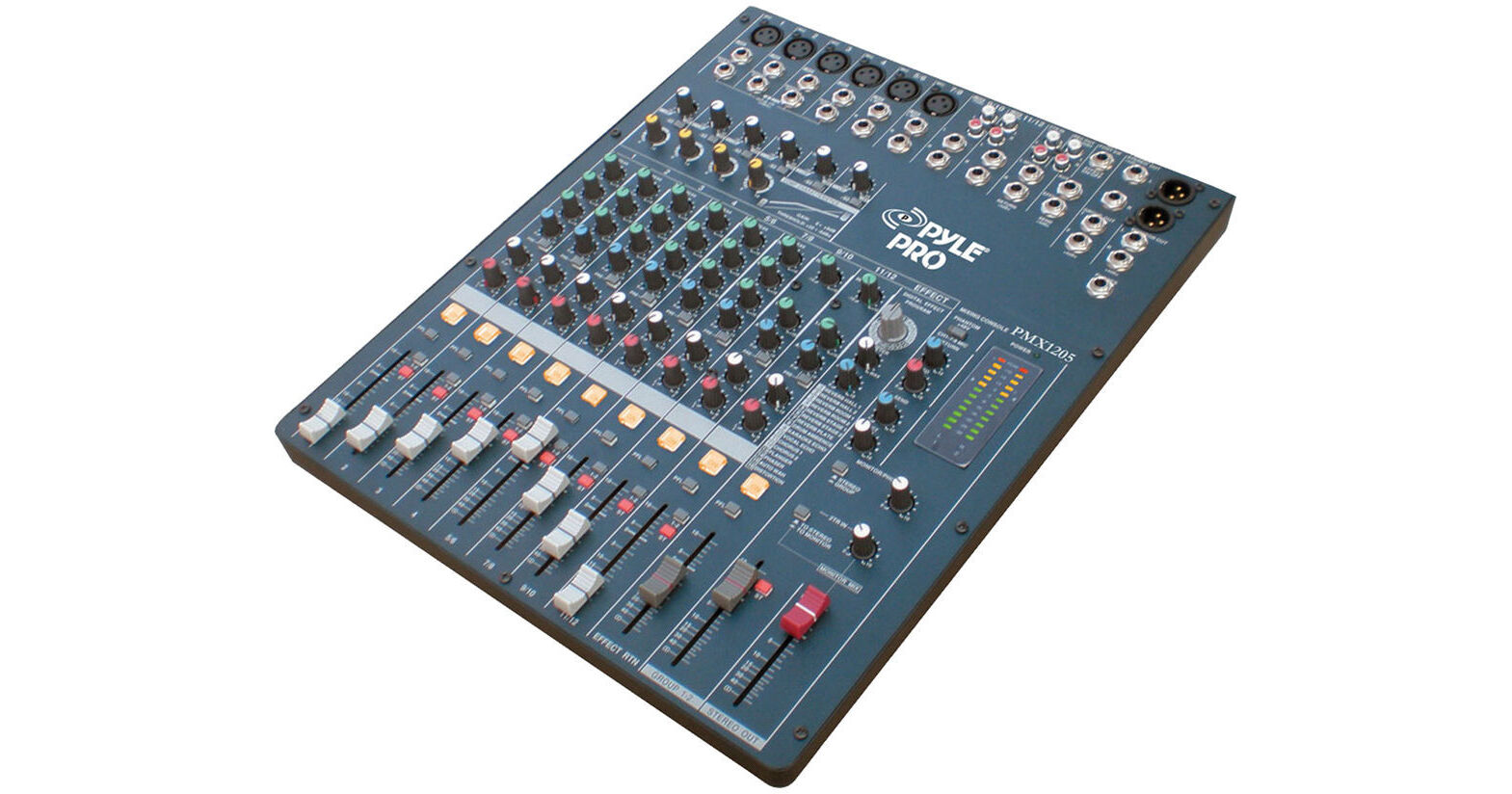
Pyle Pro PMX1205 12-Channel DSP Mixer

BH #PYPMX1205 • MFR #PMX1205
Print
Pyle Pro PMX1205 12-Channel DSP Mixer
Key Features
  • 6 Mic Inputs & 4 Stereo Line Inputs
  • 6 Buses
  • 3-Band EQ on Each Mic Channel
  • Built-In Reverb & Effects
The PMX1205 12-Channel DSP Mixer from Pyle Pro has 12 input channels, including 6 mic level inputs with preamplifiers and 4 stereo line level inputs. Each mic channel has selectable 48-volt phantom power, an insert input and output for integrating outboard gear, a single-knob compressor, and 3-band equalizer. The PMX1205 features a variety of integrated DSP effects including hall, room, plate, and stage reverbs, drum ambience reverb, vocal and karaoke delay, chorus, flanger, phaser, auto-wah, and distortion.
More Details
No Longer Available
No Store Display
Ask an Expert
866-264-7509

Pyle Pro PMX1205 Overview

The PMX1205 12-Channel DSP Mixer from Pyle Pro has 12 input channels, including 6 mic level inputs with preamplifiers and 4 stereo line level inputs. Each mic channel has selectable 48-volt phantom power, an insert input and output for integrating outboard gear, a single-knob compressor, and 3-band equalizer. The PMX1205 features a variety of integrated DSP effects including hall, room, plate, and stage reverbs, drum ambience reverb, vocal and karaoke delay, chorus, flanger, phaser, auto-wah, and distortion.

The PMX1205 has 6 buses as well as 3 auxiliary sends and 2 stereo returns to allow for a variety of routing and integration of outboard gear. You can monitor your signals via the unit's dual 12-segment LED meter. The pre-fader listen button allows you to monitor your channels before they hit your faders. Each channel additionally features an illuminated on/off button for use in on-stage or in poorly lit clubs.

Pyle Pro PMX1205 Specs

Inputs
Inputs
6x XLR Mic Level Inputs
6x Mono 1/4" (6.35 mm) TRS Line Level Inputs
4x Stereo 1/4" (6.35 mm) TRS Line Level Inputs
Input Gain
Mic Inputs 1 to 4, 5/6, 7/8: -60, -15 dB
Line Inputs 1 to 4, 5/6, 7/8: -34 dB, 10 dB
Input Impedance
Mic Inputs: 3 kΩ, for 50 to 600 Ω appropriate impedance mics
Line Inputs: 10 kΩ, 600 Ω appropriate impedance line level sources
Channels 9/10, 11/12: 10 kΩ, 600 Ω appropriate impedance line level sources
Channel Inserts (In and Out): 10 kΩ, 600 Ω appropriate impedance line level sources
Dual TR In: 10 kΩ, 600 Ω appropriate impedance line level sources
Sensitivity
Mic Level Inputs: -80 dBu (0.078 mV) @ -60 dB, -36 dBu gain (12.3 mV) @ -15 dB gain
Line Level Inputs: -54 dBu (1.55 mV) @ -34 dB gain, -10 dBu (245 mV) @ 10 dB gain
Stereo Channel Inputs: -30 dBu (2.45 mV)
Insert Channel Inputs: -20 dBu (77.5 mV)
Insert Channel Returns: -12 dBu (195 mV)
2 TR Input: -26 dBV (50.1 mV)
Nominal Level
Mic Level Inputs: -60 dBu (0.775 mV) @ -60 dB gain, -15 dBu (123 mV) @ -16 dB
Line Level Inputs: -34 dBu (15.5 mV) @ -34 dB gain, 10 dBu (2.45 V) @ 10 dB gain
Channel Insert Inputs: 0 dBu (0.775 V)
Channel Insert Returns: 4 dBu (1.23 V)
2 TR Inputs: -10 dBV (0.316 V)
Maximum Input Before Clipping
Mic Level Inputs: -40 dBu (7.75 mV) @ -60 dB gain, 4 dBu (1.23 V) @ -16 dB gain
Line Level Inputs: -14 dBu (155 mV) @ -34 dB gain, 30 dBu (24.5 V) @ 10 dB gain
Channels 9/10, 11/12: 10 dBu (2.45 V)
Channel Insert Inputs: 20 dBu (7.75 V)
Channel Insert Return: 24 dBu (12.3 V)
2 TR Inputs: 10 dBV (3.16 V)
Connectors
Mic Inputs 1 to 4: Balanced XLR3 (1= ground, 2= hot, 3= cold)
Line Inputs 1 to 4: 1/4" (6.35 mm) TRS (tip= hot, ring= cold, sleeve= ground)
Stereo Line Inputs 5/6, 7/8: Unbalanced 1/4" (6.35 mm)
Stereo Line Inputs 9/10, 11/12: Unbalanced 1/4" (6.35 mm), RCA
Channel Insert Input: 1/4" (6.35 mm) Unbalanced TRS (tip= out, ring= in, sleeve = ground)
Return: Unbalanced 1/4" (6.35 mm)
2 TR Input: RCA
Outputs
Outputs
1x Stereo XLR Out
2x 1/4" (6.35 mm) TRS group outs
2x 1/4" (6.35 mm) TRS Effects/Auxiliary outs
4x 1/4" (6.35 mm) Unbalanced TRS Insert outs
2x RCA Record outs
2x 1/4" (6.35 mm) TRS Monitor outs
1x Stereo headphone out
Output Impedance
Stereo Out: 75 Ω, 600 Ω line level appropriate impedance
Group Out: 150 Ω, 10 kΩ line level appropriate impedance
Effects Send: 150, 10 kΩ line level appropriate impedance
Channel Insert Out: 75 Ω, 10 kΩ line level appropriate impedance
Record Out: 600 Ω, 10 kΩ line level appropriate impedance
Monitor Out: 150 Ω, 10 kΩ line level appropriate impedance
Headphones Out: 100 Ω, 40 Ω line level appropriate impedance
Nominal Level
Stereo Out: 4 dBu (1.23 V)
Group Out: 4 dBu (1.23 V)
Effects Send: 4 dBu (1.23 V)
Channel Insert Out: 0 dBu (0.775 V)
Record Out: -10 dBV (0.316 V)
Monitor Out: 4 dBu (1.23 V)
Headphones Out: 3 mW
Maximum Output
Stereo Out: 24 dBu (12.3 V)
Group Out: 20 dBu (7.75 V)
Effects Send: 20 dBu (7.75 V)
Channel Insert Out: 20 dBu (7.75 V)
Record Out: 10 dBV (3.16 V)
Monitor Out: 20 dBu (7.75 V)
Headphones Out: 75 mW
Electrical
Frequency Response
20 Hz to 20 kHz (minimum -3 dB, maximum 1 dB) @ 1 kHz
Total Harmonic Distortion/Noise
0.1% @ 14 dBu @ 20 Hz to 20 kHz, input gain control @ minimum
Hum & Noise
Measured with a 6 dB/octave filter @ 12.7 kHz; equivalent to a 20 kHz filter with infinite dB/octave attenuation:
Mic Channel 1-4: EIN Rs = 150 Ω, maximum gain; -128 dBu
Stereo/Group Out: Group Master Fader @ nominal level, all channel' ST and 1-2 switches off; -88 dBu
Effects/Aux: Master Control @ nominal level, channel Effects controls @ minimum; -81 dBu
Stereo/Group Out: Master fader and one CH fader @ nominal level; -64 dBu
Stereo Out: Residual output noise; -98 dBu
Crosstalk
Adjacent Input Channels 1-4: -70 dB
Input to Output: Stereo L/R, Channels 1-4, Pan hard right or left: -70 dB
Maximum Voltage Gain
Rs = 150 Ω
Mic to Channel Insert Out: 60 dB (typical)
Mic to Stereo Out: 84 dB (typical)
Mic to Group Out: 84 dB (typical)
Mic to Group to Stereo: 94 dB (typical)
Mic to Record Out: 62.2 dB (typical)
Mic to Monitor Out, Stereo to Monitor: 94 dB(typical)
Mic to Phones Out: 83 dB (typical)
Mic to Aux, Send Pre: 76 dB (typical)
Mic to Aux, Send Post Effects Send: 86 dB (typical)
Channels 5/6, 7/8 Line to Stereo/Group Out: 58 dB (typical)
Channels 5/6, 7/8 Auxiliary Send Pre: 47 dB (typical)
Channels 5/6, 7/8 Line to Aux, Send Post Effects Send: 57 dB (typical)
Channels 9/10, 11/12 to Stereo Out: 34 dB (typical)
Channels 9/10, 11/2 to Group Out: 34 dB (typical)
Return to Stereo Out: 16 dB (typical)
Return to Effect Send: 9 dB (typical)

Rs = 600 Ω
2 TR In to Stereo Out: 27.8 dB (typical)
Phantom Power
48 V
General
HPF
Channels 1 to 7/8: 12 dB/octave @ 80 Hz
Equalization
+/- 15 dB maximum
Channels 1 to 7/8: High (shelving @ 10 kHz), Mid (peaking @ 2.5 kHz), Low (shelving @ 100 Hz)
Channels 9/10, 11/12: High (shelving @ 10 kHz), Low (shelving @ 100 Hz)
Indicator Lights
Peak: Red LED indicates post EQ signal reaches -3 dB below clipping (17 dBu)
LED Level Meter: 2x 12-point LED meter (Peak, 10, 6, 3, 0, -3, -6, -10, -15, -20, -25, -30 dB)
DSP
16x Program, Parameter Control
Power Consumption
30 W
AC Adapter
AC 35 VCT, 0.94 A
Cable Length: 12' (3.6 m)
Dimensions (WxHxD)
13.6 x 3.38 x 17.18" (346.2 x 86.1 x 436.6 mm)
Weight
7 lb (3.2 kg)
Packaging Info
Box Dimensions (LxWxH)
20.25 x 16.5 x 6.75"

Pyle Pro PMX1205 Reviews

See any errors on this page?
Whatever You Need, We've Got It