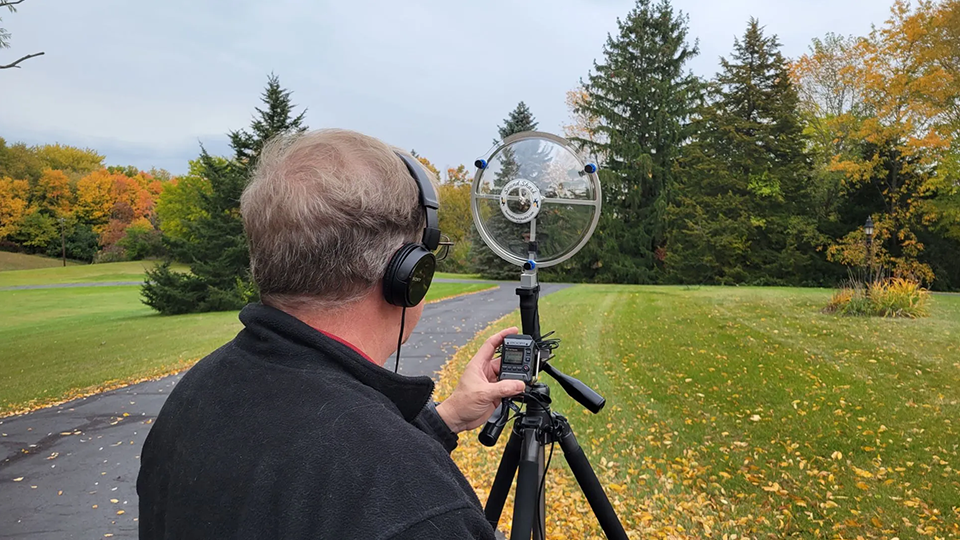
Of all the terms we use to define microphones, "parabolic" isn't one that often comes up in conversation. But what is a parabolic microphone? How do they work and what are they used for? If you're curious to learn the answers to these questions—or if you just want to know why broadcast crew members are always holding those big plastic domes on the sidelines of professional sporting events—then you've come to the right place.
What are Parabolic Microphones?
Unlike other descriptors (dynamic, ribbon, etc.), the word "parabolic" does not refer to the microphone's capsule but to a curious object attached to it: a precision-crafted concave bowl that adheres to the physical properties of a parabola. The curves of this mirror-symmetrical bowl work like a satellite dish, reflecting all incoming soundwaves to a specific point in the center on its cavity, exactly where a small-diaphragm condenser microphone is placed.

The result of this seemingly simple technology is the unrivalled ability to capture sound hyper directionally from hundreds of feet away in detail while aggressively rejecting ambient and unwanted off-axis sound. No other type of mic—not even a shotgun—can achieve the clarity and audibility of far-off distant noise quite like a parabolic microphone.
How Do They Work?
Just like how a satellite dish focuses incoming radio waves to a fixed point of reception, a parabolic microphone focuses incoming sound waves to a central point of reception through the clever use of a curve. The curve of the parabolic dish must strictly follow the shape of a parabola for sound waves to be collected at a single point; dish curves that are too concave, too flat, or too inconsistent will cause an incongruous diffusion of soundwaves away from the microphone's capsule, leading to distortion, lack of clarity, and reduced input level. Because of this, high quality manufacturers create their dishes with a parabola curve accurate up to a few thousandths of an inch.

The size of the dish affects the qualities of the captured sound. Larger dishes can reflect and collect more sound waves while providing a larger barrier against ambient sound, yielding longer ranges, better signal, and less background/wind noise. The reflectivity of the dish's material determines the amplitude of the captured sound—soft, absorptive dish materials produce less amplification and less low-frequency content.
Once the dish convenes sound waves to their central point, a microphone pointed level to the center of the concave side of the dish converts the acoustic pressure into electrical signal. This microphone will typically have either an omnidirectional or cardioid polar pattern depending on the size and depth of the parabolic dish. Cardioid tends to be better for shallow dishes, while omni is better suited for deep dishes.
Where Are They Used?
Due to the realities of capturing sound with a parabolic dish, parabolic mics do not exhibit the sort of linear, flat frequency response that a measurement condenser mic would; the typical frequency response of a parabolic mic will offer low frequencies that are quieter than the mids and highs. You'll find parabolic mics ideal for recording long-distance, full-range sources rather than close-up sounds that feature prominent sub-bass. Sporting events, surveillance, nature documentaries, sound library collections, search and rescue, wedding shoots, and videography are common applications for parabolic mics.

Types of Parabolic Micing Solutions
When shopping for a parabolic microphone, consider what your goals and needs are. Are you recording audio in nature or for news broadcasts, or do you need a huge professional parabolic system to capture the audio at professional sporting events or during search and rescue operations? Learn more about what best suits your needs here.
12"-15" Handheld/Camera Mounted Systems
For smaller operations, many smaller handheld and camera mounted parabolic dishes are about 12 to 15 inches in diameter and are typically designed to support omnidirectional lavalier microphones, making for a small and effective solution. Often a higher-quality alternative to shotgun mics, these types of parabolic systems have a range of about 30 to 50 feet and are best suited for nature and field recording, wedding and event videography, and documentary filmmaking.
24"+ Handheld Systems
For more professional operations, larger parabolic dishes (around 24 to 26 inches) come with rear handle crossbars, neck straps, and hand yokes, able to capture detailed audio at a range of up to 600 feet, and given the proper quiet environment, can even capture loud sounds from up to 1.5 miles away. Because of the size of these systems, they will typically support a small diaphragm condenser microphone capable of wireless transmission. These larger systems are best suited for sports broadcasts, espionage and surveillance, wildlife research (particularly ornithology), and positional triangulation in critical search and rescue operations.
Fixed Parabolic Systems
Fixed dishes are permanent or semi-permanent mounted systems used to capture audio from a static target location. They're often placed throughout baseball stadiums – hidden behind signage or positioned by home plate – to capture the crack of the bat or the ball hitting the catcher's glove. In some European soccer broadcasts, an array of fixed parabolic mics are positioned on the sidelines and the audio they capture is mixed based on ball position. Other uses include high-quality video conferencing and industrial monitoring of heavy machinery, particularly in power plants and other critical infrastructure.
Microphone Type
Most parabolic microphone systems will employ the use of an omnidirectional microphone capsule due to its 360-degree pickup pattern, ideal for capturing all the soundwaves that the dish reflects to its focal point, providing the best signal gain from any given direction.
However, there are times when a cardioid microphone is preferred, particularly in environments with loud and consistent ambient noise—such as the cheering of 70,000 inebriated football fans. Cardioid microphones offer better rejection of sounds coming from behind the dish at the cost of reduced signal quality and gain from the desired direction.
Conclusion
Specialized jobs required specialized tools; when it comes to capturing sources at a great distance, parabolic mics are the answer. Stop by the B&H SuperStore or visit our website to dig deeper and find out what kind of parabolic mic best suits your needs!
