Search results for: photography buying guide film photo scanning
About 8 filtered results
by Luke Rollins · Posted
If your mom isn’t just the family photographer, but the family’s director of photography, production designer, and art director as well, chances are she’ll appreciate a photo-related gift for Mother’s Day. But if she’s the type of mom who loves to research and investigate every purchase she makes, you might want to think outside the box to find a gift that surprises or excites her or is just something she doesn’t already have. Here are some suggestions for Mother’s Day photo gifts for the mom who has it all:
Fun Little Digital Point &

by Christopher Witt · Posted
Humans’ fascination with the stars is as old as our ability to think and ask questions. For millennia we, as a species, were limited to observing the heavens with just our eyes. Of course, back then we were able to see more because light pollution didn’t exist, but making detailed observations was impossible. The invention of the microscope led to the development of the telescope, which allowed people to finally start exploring the larger universe. As technological advances were made and telescopes got bigger and better, their reach and the

by Bjorn Petersen · Posted
In an age where darkrooms are scarce, yet film photography is seeing a resurgence in popularity, a scanner can be your best option for converting film originals to usable digital files for printing, sharing, and archiving. Whether you are an active film photographer or just have an archive of negatives and slides from the past, a film scanner is a useful, dedicated tool that will breathe new life into your film originals.
Ranging from the most basic models for simply producing a web-shareable image, to the top-of-the-line versions for

by Todd Vorenkamp · Posted
What is the best camera for beginners? While this seems like a straightforward question, and many websites will just throw a list of camera options at you, the answer can be more complex than one specific camera recommended for every newbie photographer. Giving this question some thought and considering a few options may pay future dividends as a novice photographer evolves into a photographic artist. One certainty is that an entry-level camera should be easy to use, convenient to carry and employ, as well as being intuitive, while also

by Jill Waterman · Posted
“How do you make pictures about a person who doesn't exist anymore?” This was the fundamental question facing Jessica Hines while sorting through a box of her brother Gary’s letters, photographs, and other objects from his military service in Vietnam some 35 years after his return—25 years after his life ended in a battle with post-traumatic stress.
Photographs © Jessica Hines

by Bjorn Petersen · Posted
For most photographers, the home studio is the studio. Many of us don’t have our own separate studio or frequent access or the need to work at a professional commercial studio. And regardless if it’s time, accessibility, availability, resources, or even by choice, the truth is that it’s often a lot easier and more convenient to do our “studio photography” at home. Convenience and preference aside, one of the key differentiators of a commercial studio is its purpose-built design, and its array of available tools. Cameras, lights, stands, maybe

by Allan Weitz · Posted
Picture editing is an integral part of the photographic process, and this holds true whether your format is film or digital. Digital shooters typically upload images to their computers, tablets, or phones, edit the files in Lightroom, Photoshop, or comparable editing program, and, with a few keystrokes output wall-size murals or scaled-down Instagram posts.
The tools and workflow of film editing are different. Editing film requires a light table, magnifier or loupe, storage sleeves, and, if you plan on digitizing your film images, a film
by Eric Reichbaum · Posted
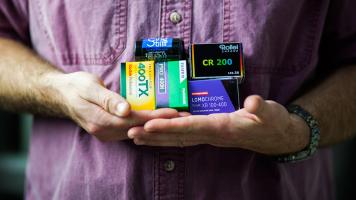
Maybe you’re an amateur digital photographer, or a young professional photographer who got into photography after darkrooms were removed from your school’s classroom, and you’re interested in shooting film but you don’t know where to begin. This guide will help you navigate your way through the multitude of options out there. While there aren’t nearly as many types or sizes of film as there were in the past, there are still enough to make choosing your film a daunting task.
Let’s take a look at your choices and, hopefully, help you narrow the